
Abstract
Through a documentary analysis of existing agreements and applicable national and international regulatory frameworks, complemented by a specialized review of security cooperation, this study examines the complementarity of three instruments: the 1st Security Force Assistance Brigade (1st SFAB), the West Virginia National Guard (NGWV), and U.S. Army Special Forces (SF). The findings demonstrate that the historical fragmentation of cooperation efforts has constrained the consolidation of sustainable institutional capabilities. In response to this limitation, the study proposes a planning model that integrates the DOTMLPF-P framework with warfighting functions through five operational phases, thereby configuring a planning scheme applicable to the Peruvian Army’s (EP) Plan de Transformación Institucional (PTI) (Institutional Transformation Plan) through 2034. Finally, the study argues that military cooperation must be aligned with national strategic priorities in order to prevent operational dependencies and strengthen the institutionalization of force development processes.
Keywords: security cooperation, bilateral military planning, military capability development, transnational threats
Introduction
Peru has the potential to emerge as a regional security leader, capable of transforming military cooperation into strategic autonomy. This process unfolds in a context where the Armed Forces (FF.AA.) have expanded their role beyond traditional external defense as a consequence of the convergence of transnational threats that demand more flexible, interoperable, and resilient operational and institutional capabilities.
The security environment requires immediate and tangible outcomes that the current cooperation framework with the United States (U.S.) cannot guarantee on its own, neither in terms of capability development nor national ownership, a circumstance that generates sustainability risks when external assistance diminishes. Historically, military cooperation in Peru has been significant; however, it has often lacked an institutional structure capable of ensuring its sustainability. Although the situation presents variations across the armed services, all share a common challenge: the absence of a clearly defined strategic partnership model.
The structure of this article is organized as follows: first, it characterizes the complex regional security environment and examines how international cooperation functions as a strategic tool; second, it analyzes the influence of these mechanisms on military capability development, identifying main structural constraints; third, based on specialized literature and experience in international cooperation management, it proposes an agreement-planning model that integrates main cooperation instruments with capability-based assessment approaches, aimed at effectively contributing to the PTI of the EP through 2034.
This study contends that the effectiveness of military cooperation between the EP and U.S. Army South (USARSOUTH) depends on the adoption of an integrative approach. Within this framework, it is necessary to synchronize the conventional capabilities of the 1st SFAB, the strategic cooperation developed with the NGWV, and the specialized operational reach of the SF in order to generate sustainable capabilities that directly contribute to achieving shared security objectives by both countries.
1. National Security and International Cooperation
1.1. Context of Transnational Threats
Threats have evolved at a pace that demands innovative and urgent security measures. The rapid transformation of complex phenomena such as transnational organized crime (TOC) has overwhelmed the institutional response capacities of the Peruvian State, seriously undermining national stability and development. This trend is confirmed by official data indicating that illegal mining has consolidated itself as one of the country’s primary illicit economies, even surpassing drug trafficking, while cybercrime reports quadrupled between 2018 and 2021.
These effects are exacerbated by Peru’s geographic vulnerability to natural phenomena, which have generated emergencies whose frequency increased significantly between 2014 and 2023. Collectively, such events affected 16.2 million people between 1990 and 2020, of whom 511,000 lost their homes.
This scenario creates a vicious cycle in which not only economic competitiveness deteriorates, but security is also weakened due to governmental inefficiency. As a result, the FF.AA. are increasingly overburdened with internal security tasks requiring joint, integrated, and intersectoral action, functions for which they often lack adequate preparation and capabilities. In this context, international cooperation emerges as an indispensable—though insufficient on its own—tool to strengthen capabilities that the state has not yet been able to develop autonomously.
1.2. International Cooperation as a Strategic Tool
This context of instability has driven a growing trend toward the development of flexible, interoperable, and resilient capabilities through international cooperation mechanisms, which have historically exhibited a gap between strategic vision and tactical execution. Within this framework, the U.S. recognizes that strengthening partner-nation capabilities constitutes a global priority aimed at sharing responsibilities in the preservation of security and long-term stability.
Under this logic, the U.S. National Security Strategy (NSS 2025) allocates 20,000 experts dedicated to consolidating international cooperation, prioritizing transparency and governance strengthening over mere equipment transfers. This “full-spectrum” approach seeks to synchronize political will with operational planning capable of generating autonomous and sustainable capabilities in partner nations, transforming reactive assistance into a proactive mechanism that ensures strategic return on investment.
Similarly, the recent publication of the U.S. National Security Strategy (NSS) 2025 and National Defense Strategy (NDS) 2026 positions the Western Hemisphere as a priority area within contemporary geopolitical competition, framed within a strategic reinterpretation of the Monroe Doctrine. In this context, Peru has been designated by the U.S. government as a Major Non-NATO Ally, a status that expands access to benefits associated with international assistance and cooperation programs.
Accordingly, the current security cooperation environment between both countries presents significant opportunities and underscores the need to maximize outcomes in addressing complex security challenges. This imperative requires assessing both the progress achieved and the persistent obstacles that continue to limit the consolidation of truly strategic cooperation.
2. Security Cooperation: Challenges and Progress
2.1. Institutional Fragmentation in Cooperation Management
International security cooperation, referred to in Peru as International Technical Cooperation (ITC) within the security and defense sector, has operated in a fragmented manner at the strategic level, shaped by historical non-alignment approaches rooted in the Westphalian paradigm. This paradigm, rigidly centered on territorial sovereignty as a constraint on cooperation, currently faces the need to transition toward a shared security approach responsive to common threats.
In 2012, Peru enacted its ITC policy under the responsibility of the Ministry of Foreign Affairs (RREE). However, its implementation faces integration challenges involving the Ministry of Defense (MINDEF), the Ministry of the Interior (MININTER), and other sectors tasked with incorporating a multidimensional approach. This situation is explained by limited coordination among institutional actors, as highlighted in the Política Nacional Multisectorial de Seguridad y Defensa Nacional (PNMSDN) (National Multisectoral Policy on Security and National Defense) to 2030.
ITC regulations are primarily oriented toward development projects rather than security-related initiatives, thereby limiting the country’s ability to prevent and respond to transnational threats. As noted by César Augusto Jordán Palomino, former Director of International Cooperation of Peru, activities related to security and defense are managed independently by MINDEF, according to its mandate, evidencing the absence of a coordinating entity for ITC from a comprehensive security perspective.
This situation is corroborated by the Peruvian Agency for International Cooperation (APCI), which oversees development-oriented ITC commitments, while the RREE manages Antarctic cooperation and the MINDEF concentrates on defense-related initiatives. Additionally, representatives from the MINDEF’s Dirección General de Relaciones Internacionales (DGRI) (Directorate General for International Relations) have emphasized that ITC in security and defense requires more flexible and adaptive mechanisms to capitalize on opportunities in political instability contexts. In summary, Peru’s approach to security cooperation exhibits significant regulatory fragmentation that constrains strategic integration. In light of this institutional weakness, the bilateral relationship with the U.S. emerges as a conducive platform for developing results-oriented cooperation mechanisms.
2.2. Bilateral Framework for Security Cooperation
Cooperation between Peru and the United States must be grounded in a balance between efficient force development processes and the operational effectiveness of capabilities designed to address common threats. According to U.S. policy, international cooperation constitutes a strategic pillar and a “first-resort instrument” for achieving foreign policy objectives through strengthening foreign partner capabilities in confronting common challenges.
This orientation is implemented through U.S. Department of State (DOS) funds established under Title 22, including Foreign Military Financing (FMF), Foreign Military Sales (FMS), and International Military Education and Training (IMET), among other assistance programs. Complementarily, the Department of Defense has resources under Title 10, including the Capacity Development Fund (CDF, Section 2282) and the Counterterrorism Partnerships Fund (CTPF), as well as other cooperation mechanisms aimed at strengthening partner force capabilities.
This cooperative balance is essential to address security challenges such as illicit cocaine trafficking in Peru, whose potential production reached 513.5 metric tons in 2020, fueling an illegal economy that distorts regional markets. This threat, along with other transnational threats, has led the Peruvian government to designate national security and defense as the primary strategic pillar in the 2025–2026 General Government Policy.
In response to the deteriorating security environment, Peru has declared recurrent states of emergency in various border districts and authorized the entry of U.S. special forces to conduct cooperative activities in support of the FF.AA. and the National Police of Peru (PNP). Nevertheless, strengthening these mechanisms requires empirical adjustments based on the country’s institutional absorption capacity, ensuring that efforts are sustainable and do not remain limited to superficial responses to the expansion of organized crime.
Cooperation between Peru and the U.S. is currently undergoing a strengthening phase driven by the political will of both parties, as evidenced by the meeting held on December 10, 2025, in Lima, aimed at jointly addressing security challenges. Consequently, this relationship must be consolidated through long-term strategic management that translates political guidance into military cooperation initiatives focused on capability development and employment, in accordance with the constitutional roles of FF. AA.: external defense, disaster risk management support, national development support, internal order support, and foreign policy support.
3. Strategic Integration of Military Cooperation
Alignment across several decision-making levels and among actors involved in international cooperation is essential for the generation of military capabilities. This institutional convergence allows this mechanism to function as a strategic tool, preventing it from being reduced to isolated, tactical-level support. In this regard, military cooperation cannot be limited to the mere equipment transfer; rather, it requires the continuous strengthening of institutional management to ensure proper absorption and sustainability of developed capabilities.
The absence of such a structural approach increases the risk of dispersing efforts in the area of military cooperation. Through effective coordination between public policies and institutional management, states can transform technical assistance into autonomous, effective, and sustainable defense capabilities over time. In this way, synchronizing political will with technical execution in the military domain enables a strategic return on investment for all parties involved. Consequently, military cooperation constitutes a core component of security cooperation, within which military-related efforts must be optimized to ensure the viability and coherence of existing strategic agreements.
There is a longstanding tradition of military partnership between Peru and the United States, making it imperative to take on the challenge of ensuring capability development. However, this outcome is not guaranteed by commitments with the NGWV (1996) nor by bilateral agreements between the armed forces (2016), as both have historically undergone frequent modifications that hinder the identification and sustainment of cooperation objectives. This situation creates the need for a model that integrates strategic priorities, institutional requirements, and military cooperation instruments.
3.1. Complementarity of Instruments and Approaches for Military Cooperation
3.1.1. Military Doctrinal Framework
Within the military domain, the adoption of new strategic concepts is fundamental. In 2024, the EP approved Manual MT 3-3.1.1, titled “International Security Cooperation,” a document that aligns institutional doctrine with contemporary security cooperation paradigms. It serves as a guiding framework for capability development within an international cooperation context consistent with Peru’s foreign policy.
To this end, it is essential to precisely define institutional priorities and capability gaps requiring external support in order to achieve effective strategic planning. In this context, the EP must maintain close coordination with the military component of the partner nation—specifically USARSOUTH—to align institutional efforts with available cooperation instruments and prevent initiative fragmentation.
For this process to yield tangible outcomes, each cooperation initiative must generate measurable effects within the institutional system. From this perspective, cooperation instruments can act as capability development enablers when integrated with the DOTMLPF-P framework and warfighting functions.
Table 1 provides an illustrative example of how doctrinal and operational components can be structured to strengthen institutional response to Escenarios de Control del Riesgo (EGR) (Risk Control Scenarios) associated with natural disasters.
Table 1
Integration of DOTMLPF-P dimensions for institutional response to natural disasters
| Dimension | Command and Control (C2) | Sustainment (Logistics) | Intelligence and Surveillance | Movement and Maneuver |
|---|---|---|---|---|
| Doctrine | Joint decision-making protocols for crisis situations aligned with international standards | Emergency logistics manuals and supply chain management in disaster zones | Procedures for the use of sensors and drones in search and rescue operations | Rapid deployment tactics for engineer units in collapsed terrain |
| Organization | Establishment of Disaster Risk Management (DRM) cells to coordinate with civilian agencies such as the National Institute of Civil Defense (INDECI) | Structuring assistance battalions with modular logistical support capabilities | Specialized reconnaissance units focused on real-time damage assessment | Multi-role units capable of transitioning from combat operations to humanitarian assistance missions |
| Training | Tabletop simulation exercises based on earthquake and landslide scenarios | Technical training in maintenance of water purification systems and mobile power generation | Training in satellite imagery analysis and risk-area mapping | Training in aeromedical evacuation and collapsed-structure rescue operations |
| Equipment | Interoperable communication systems | Water purification plants, field hospitals, and modular bridges | Long-ranges drones and thermal imaging systems for survivor detection | Amphibious vehicles and heavy engineering equipment |
| Education and Leadership | Officer education in DRM at U.S. institutions | Certification in resource management and critical supply administration during emergencies | Specialization in meteorological and geospatial data interpretation | Decision-making under extreme pressure with a civil defense operational focus |
| Personnel | Permanent liaison officers with the West Virginia National Guard (WVNG) specializing in disaster management | Humanitarian logistics specialists and equipment maintenance technicians | Risk analysts and unmanned systems operators | Rapid response teams with combat medical training adapted to civilian contexts |
| Facilities | Emergency Operations Centers | Prepositioned regional warehouses for humanitarian assistance | Data reception stations and information processing centers | Forward operating bases with reinforced airstrips for heavy cargo operations |
| Policy | Agreements for immediate disaster response | Transparency policies for the management of foreign donations and resources | Regulations on the use of military assets for surveillance in restricted areas | Legal frameworks for military support to civil authorities regarding the use of force |
Source: Author’s own elaboration based on the Manual MT 3-3.1.1, “International Security Cooperation.”
3.2. Complementarity of Cooperation Instruments
Within this framework, the 1st SFAB emerges as one of the central pillars of cooperation by facilitating institutional management and capability generation. However, the support provided by this unit presents limitations in developing capabilities oriented toward support to civil authorities. For this reason, it is necessary to complement these efforts through the participation of WVNG in order to address challenges associated with comprehensive security. In this context, these U.S. cooperation instruments can effectively contribute to the EP’s preparedness to fulfill its constitutional roles.
Additional cooperation mechanisms include the SF and various civilian security agencies capable of supporting Peru through donations, training programs, intelligence sharing, and specialized force employment, among other forms of assistance. However, the participation of these actors requires political authorization to operate in complex security environments.
All cooperation instruments must be institutionalized in order to strengthen both the development and employment of military capabilities. Accordingly, the 1st SFAB, WVNG, and SF should be integrated into the planning process of bilateral agreements, following a logic that prioritizes capabilities based on the resources available to both parties.
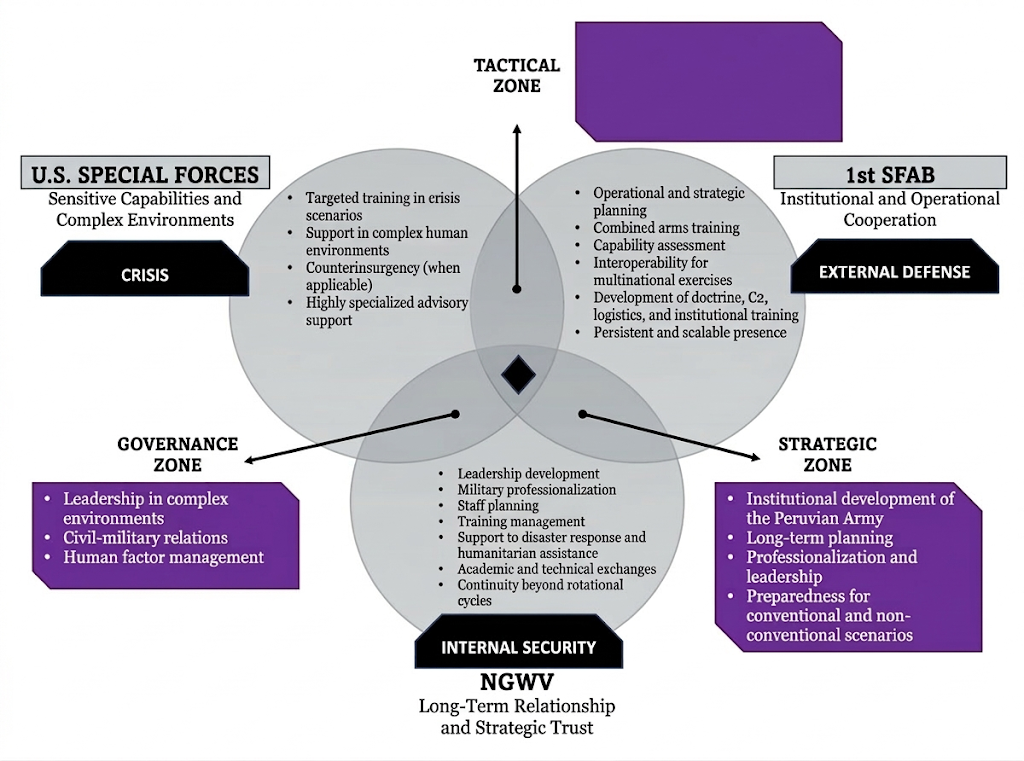
Figure 1 illustrates the articulation of the EP’s efforts with the three U.S. cooperation mechanisms, organized along three strategic axes converging in a central zone aimed at addressing operational, strategic, and institutional governance requirements. Along the crisis axis, SF provides specialized capabilities for complex environments through targeted training, technical advisory support, and tactical counterinsurgency operations. Along the external defense axis, the 1st SFAB delivers institutional and operational cooperation through planning activities, combined arms training, and multinational interoperability. Finally, along the internal security axis, the WVNG sustains a long-term relationship grounded in strategic trust, focused on leadership development, military professionalization, and institutional continuity beyond rotational cycles.
Figure 1. Complementarity of military cooperation instruments
Source: Author’s own elaboration based on U.S. regulatory frameworks (ATP 3-96.1, FM 3-05, and DoDI 5111.20).
3.2.1. Complementarity of the Security Force Assistance Brigade
The SFAB constitutes one of the most specialized instruments of U.S. military cooperation for the development of conventional capabilities. Its strength lies in the deployment of highly trained personnel who serve as military advisors, prepared to operate in complex security environments.
These brigades, composed of approximately 816 personnel, concentrate elite human capital, enabling them to advise partner forces from the tactical to the operational level. Moreover, this organization has accumulated experience across 54 partner nations through the deployment of 60 multifunctional teams, generating an impact that extends beyond training activities by consolidating professional relationships between military institutions.
Comparative experience demonstrates that the impact of SFAB activities increases significantly when they are integrated into the strategic objectives of the partner nation. A representative example is observed in the 1st SFAB mission in Tunisia, where a successful strategic transition was achieved by aligning U.S. investments with the MINDEF’s commitment to managing cooperation, thereby strengthening the sustainability of international efforts.
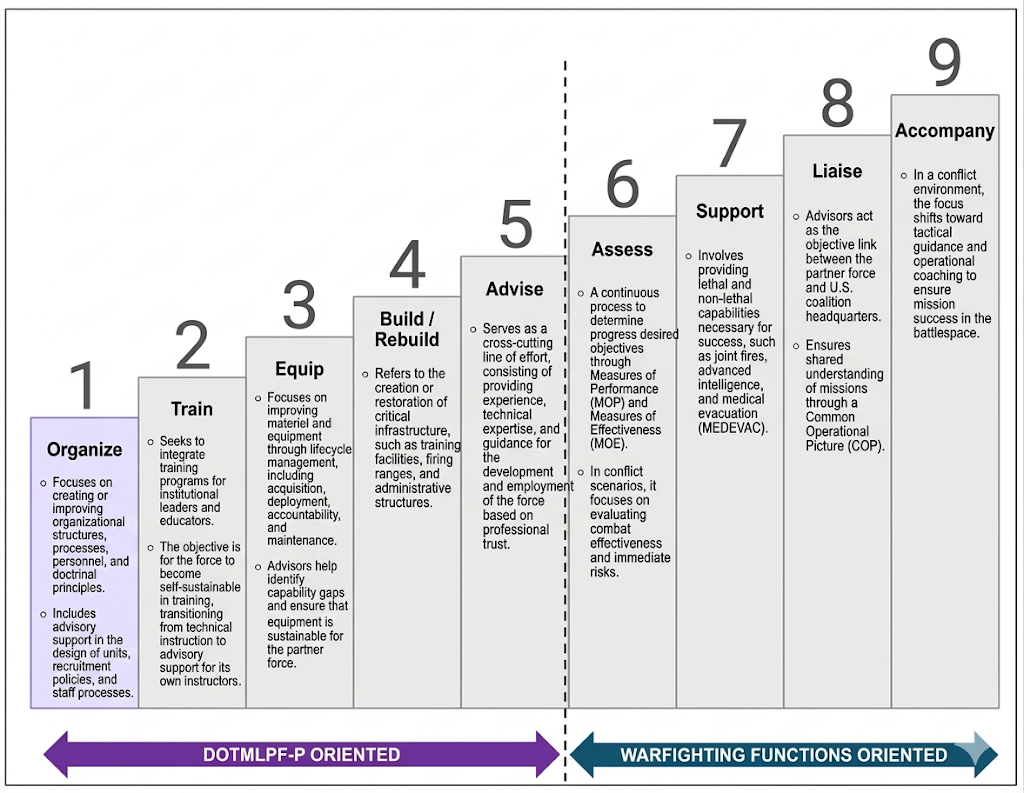
Figure 2 schematically illustrates the phases structuring the integration cycle applied by the SFAB in cooperation processes aimed at capability development.
Figure 2. SFAB integration cycle steps
Source: Author’s own elaboration based on ATP 3-96.1 manual
In the case of Peru, military cooperation is consistent with the U.S. Southern Command Campaign Plan, whose primary strategy focuses on countering transnational threats in the Western Hemisphere. Within this framework, cooperation activities between the 1st SFAB and the EP have been strengthened through bilateral agreements aimed at combining training between advisory teams and selected combat units, including the 1st Cavalry Brigade—Sullana. Through this integration, the 1st SFAB can function as an economy-of-force element capable of progressively accompanying capability development processes in peacetime, as well as supporting force employment in conflict scenarios.
The success of SFAB advisors does not rely solely on the transfer of tactical skills; rather, their strategic value lies in their ability to complete the institutional integration cycle, thereby contributing to organizational strengthening. Accordingly, the effective employment of the 1st SFAB in support of the EP’s PTI 2034 will require the establishment, coordinated with USARSOUTH, of measurable, verifiable, and properly resourced objectives aimed at closing previously prioritized conventional gaps.
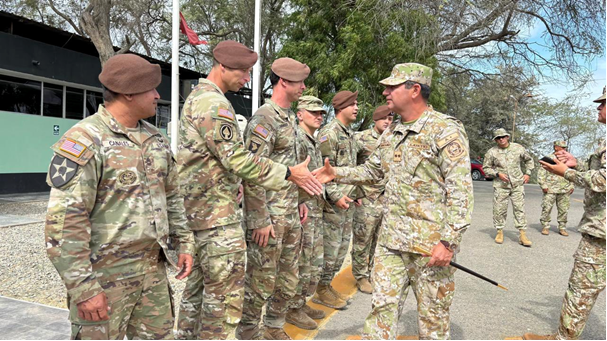
Figure 3 shows a combined training exercise conducted between EP units and 1st SFAB advisors, illustrating the practical application of the cooperation mechanisms described.
Figure 3. SFAB-2025 Combined training exercise between the 1st Cavalry Brigade and the 1st SFAB
Source: Image obtained from the Information Office of the 1st Cavalry Brigade, November 19, 2025.
3.2.2. Complementarity of the West Virginia National Guard
The State Partnership Program (SPP), implemented through the National Guard, constitutes one of the most stable, predictable, and institutionalized pillars of U.S. military cooperation with partner nations. Established in 1993 with the initial participation of 15 countries, the program expanded to 93 partner nations by 2022, with the objective of developing non-conventional military capabilities through expert exchanges and the implementation of activities focused on institutional strengthening.
A concrete example is the partnership between the State of West Virginia and Peru, which has enabled the WVNG to contribute to strengthening functional interoperability through more than 30 cooperation activities conducted in 2024. The strategic value of the SPP lies in its ability to combine continuity and flexibility, essential attributes for developing sustainable capabilities with multidimensional impact on comprehensive security.
This strategic partnership produces tangible and measurable outcomes. These include the professionalization of officers and non-commissioned officers through leadership workshops conducted at the Army Technical School (ETE), as well as the enhancement of logistical operations through preventive maintenance of HMMWV vehicles assigned to United Nations (UN) peacekeeping missions. Likewise, this cooperation has facilitated the transfer of specialized technical knowledge, such as training in aeromedical evacuation and disaster management, thereby improving the response capacity of key units, including the 1st Multipurpose Brigade.
This collaboration extends beyond the technical domain by strengthening humanitarian commitment, as evidenced by joint participation in disaster response and public health crises in Peru, including the distribution of COVID-19 vaccines. To consolidate this relationship, the position of Bilateral Affairs Officer of the WVNG at the U.S. Embassy in Lima was established in 2021, aimed at contributing to the sustainability of institutional reforms in the country.
There exists a longstanding relationship between the WVNG and the Peruvian Armed Forces focused on strengthening capabilities for supporting civilian authorities, a linkage that transcends political and budgetary cycles. The SPP provides resources that enable the WVNG, through highly experienced permanent personnel, to develop institutional and operational capacities associated with Peru’s internal security.
3.2.3. Complementarity of Special Forces Units
Security cooperation based on SF attains legitimacy and effectiveness when employed in a limited manner and supported by a clear institutional reform commitment. The specialized support provided by these units is conducted in sensitive contexts to address critical threats affecting partner-nation security. This modality of cooperation does not substitute the political will of the host country.
An illustrative example is found in U.S. cooperation in Pakistan, where approximately 13 billion dollars was allocated to operations in tribal areas involving SF participation. However, the absence of sustained political commitment prevented significant progress in countering insurgent groups. In contrast, the Colombian case demonstrates the utility of these units in supporting internal security in complex environments: the presence of fewer than 800 U.S. troops made it possible to advise on the transformation of local capabilities and contributed to dismantling narcoterrorist networks. Thus, the success of cooperation depends primarily on political will and the institutionalization of processes, beyond the magnitude of financial resources or troop levels deployed.
In the employment of SF, unrestricted respect for human rights is essential in order to preserve democratic values. This principle underscores that their deployment requires a governmental commitment aimed at ensuring that the partner force develops sustainable capabilities once external assistance has ended. For SF to operate as a force multiplier for security, their tactical execution must be integrated into a broader strategy that prioritizes long-term outcomes.
In the case of Peru, SF could constitute a relevant component for force development and employment in critical scenarios. This process began with political authorization in 2025 and was subsequently consolidated through Legislative Resolution No. 32526 (2026), which established the legal framework for the entry of specialized teams, including U.S. Navy SEAL units, with the objective of training Peru’s elite commandos.
The sophistication of this support extends beyond the application of lethal force. For example, specialized U.S. teams provide technical expertise in institutional engagement and the conduct of information operations aimed at safeguarding the state’s strategic narrative. At the operational level, these units enhance the training of Peruvian forces tasked with countering high-impact crimes, including illicit drug trafficking (IDT), illegal arms trafficking, and human trafficking.
Additionally, this cooperation may contribute to strengthening intersectoral operational capacity in border regions requiring enhanced monitoring against IDT and arms trafficking. Therefore, SF participation must ensure that the employment of force is integrated into joint or multisectoral campaign plans, aligning institutional capability development with the objective of achieving strategic sustainability.
3.3. Complementarity of DOTMLPF-P and Functions of War
The EP must institutionalize interoperability through agreements that enable the effective utilization of capabilities provided by the 1st SFAB and the WVNG, while incorporating lessons learned from cooperation with SF. This process requires integrating crisis response, internal security, and external defense within a coherent capability development framework.
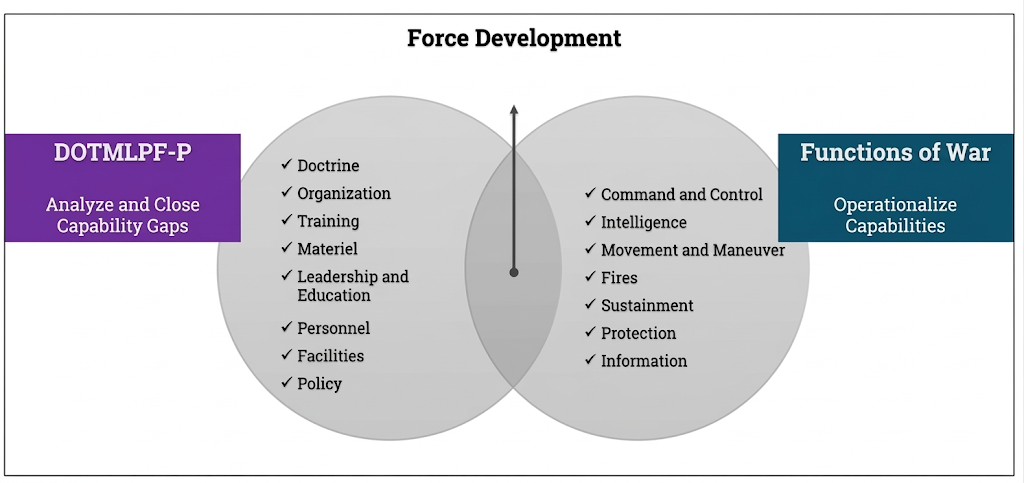
In this context, cooperation instruments must apply the DOTMLPF-P framework to identify and close structural gaps, while the war functions approach addresses operational gaps associated with force employment. From this perspective, DOTMLPF-P explains why a given capability does not exist or lacks institutional sustainability. For their part, the functions of war enable the operationalization and validation of that capability through training, exercises, and operational assessment processes.
The interaction between both approaches enables the integration of doctrinal, organizational, and operational components necessary for comprehensive force development, establishing an analytical framework in which these tools are complementary and interdependent.
Figure 4 illustrates the conceptual relationship between the DOTMLPF-P framework and functions of war, showing how both analytical approaches contribute to the assessment and development of military capabilities.
Figure 4. Complementarity of military capability analysis approaches
 Source: Author’s own elaboration.
4. Toward a Model for Planning Military Agreements
4.1. Considerations for a Model
Any model must facilitate the planning process in order to translate strategic intentions into measurable actions that ensure verifiable outcomes. In this context, the planning of bilateral agreements between armies must incorporate a territorial threat-based approach under clear leadership, prioritizing and integrating the capabilities to be developed.
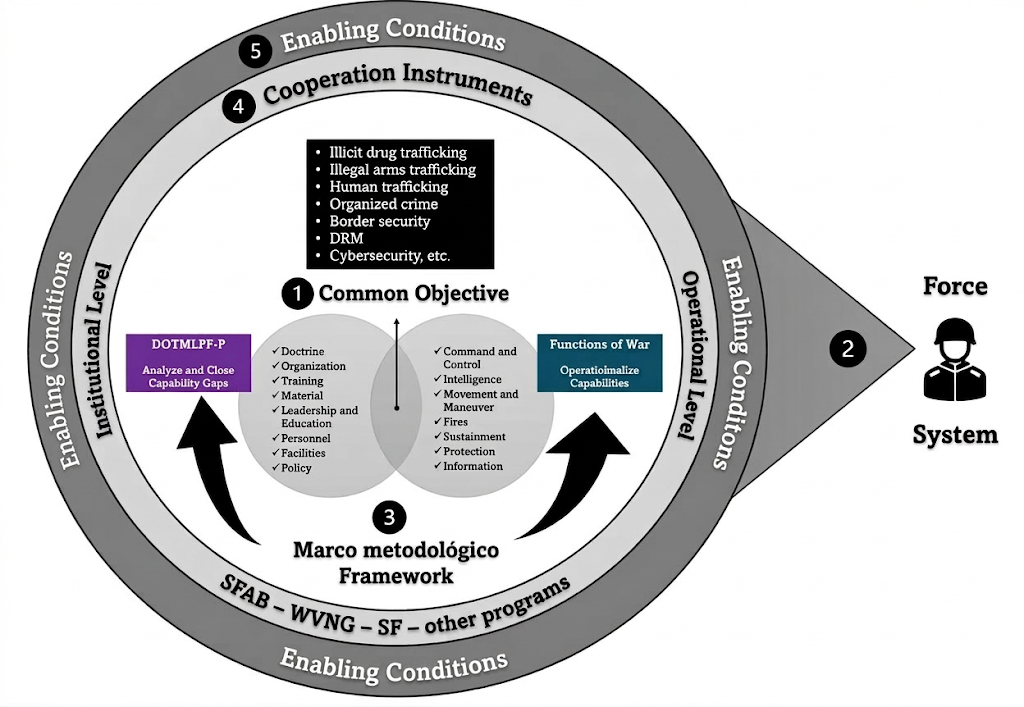
The proposed model is structured into five steps: (1) define the common objective; (2) designate the responsible unit or system; (3) establish the methodological framework; (4) identify available cooperation instruments; and (5) implement enabling conditions necessary for process sustainability.
The first step addresses the “why” of cooperation through the identification of shared threats requiring priority attention. These include: conventional operations linked to peacekeeping forces, regional stabilization operations, countering illicit drug trafficking (IDT), combating illegal arms trafficking, countering human trafficking, addressing transnational organized crime (TOC), border security, DRM, and cybersecurity.
The second step concerns the “who,” which entails designating the unit or system that will assume specific responsibility for integrating institutional efforts and coordinating with other systems to ensure cooperation effectiveness.
The third step corresponds to the “how,” represented by a methodological framework aimed at analyzing and closing identified capability gaps. To this end, the DOTMLPF-P framework and functions of war are employed in a complementary manner; these analytical tools enable assessment of both structural and operational dimensions of capability development.
The fourth step addresses the “with what” the cooperation will be executed, involving the selection and integration of available tools in accordance with their strategic purpose, including the 1st SFAB, WVNG, SF, and other applicable U.S. cooperation programs.
The fifth step encompasses enabling conditions designed to ensure sustainability of efforts through regulatory frameworks, monitoring mechanisms, and continuous improvement processes that guarantee the model’s legitimacy and strategic coherence. This process must be conducted under political and legal oversight to align the strategic priorities of both parties, avoid structural dependencies, and strengthen force management across conventional and non-conventional scenarios.
The model is grounded on three fundamental pillars. The first consists of identifying capability gaps aligned with the requirements of the PTI 2034, avoiding a restrictive focus on capabilities offered by the external partner. The second pillar emphasizes synchronization of efforts, integrating the aforementioned cooperation instruments with the institutional processes of the EP. The third pillar is interoperability, aimed at operating under international standards without compromising autonomy in strategic decision-making.
Figure 5. Military agreements planning model
 Source: Author’s own elaboration.
4.2. From One-Off Operations to Institutional Development
In scenarios where the strategic-operational level assumes responsibility for managing cooperation agreements involving the employment of specialized U.S. equipment, it is essential for the EP to adopt a continuous learning approach. This entails systematizing lessons learned from operational experience through force analysis from the perspective of the functions of war.
The disaggregation of operational experience enables the identification of effective practices and their assimilation through doctrinal, organizational, and training adjustments. In this way, the employment of force ceases to be conceived as an isolated event aimed solely at achieving immediate effects and instead becomes a strategic input for future force development and employment.
Conclusions
The review of the regulatory framework for international cooperation in Peru highlights the need to strengthen intersectoral coordination in order to achieve effective outcomes against threats to national security. The evidence analyzed demonstrates that the current cooperation structure exhibits significant levels of institutional fragmentation, which negatively impacts the effectiveness of military cooperation.
The analysis of cooperation between the EP and USARSOUTH shows that, despite the intensity and diversity of activities conducted, the conversion of external assistance into sustainable institutional capabilities remains limited. Furthermore, the study identifies the absence of a planning framework capable of coherently integrating the various cooperation instruments with institutional strategic priorities, thereby constraining the impact of these initiatives.
In this context, the study demonstrates that the 1st SFAB, WVNG, and the SF constitute complementary instruments for the development of both conventional and non-conventional military capabilities. However, their potential can only be maximized when these mechanisms are integrated within a planning model that moves beyond the logic of isolated activities and is oriented toward the systematic closure of previously identified capability gaps.
The proposed model, grounded in the complementarity between DOTMLPF-P and functions of war, provides a methodological guide for aligning military cooperation with the objectives of the EP’s PTI through 2034. Its structured application enables the reduction of institutional fragmentation, the strengthening of capability interoperability, and the optimization of force development within the context of bilateral cooperation.
Based on these findings, the study suggests the need to deepen future research along at least three analytical lines. The first involves comparative evaluation of cooperation models implemented by other U.S. Major non-NATO Allies. The second focuses on analyzing the impact of strategic competition among great powers on the design of security cooperation in Peru. The third proposes the development of mechanisms for the systematic measurement of cooperation outcomes at the tactical and operational levels. Progress along these lines will refine the proposed model and contribute to strengthening sovereign interoperability, reducing external dependencies, consolidating strategic autonomy, and expanding Peru’s role in international security.
References
- Institute of Criminology and Studies on Violence, Threats to State Security in Peru: Analysis of the Overall Situation (Madrid: Prosegur Research, 2022), 4.
- National Center for Strategic Planning (CEPLAN), Report of the 25th Forum on the Future: Current Situation and Future Outlook for Mining in Peru (Lima: CEPLAN, 2024), 53; Ombudsman’s Office, Cybercrime in Peru: Strategies and Challenges for the State. Ombudsman’s Report No. 001-2023-DP/ADHPD (Lima: Ombudsman’s Office, 2023), 32.
- Government of Peru, Report 2024: Global and National Risks and Opportunities for Peru 2024–2034 (Lima: Government of Peru, 2024), 46; Government of Peru, Strategic National Development Plan to 2050 (Lima: National Center for Strategic Planning, 2023), 110; Government of Peru, Prospective Analysis Report 2025–2050 (Lima: National Center for Strategic Planning, 2023), 159–160.
- National Center for Strategic Planning (CEPLAN), Strategic National Development Plan to 2050 (Lima: CEPLAN, 2023), 193; Institute of Criminology and Studies on Violence, Threats to State Security in Peru: Analysis of the General Situation (Madrid: Prosegur Research, 2022), 15.
- U.S. Government Accountability Office, Building Partner Capacity: Key Practices to Effectively Manage Department of Defense Efforts to Promote Security Cooperation, GAO-13-335T (Washington, DC: U.S. Government Accountability Office, 2013), 2.
- Defense Security Cooperation Agency, Strategic Plan 2025 (Washington, DC: U.S. Department of Defense, 2021), i.
- Dafna H. Rand and Stephen Tankel, Security Cooperation & Assistance: Rethinking the Return on Investment (Washington, DC: Center for a New American Security, 2015), 4.
- J. McNerney et al., SMART Security Cooperation Objectives: Improving DoD Planning and Guidance (Santa Monica, CA: RAND Corporation, 2016), 11.
- The White House, National Security Strategy of the United States of America (Washington, DC: The White House, 2025); U.S. Department of Defense, “National Defense Strategy: Restoring Peace Through Strength for a New Golden Age of America” (Washington, DC, 2026).
- Laura Solano, “A New Strategic Horizon: The Peru-US Alliance Reaches Historic Heights,” Diálogo Américas, accessed February 6, 2026, https://dialogo-americas.com/articles/a-new-strategic-horizon-the-peru-us-alliance-reaches-historic-heights/.
- Amandine Gnanguênon and Stephanie C. Hofmann, “Regional Security Cooperation,” in Handbook of Regional Cooperation and Integration (Cheltenham: Edward Elgar, 2024), 164.
- Peru, Ministry of Defense, Supreme Decree No. 005-2021-DE, approving the “National Multisectoral Policy on Security and National Defense to 2030,” Official Gazette El Peruano, July 23, 2021, 35.
- Congress of the Republic of Peru, “LIVE: APEC Legislative International Cooperation Working Group | November 13, 2024,” YouTube video, 2:19:34, published in 2024, https://www.youtube.com/watch?v=xdwQM-59oac.
- Peru, Peruvian Agency for International Cooperation (APCI), “About Us,” accessed December 10, 2025, https://www.gob.pe/institucion/apci/institucional
- Author’s interview with Augusto Cabrera Rebaza and Guillermo Augusto Portillo Carrillo, Zoom meeting, December 4, 2024.
- Defense Security Cooperation Agency, Strategic Plan 2025 (Washington, DC: U.S. Department of Defense, 2021), 1.
- Dafna H. Rand and Stephen Tankel, Security Cooperation & Assistance: Rethinking the Return on Investment (Washington, DC: Center for a New American Security, 2015), 5–6.
- Institute of Criminology and Studies on Violence, Threats to State Security in Peru: Analysis of the General Situation (Madrid: Prosegur Research, 2022), 7.
- Presidency of the Council of Ministers, “Executive Approves the General Government Policy 2025–2026,” December 20, 2025, accessed January 1, 2026, https://www.gob.pe/institucion/pcm/noticias/1317002-ejecutivo-aprueba-la-politica-general-de-gobierno-2025-2026.
- Peru, Office of the President of the Council of Ministers, Supreme Decree No. 137-2025-PCM, Official Gazette *El Peruano*, December 6, 2025; Peru, Congress of the Republic, Legislative Resolution No. 32214, Official Gazette El Peruano, December 27, 2024; Peru, Congress of the Republic, Legislative Resolution No. 32526, Official Gazette El Peruano, December 14, 2025.
- Christopher Paul et al., The RAND Security Cooperation Prioritization and Propensity Matching Tool: Methods and User’s Guide (Santa Monica, CA: RAND Corporation, 2013), ix.
- Office of the President of the Republic of Peru, “President Jerí Led Meeting with FBI Delegation and Public Safety Experts to Develop New National Plan,” last modified December 10, 2025, accessed December 25, 2025, https://www.gob.pe/institucion/presidencia/noticias/1308740-presidente-jeri-lidero-reunion-con-delegacion-del-fbi-y-expertos-en-seguridad-ciudadana-para-elaboracion-de-nuevo-plan-nacional.
- R. Evan Ellis, Toward a More Effective DoD Contribution to Strategic Competition in the Western Hemisphere (Carlisle Barracks, PA: U.S. Army War College Press, 2025), 9.
- U.S. Department of Defense, Strategic Evaluations of Institutional Capacity Building in Colombia and Indonesia (2013–2018) (Washington, DC: Office of the Deputy Assistant Secretary of Defense for Global Partnerships, 2019), 5.
- Thomas W. Ross, “Enhancing Security Cooperation Effectiveness: A Model for Capability Package Planning,” Joint Force Quarterly 80 (first quarter 2016): 26.
- Defense Security Cooperation Agency, Strategic Plan 2025 (Washington, DC: U.S. Department of Defense, 2021), 4.
- Dafna H. Rand and Stephen Tankel, Security Cooperation & Assistance: Rethinking the Return on Investment (Washington, DC: Center for a New American Security, 2015), 24.
- Peruvian Army, “Analysis of Agreements: Proposal for Strategic Guidelines for Agreements between the Peruvian and U.S. Armies,” institutional document, 4.
- Peru, Peruvian Army, Manual MT 3-3.1.1, International Relations: “International Security Cooperation,” ed. 2024 (Lima: Peruvian Army, 2024), 126–137.
- Andrew Feickert, Army Security Force Assistance Brigades (SFABs), IF10675 (Washington, DC: Congressional Research Service, 2025), 1–2.
- Charles McEnany, The U.S. Army’s Security Force Assistance Triad: Security Force Assistance Brigades, Special Forces, and the State Partnership Program, Spotlight 22-3 (Arlington, VA: Association of the United States Army, 2022), 3.
- U.S. Army Security Force Assistance Command, 2025 SFAC Factbook (Fort Liberty, NC: U.S. Army Security Force Assistance Command, 2024), 26.
- Headquarters, Department of the Army, Security Force Assistance Brigade, Army Techniques Publication No. 3-96.1 (Washington, DC: Department of the Army, 2025), 91.
- U.S. Southern Command, “SOUTHCOM Commanders’ Priorities,” accessed December 30, 2025, https://www.southcom.mil/Commanders-Priorities/.
- Peruvian Army and United States Army, “Agreement between the Peruvian Army and the United States Army South” (bilateral agreement, 2023), 49.
- Headquarters, Department of the Army, Security Force Assistance Mission Handbook, Training Circular No. 3-22 (Washington, DC: Department of the Army, 2025), vii–viii.
- Headquarters, Department of the Army, Security Force Assistance Brigade, Army Techniques Publication No. 3-96.1 (Washington, DC: Department of the Army, 2025), 4–5.
- U.S. Government Accountability Office, State Partnership Program: DOD Should Ensure Partner States Record Completed Activities and Clarify Appropriate Authorities, GAO-22-104672 (Washington, DC: U.S. Government Accountability Office, 2022), 5.
- West Virginia National Guard, 2024 Annual Report (Charleston, WV: West Virginia National Guard, 2024), 21.
- Peruvian Army and United States Army, “Agreement between the Peruvian Army and the United States Army South” (bilateral agreement, 2024), 7.
- West Virginia National Guard, 2019 Annual Report (Charleston, WV: West Virginia National Guard, 2019), 73.
- West Virginia National Guard, 2021 Annual Report (Charleston, WV: West Virginia National Guard, 2021), 78.
- Dafna H. Rand and Stephen Tankel, Security Cooperation & Assistance: Rethinking the Return on Investment (Washington, DC: Center for a New American Security, 2015), 11
- bid., 19.
- James G. Stavridis, Partnership for the Americas: Western Hemisphere Strategy and U.S. Southern Command (Washington, DC: NDU Press, 2010), 17.
- Dafna H. Rand and Stephen Tankel, Security Cooperation & Assistance: Rethinking the Return on Investment (Washington, DC: Center for a New American Security, 2015), 12.
- Thomas W. Ross, “Enhancing Security Cooperation Effectiveness: A Model for Capability Package Planning,” Joint Force Quarterly 80 (2016): 27.
- Peru, Congress of the Republic, Legislative Resolution No. 32526, Official Gazette El Peruano, 2025, 4–5.
- Peru, Presidency of the Council of Ministers, Supreme Decree No. 137-2025-PCM, Official Gazette El Peruano, 2025, 14.