
Abstract
The current situation of “permacrisis,” understood as a prolonged period of instability and insecurity, has increased the vulnerability of countries in Latin America and the Caribbean. Combined with institutional weakness, porous borders, and high levels of corruption, it has made crime the main challenge to the security and sovereignty of states, with a consequent impact on socioeconomic development. In Peru, transnational crime is linked to most of the identified national security threats, turning border regions into geostrategic spaces for criminal activity and highlighting the need to rethink national border-security policy, with clearly defined institutional responsibilities and a systemic, regionally cooperative approach. In this context, the adaptability of transnational crime, its efforts to maintain territorial control, and its links to global illicit markets have turned it into a geopolitical instrument known as geocriminality, used both by criminal organizations and by certain states seeking to undermine countries with opposing interests, thereby weakening their security, governance, and political stability.
Keywords: geocriminality; criminal governance; cockroach effect; criminal value chain
Introduction
This article aims to identify how the instrumentalization of transnational crime, or “geocriminality,” affects the national security and sovereignty of states. The importance of this research lies in the fact that, once the negative impact of geocriminality is identified, strategies can be developed to address it at the regional, national, and institutional levels.
To develop the study, the current situation of “permacrisis” affecting the international system is analyzed, the criminal business model is examined, and the conditions of vulnerability in Latin America and the Caribbean are described. These realities favor the emergence of “criminal governance” and, together with porous borders, enable transnational crime to become an instrument for destabilizing states—a phenomenon known as geocriminality. This phenomenon is connected to various threats to national security and sovereignty and has a significant impact on socioeconomic development. Therefore, establishing security strategies based on a systemic approach makes it possible to address this complex problem and promote cooperation and synergistic solutions to common problems and risks, especially when the capacities and resources available to assist affected populations are limited.
This study adopts a qualitative approach based on the collection of specialized literature and the views of experts on the subject. This approach makes it possible to understand national and regional security challenges and to achieve the article’s main objective: identifying how geocriminality has become a tool for destabilizing states and proposing recommendations from a current and realistic perspective.
Global Permacrisis and the Transnational Criminal Business Model
In recent years, crime has increased dramatically as a result of the “permacrisis” affecting the international system and the unprecedented multidimensional crisis directly impacting Latin America. Since 2017, the United States National Security Council (NSC) has identified a continued growth and diversification of criminal activities, producing “explosive and catastrophic” effects for countries around the world. In addition, natural disasters associated with climate change, inadequate governance, the aftermath of COVID-19, territorial disputes, wars, and current energy crises have reduced states’ ability to meet the population’s basic needs and have exponentially intensified political, social, and economic weakening in most countries, plunging the world into the phenomenon known as “permacrisis” (Zuleeg 2026).
From an economic perspective, this growth in crime has generated substantial illicit profits through the transnational business model it employs and the use of bargaining mechanisms based on a wide range of criminal activities. High demand for illegal goods and services creates a strong correlation between crime and the economy, shaping a crime-based business model characterized by a flexible and adaptive structure (Novak and Namihas 2023). It is transnational in nature, with distinct but functionally integrated nodes, corridors, and centers of power that transcend national and international boundaries and enable expansion and wealth generation through illicit finance. Consequently, increasing the size of a state’s formal economy and reducing all forms of illegal economic activity have a positive effect on national development and help reduce crime-related offenses (Boluarte 2026; Looney and Turner 2018).
Crime also produces negative effects in the political and social spheres and, particularly, within the judicial system, where its aim is to penetrate the functional structure of state institutions. Holst draws on Michael E. Porter’s value-chain model and defines this dynamic as a “criminal value chain” that exploits society’s basic needs,1 reflected in social and economic inequality, state weakness, and corruption among justice-sector officials (The Criminal Value Chain 2023), in order to gain a greater competitive advantage over state governance. Crime also seeks to create a symbiotic relationship between criminal and governmental organizations, affecting institutions from within and generating an alternative social, political, and economic order known as “criminal governance” (David Rockefeller Center for Latin American Studies 2025). The objective of crime is not to create a parallel state or wage war against the existing one, but rather to operate with impunity and generate wealth within it, exploiting institutional weaknesses and attempting to impose norms and rules through the criminalization of state institutions. In this context, Holst’s graphic representation in Figure 1 illustrates how criminal activity is organized as a chain for generating illicit value, fueled by social needs and institutional weaknesses.
Figure 1
Outline of the illicit value chain according to Holst
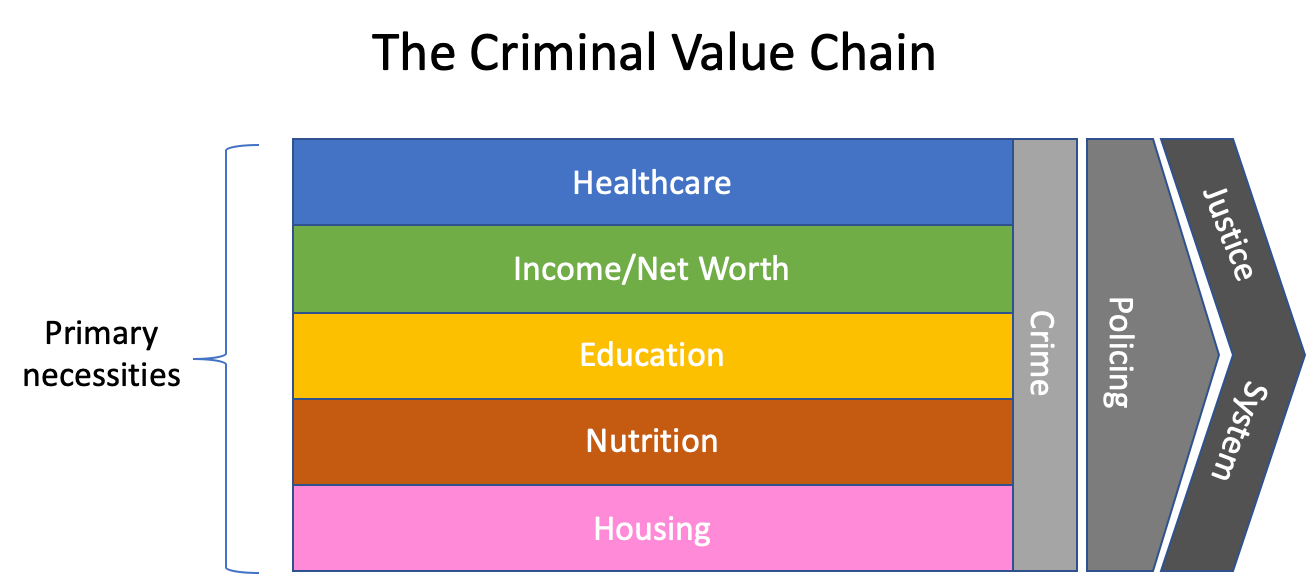
Note. The figure illustrates the functional structure of the criminal activity proposed by Holst, based on Michael E. Porter’s value-chain model, in which crime generates illicit value by exploiting social needs and institutional weaknesses.
Source: Jared Holst, “The Criminal Value Chain,” Brands Me a Lot, February 21, 2023, accessed April 15, 2026, https://brandsmeanalot.substack.com/p/the-criminal-value-chain
Furthermore, crime operates beyond a state’s boundaries, interests, and protective measures, giving it a transnational character and making it much more difficult to control, particularly in countries such as Peru, which have tri-border areas, rugged geography, and limited territorial control.2 Throughout the region, transnational crime has exploited the international extent of borders and their vast, inhospitable geography, as well as weak border control. This has made borders porous—the main multiplier of transnational crime and an environment conducive to the sheltering, expansion, and intensification of cross-border criminal activity—giving rise to the phenomenon known as the “cockroach effect” (Dammert and Sampó 2025; Amoo 2026; Novak and Namihas 2023).
This reality allows transnational crime to disregard the political concept of borders and turn them into strategic spaces for criminal coordination and mobility. In Peruvian territory, transnational crime finds border areas conducive to carrying out illicit activities and facilitating the entry of international criminal organizations. Tri-border areas have become zones of criminal and financial convergence where domestic and foreign criminal organizations operate, sometimes in rivalry and sometimes jointly, seeking to maintain control of the area. Examples include the Tren de Aragua criminal group from Venezuela and Ecuador’s “Tijerones,” which operate mainly along the Peru–Ecuador border. Along the Peru–Colombia–Brazil border operates one of Brazil’s most important criminal groups, the Comando Vermelho (Red Command), as well as dissident criminal organizations originating from Colombia’s Revolutionary Armed Forces of Colombia (FARC), known as the Clan del Golfo, and the National Liberation Army (ELN), among others (Gonzales Begazo 2023).
Along the Peru–Bolivia border, family-based criminal organizations operate mainly in drug trafficking (TID), illegal gold trafficking, smuggling, and currency counterfeiting. Along the border with Chile, criminal organizations are primarily involved in TID and smuggling, with a recent increase in human trafficking (Vásquez 2024). In addition, Peru’s National Intelligence Directorate (DINI) has identified a number of “contemporary threats” to the National Security and Defense System (SIDENA) that are directly or indirectly associated with transnational crime. These include residual terrorist groups that finance their ideological activities by providing security to transnational criminal organizations involved in drug trafficking and TID; irregular migration and related criminal activities such as human trafficking and migrant smuggling; environmental damage caused by illegal mining, illegal logging, and wildlife trafficking; as well as threats to digital security and corruption and its impact on the democratic system. Together, these factors demonstrate how the diversification of transnational threats is affecting the country’s national security (Novak and Namihas 2023; Eduardo 2022).
The Instrumentalization of Crime or “Geocriminality”
The transnational business model used by criminal organizations, their capacity for adaptation and governance, the existence of porous borders, and institutional penetration in states have facilitated the instrumentalization of crime by actors seeking to destabilize security and sovereignty. Transnational crime has become a foreign-policy tool known as the “geopolitics of crime” or “geocriminality.” Its purpose is to redirect criminal activity and use criminal organizations as geopolitical actors in order to establish de facto criminal sovereignty, confront state authority, undermine territorial control, and weaken the sovereignty and authority of states (Schuett and Schramm 2025). In particular, geocriminality is frequently employed by authoritarian governments isolated from the international community and with limited internal and external control. These conditions allow them to instrumentalize crime more freely and with few legal consequences through a range of hybrid threats, including irregular migration and attacks on states’ critical infrastructure through cyberspace (Vásquez 2024; Schuett and Schramm 2025). These hybrid threats are constantly evolving and require states to rethink their regional security systems by integrating legal strategies, intelligence, cyber defense, and diplomatic measures among affected countries.
One example of the effects of geocriminality in Latin America is the exploitation of the plight of migrants who enter a country irregularly. In Latin America, irregular migration has contributed to one of the region’s most serious humanitarian crises in recent years because of its connection to human suffering and violations of migrants’ dignity. These circumstances are exploited by transnational criminal organizations and/or governments whose interests conflict with those of receiving states. They not only introduce criminals and intelligence agents into the social fabric in a gradual, concealed, and systemic manner, but also adopt restrictive border measures that intensify nationalism among neighboring countries. They take advantage of existing structural weaknesses, the strong ideological polarization surrounding migrants’ rights, and media and legal pressure from domestic and international public opinion, thereby seriously affecting states’ security and defense systems (Gonzales Begazo 2023).
Approaches and Responses to Border Security
Senge (1994) argues that societies often try to solve problems by viewing the world in a “separate and disconnected” way, rather than forming “great teams” that trust one another, build on their strengths, and overcome their weaknesses together in order to achieve extraordinary results.
From a realistic and objective perspective, it is a primary duty of the Peruvian state to defend national sovereignty and protect the population from threats to its security,3 through SIDENA, which is comprehensive and permanent.4 However, the current situation requires the state to employ a range of tools based on a systemic and holistic approach, identifying sectors or organizations that can work as teams and lead each strategy established to combat crime, rather than focusing exclusively on coercive measures that undermine government legitimacy (Vásquez 2024). Likewise, although the world is experiencing a constant struggle for power, liberal-constructivist principles that promote cooperative, human, and multidimensional security focused on individuals require a reassessment of traditional security approaches. This calls not only for comprehensive and inclusive state action, but also for more effective, sustained, integrated, and strategic regional cooperation measures adapted to existing realities by national and international actors, enabling states to regain legitimacy, territorial control, and social cohesion and successfully confront transnational criminal governance (Vásquez 2024).
As borders have become an area of criminal franchising, where complex adaptive systems of transnational crime move easily through porous boundaries, it is essential to find solutions to the country’s border-security challenges. To this end, border-control tasks should be made more effective through a systemic and process-based approach, identifying who owns the border-security process (Learning 2023)—that is, which organization is responsible for managing border security, ensuring that the state’s strategic objectives are achieved and coordinating the responsibilities of all its components, while defining strategies that optimize the use of national resources to reach the required levels of security.
In this regard, the Constitution establishes that the Peruvian National Police (PNP) is responsible for border surveillance and control.5 However, the Armed Forces Law assigns similar responsibilities to the three military services. Other sectors and state entities involved in border control and development also participate, including the Ministry of Foreign Affairs (RREE), Regional Governments (GORE), Municipal Governments (GG. MM.), and state oversight and regulatory bodies, among others. This situation makes an appropriate legal framework essential, as well as a national policy to guide state decisions on border security and development. Such a policy should complement existing policies, including the National Policy to Combat Organized Crime (PNMSC) 2019–2030, the National Policy on Trafficking in Persons and Its Forms of Exploitation through 2030, and the National Security and Defense Policy (PNMSDN), among others, providing stronger policy and state-level tools to optimize the work of the institutions involved, with clearly defined indicators and outcomes.
The country’s border-security challenges offer significant opportunities to improve the use of the capabilities of the Peruvian Army (EP), which is responsible for exercising control, surveillance, and defense of the national territory on land.6 Considering that “it is easier to achieve interoperability among military forces from different countries than among different institutions within the same country” (Fontena and Muñoz 2003), joint and multinational military operations and actions are currently being conducted by binational and multinational forces as a means of contributing to the solution of common problems (Gonzales Begazo 2023). Likewise, institutional strategic programs should continue to be developed to strengthen territorial control with adequate resources, prioritizing technological solutions that improve existing capabilities. Social, economic, and border-development assistance mechanisms should also be strengthened by integrating Army border and rural-settlement units with other state organizations and nongovernmental cooperation bodies. At the regional level, this should involve not only intelligence sharing and operational control, but also overcoming structural limitations within states, such as establishing harmonized legal frameworks against crime, reducing disparities in institutional capabilities, and mitigating the risk of state weakening caused by political and media pressures. All of this should be reflected in common regional protocols and doctrine against organized crime.
Conclusions
- Considering these aspects and recognizing that risks and threats know no borders, it can be concluded that transnational crime is no longer merely a criminal matter but has become a non-state geopolitical actor with a real capacity to influence the security, governance, and political stability of states. This criminal actor undermines control over territory, populations, and strategic resources and exploits complex transnational networks linked to global illicit markets to consolidate its power.
- This problem requires, at the strategic level, a new geopolitical view of crime based not only on national strategies but also on state decisions in foreign policy that help address border problems and facilitate regional integration. At the tactical-operational level, military capabilities supported by advanced technology must be developed to improve border-protection measures, while promoting the use of joint capabilities among countries in the region, supported by standardized protocols and success indicators that make it possible to establish an effective cooperative security system to confront transnational crime.
Bibliography
- Sonia Alda Mejías, “Estado y crimen organizado en América Latina: Posibles relaciones y complicidades,” Revista Política y Estrategia (2014): 73–107.
- Olajumoke Opeyemi Amoo, “Porous Borders and the Crisis of Sovereignty: Reexamining Nigeria’s Border Governance in the 21st Century,” LASU Postgraduate School Journal, 2026, 850–869.
- Manuel Boluarte, “Economías criminales mueven más de US$ 28 mil millones al año en el Perú,” Inforegión, 2026, 6.
- Collins, “Definición de ‘permacrisis’,” Collins Dictionary, n.d.
- Lucía Dammert and Carolina Sampó, What do we know about organized crime in Latin America and the Caribbean? (Panama: UNDP, 2025).
- David Rockefeller Center for Latin American Studies, Harvard University, May 5, 2025, https://www.drclas.harvard.edu/news/2025/05/organized-crime-and-insecurity-latin-.
- Manolo Eduardo, “Amenazas contemporáneas, los roles de las Fuerzas Armadas y su integración son la Sociedad,” Pensamiento Conjunto, 2022, 14.
- Tomás Ezerskii, “Vacancias, escándalos y caos institucional: el 2025 que expuso el fracaso total de la política peruana,” Infobae, January 2, 2026, https://www.infobae.com/peru/2026/01/03/vacancias-escandalos-y-caos-institucional-el-2025-que-expuso-el-fracaso-total-de-la-politica-peruana/ (accessed April 15, 2026).
- Hugo Fontena and Francisco Muñoz, “Reflexiones acerca de la interoperación,” Revista de la Marina, 2003, 1–13.
- Ronald Ivan Gonzales Begazo, “Análisis de la situación actual de la defensa nacional del Perú en el contexto de la crisis venezolana,” La Crisis Migratoria en Perú. Implicancias para la [editorial details according to the author].
- Steven Groves, The Interdependence of National Security and National Sovereignty, May 17, 2010, https://www.heritage.org/defense/report/the-interdependence-national-security-and-national-sovereignty (accessed April 15, 2026).
- Robert Harris, “Introduction to Problem Solving,” July 2, 1998, https://www.virtualsalt.com/introduction-to-problem-solving/ (accessed April 15, 2026).
- Jared Holst, “The Criminal Value Chain,” February 21, 2023, https://brandsmeanalot.substack.com/p/the-criminal-value-chain (accessed April 15, 2026).
- Imarticus Learning, “What is a Process Owner and What is Their Role in Operations?,” May 16, 2023, https://imarticus.org/blog/what-is-a-process-owner-and-what-is-their-role-in-operations/ (accessed April 15, 2026).
- Saraí Martí, “Qué es la permacrisis, características y cómo afecta a la economía mundial,” Economía 3, January 10, 2024, https://economia3.com/2024/01/10/595033-que-es-la-permacrisis-caracteristicas-y-como-afecta-a-la-economia-mundial/ (accessed April 15, 2026).
- Edgardo Mercado Jarrin, La Seguridad Integral (Lima: Escuela Superior de Guerra del Ejército, 1979).
- Fabian Novak and Sandra Namihas, Amenazas a la Seguridad (Lima: Konrad Adenauer Stiftung, 2023).
- OCHA, Panorama de los Desastres en América Latina y el Caribe 2000–2022, September 7, 2023, https://www.unocha.org/publications/report/world/panorama-de-los-desastres-en-america-latina-y-el-caribe-2000-2022 (accessed April 15, 2026).
- OAS, “Declaración de la Seguridad de las Américas,” Special Conference on Security (Mexico: OAS, 2003), 13.
- Pere Ortega, “La OTAN una amenaza para la democracia,” January 8, 2018, https://centredelas.org/actualitat/la-otan-una-amenaza-para-la-democracia/?lang=es (accessed April 15, 2026).
- Robert Schuett and Philipp Schramm, Gangs of Geopolitics, April 22, 2025, https://www.globalpolicyjournal.com/blog/22/04/2025/gangs-geopolitics (accessed April 15, 2026).
- Peter Senge, La Quinta Disciplina (Ediciones Granica S.A., 1994).
- Camille Vasquez, “La cooperación para la Investigación y persecución penal del crimen organizado trasnacional en Bolivia, Perú, Chile y Argentina,” Centro de Estudios de Justicia de las Américas (CEJA), 2024, 40.
- Fabian Zuleeg, “European Policy Centre,” April 7, 2026, https://www.epc.eu/publication/europes-place-in-the-global-permacrisis/ (accessed April 15, 2026).