
Abstract
Defense investment is a strategic component of public spending that, from a Keynesian perspective, can stimulate aggregate demand and accelerate economic growth. This article examines defense spending as a fiscal policy instrument and evaluates its effects on the four components of aggregate demand: consumption, investment, public spending, and net exports, considering transmission channels such as employment, production chains, dual research and development (R&D), and technological spillovers. International experiences are reviewed, with an emphasis on Brazil, Argentina, and Chile, highlighting the institutional and macroeconomic conditions that enhance or limit results. The findings suggest that defense investment generates benefits when it prioritizes projects with high technological content, effective transfer mechanisms, and coordination with civilian industry. However, it faces risks of fiscal sustainability, crowding out of private investment, and allocative efficiency if it is executed without cost-benefit criteria and transparency. For Peru, guidelines are proposed that combine macrofiscal sustainability with a dual innovation agenda (cybersecurity, drones, secure communications), institutional strengthening, and offset negotiation processes in procurement, in order to maximize synergies between national security, technological development, and competitiveness.
Keywords: defense investment, military industry, technological modernization, employment, economic growth
Introduction
Investment in the defense sector is an essential component of public spending with effects that transcend national security. From a Keynesian perspective, defense spending can act as an engine of aggregate demand, stimulating economic activity, generating employment, and promoting technological innovation, especially in contexts of low economic growth or recession.
In South America, the debate on the relationship between military spending and economic development has taken on renewed relevance. Countries such as Brazil, Argentina, and Chile have implemented different defense investment policies with varying results: some have strengthened their national industry, while others face difficulties due to fiscal constraints and a lack of strategic continuity. For Peru, which allocates around 1.1% of its gross domestic product (GDP) to defense,1 understanding how military investment can contribute to economic and technological development is essential for designing sustainable public policies.
This article analyzes defense investment from a Keynesian perspective, evaluating its role as a fiscal policy instrument and its effects on the components of aggregate demand: consumption, investment, public spending, and net exports. It also examines international and regional experiences to identify lessons applicable to the Peruvian case.
The study attempts to answer three key questions:
- How does defense spending operate as a fiscal policy instrument within the Keynesian model?
- What lessons can be learned from South American experiences with military investment?
- What strategies would allow Peru to maximize the economic benefits of defense investment, minimize its opportunity costs, and maintain fiscal sustainability?
1. Fundamentals of Aggregate Demand in Keynesian Theory
John Maynard Keynes (1883-1946) was a British economist and founder of the Keynesian school. In his influential work, The General Theory of Employment, Interest and Money (1936),2 revolutionized macroeconomics by arguing that markets do not always automatically achieve full employment, challenging classical postulates.
The Keynesian school emphasizes the role of the state in the economy, establishing that aggregate demand—consumption, investment, government spending, and net exports—determines the level of production and employment. In periods of recession, it recommends increasing government spending and reducing taxes to stimulate growth.
Paul A. Samuelson developed the neoclassical-Keynesian synthesis, integrating its postulates with classical microeconomics.3 He formalized the fiscal multiplier, a concept that explains how increased public spending can generate greater growth in total national income.4 In defense, this principle clarifies how state investment in military equipment or industry amplifies economic impact, stimulating employment and related production. Thus, defense spending is considered an economic and strategic tool that drives growth and sovereignty.
For his part, John R. Hicks developed the IS-LM (Investment-Savings/Liquidity-Money) model, which analyzes the joint equilibrium between goods and money markets.5 This model allows us to understand how fiscal policies, such as increased public spending on defense, interact with monetary policies and affect the overall level of production, employment, and interest rates. In the case of Peru, for example, fiscal expansion to modernize the Armed Forces (FF. AA.) shifts the IS curve to the right, raising domestic product and reducing unemployment, although it may generate pressure on interest rates that affect private investment. From a national security perspective, the Hicks model helps us understand that defense has not only strategic implications but also macroeconomic effects that must be managed in a coordinated manner to avoid financial imbalances and maximize economic stability.
Paul Krugman revitalized Keynesian ideas by defending the need for expansionary fiscal policies in times of crisis, especially during the Great Recession of 2008–2009.6 According to this author, when private demand contracts, the state must take an active role through public investment to avoid recession. Applied to defense spending, Krugman’s argument suggests that, in contexts of economic slowdown or low private investment, military investment can serve as an immediate stimulus for production and employment, without compromising fiscal sustainability if managed efficiently. Furthermore, in environments where internal and external security is a priority, as in the case of Peru, which faces hybrid threats, drug trafficking, and illegal mining, this type of investment serves a dual purpose: stabilizing the economy and strengthening the state’s response capacity.
Joseph E. Stiglitz expanded the Keynesian framework by incorporating market failures and asymmetric information, highlighting the role of the state as a corrective agent and promoter of innovation.7 In this regard, Stiglitz emphasizes that public spending can generate positive externalities or technological spillovers that benefit civilian sectors. In the field of defense, this translates into the development of technologies with dual applications, such as drones, cybersecurity, communication systems, and advanced materials. These innovations, driven by the military sector, are then transferred to the civilian sector, strengthening the national productive fabric and generating a virtuous circle of development. In terms of national security, Stiglitz’s approach reinforces the idea that investing in defense not only protects the country from external threats, but can also be a way to strengthen technological sovereignty and reduce dependence on strategic imports.
The contributions of Samuelson, Hicks, Krugman, and Stiglitz consolidate the theoretical foundation that supports defense investment from a Keynesian perspective. They all agree on recognizing the role of the state as an engine of the economy and a promoter of technological development. Its application to the Peruvian context shows that well-planned and fiscally sustainable defense spending can act as an economic multiplier, generating innovation, employment, and technological autonomy, without compromising the country’s macroeconomic balance or social priorities.
Keynesian theory holds that the level of economic activity is determined by aggregate demand, expressed in the following equation:
AD = C + I + G + (X − M)
Where:
- C is household consumption,
- I is private investment,
- G is government spending,
- X − M represents net exports.
Figure 1 illustrates how public spending on defense can shift the aggregate demand curve, stimulating domestic production and employment, and creating the challenge of maintaining overall economic equilibrium.
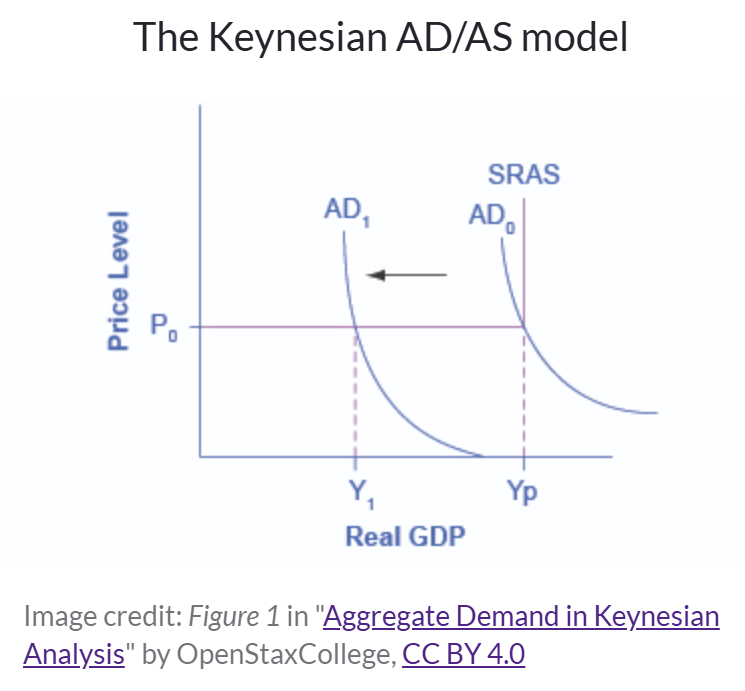
Figure 1
Keynesian model of aggregate supply and demand (AD/AS)
The main acronyms used are explained below:
- AD (Aggregate Demand): corresponds to the total expenditure by households, businesses, and the government on goods and services.
- SRAS (Short-Run Aggregate Supply): expresses the amount of production that businesses are willing to offer based on the price level.
- A shift of AD to the right (from AD₁ to AD₀) implies an increase in production (from Y₁ to Yₚ) and a reduction in unemployment.
- Conversely, a fall in AD reduces production and puts the economy into a phase of slower growth or recession.
When the government increases military investment, for example, to modernize the armed forces, it is increasing aggregate demand. This increased spending boosts economic activity, generates employment, and stimulates sectors such as industry, technology, and construction. However, if the level of investment is very high or is not accompanied by a balanced fiscal and monetary policy, it can lead to inflationary pressures or a fiscal deficit, affecting macroeconomic stability.
2. Defense Spending as a Fiscal Policy Instrument within the Keynesian Model
Investment in defense is a strategic component of public spending and plays a fundamental role within the Keynesian model of fiscal policy. From this perspective, defense spending not only strengthens the military capabilities of the state, but also acts as an engine of aggregate demand, driving economic growth, job creation, and technological innovation. According to John Maynard Keynes in The General Theory of Employment, Interest and Money (1936), the state must actively intervene to revive the economic cycle through expansionary fiscal policies in contexts of insufficient demand. In this context, defense investment is presented as an ideal tool for stimulating domestic production and counteracting periods of recession or economic slowdown.
Keynes argued that markets do not self-regulate toward full employment and that private spending tends to contract in crisis situations due to lack of confidence and profitability. In response, the state must take a leading role by increasing public spending to generate a multiplier effect. This principle applies directly to defense spending, given that each monetary unit invested in military equipment, infrastructure, maintenance, or technological development generates multiple positive effects in productive and service sectors. For example, the construction of military bases and logistics systems boosts industries such as construction, engineering, metallurgy, electronics, and technology, generating direct and indirect employment.
Aggregate demand, expressed in the equation AD = C + I + G + (X − M), summarizes how the Keynesian model works:
- C (consumption): increases when people work on defense projects, receive salaries, and spend more on goods and services.
- I (investment): grows because private companies invest in technology and production to supply the defense sector.
- G (government spending): this is the initial impetus, as the state invests in defense to stimulate the economy and create jobs.
- (X − M) (net exports): improves when the country produces its own equipment and reduces imports, or even exports military technology.
Paul A. Samuelson formalized this effect in his neoclassical-Keynesian synthesis, explaining that a properly implemented expansionary fiscal policy can amplify the impact of public spending on income and employment. In the field of defense, this translates into a specific phenomenon: military acquisitions and modernization programs boost domestic production, encourage the hiring of technical personnel, and strengthen the industrial base. Thus, state investment in defense becomes a dual-purpose instrument: on the one hand, it strengthens national security and sovereignty; and on the other, it stimulates economic activity through GDP growth and employment expansion.
The IS-LM model developed by John R. Hicks helps us understand how fiscal policy on defense spending interacts with monetary policy. An increase in public spending shifts the IS curve to the right, raising the level of production and reducing unemployment. However, if public spending is financed through excessive debt, it can put pressure on interest rates, making credit more expensive and affecting private investment. This phenomenon, known as the crowding-out effect, represents one of the main risks of expansionary fiscal policies. In the case of Peru, a policy of modernizing the armed forces aimed at technological innovation and strengthening industrial capacities could increase the level of output and employment, provided that it is combined with prudent and sustainable fiscal management.
Defense spending, in addition to its immediate effects on demand, contributes to the strengthening of strategic sectors that generate innovation and competitiveness. Paul Krugman, in analyzing the 2008–2009 financial crisis, emphasized that in times of economic contraction, the state must take an active role through public investment to prevent a prolonged decline in production. In this scenario, investment in defense becomes an immediate economic stimulus, due to its high domestic content and its capacity to generate productive linkages. In developing countries such as Peru, where defense spending represents about 1.1% of GDP, this type of investment can sustain growth in times of weak private demand, while strengthening the institutional capacity of the state to respond to hybrid threats (drug trafficking and cyberattacks).
Joseph E. Stiglitz expanded Keynesian theory by introducing the concept of market failures and the role of the state as a promoter of innovation. In his analysis, public defense spending not only has multiplier effects on production and employment, but also generates positive externalities known as technological spillovers. These arise when innovations developed for military purposes are subsequently transferred to the civilian sphere, driving overall technological progress. Paradigmatic examples are the creation of the Internet, GPS, and radar systems, all of which originated in defense projects and were later adopted by the civilian economy. In the case of Peru, investment in defense focused on research, cybersecurity, and secure communications could generate similar benefits, fostering a solid technological base with dual applications for industry and society.
From a complementary perspective, Keith Hartley (2007) argues that defense should be understood as a pure public good, characterized by non-exclusion (no one can be deprived of its protection) and non-rivalry (its provision is not exhausted by simultaneous use by society). Under this principle, the state is the sole legitimate provider of national security, and its defense spending becomes a collective investment that benefits the entire population. Furthermore, Hartley recognizes that the provision of this public good has a significant economic dimension: military spending generates demand in multiple industrial sectors, boosts employment, and strengthens the productive apparatus. Thus, state intervention in defense not only responds to a need for security but also serves the purpose of economic and social development.
The aggregate supply and demand (AD/AS) model allows us to visualize this process graphically. The aggregate demand (AD) curve represents the total expenditure of consumers, businesses, and the government on goods and services. When the government increases military spending, the AD curve shifts to the right (from AD₁ to AD₀), causing an increase in production (from Y₁ to Yₚ) and a reduction in unemployment. This movement reflects how expansionary fiscal policy, in this case through defense spending, can increase the level of economic activity and improve social welfare. However, if spending increases disproportionately or without productivity support, it can generate inflationary pressures and fiscal imbalances, affecting macroeconomic stability.
In the Peruvian context, defense spending plays an increasingly important role as an economic policy instrument. Public investment in defense projects, such as the development of capabilities in cybersecurity, border surveillance, satellite technology, and secure communications, not only strengthens national security but also stimulates the domestic economy by creating specialized jobs, contracting technological services, and increasing demand for domestic inputs. This type of spending has a strong territorial impact, as it boosts regional economies and promotes productive decentralization.
The effectiveness of defense spending depends on its planning, execution, and control. Public spending focused exclusively on procurement, without criteria for sustainability or coordination with domestic industry, can lose its multiplier potential. In contrast, a defense fiscal policy aligned with innovation, research, and industrial development objectives can generate a virtuous circle between security and economic growth.
In summary, within the Keynesian model, defense spending operates as an instrument of expansionary fiscal policy which, when implemented responsibly and strategically, can boost domestic production, create jobs, foster technological innovation, and strengthen the economic sovereignty of the state. Its effectiveness depends on the government’s ability to harmonize fiscal expansion with macroeconomic stability, transforming defense investment into a pillar of productive development and national stability.
3. Lessons from South American Experiences in Military Investment
South American experiences clearly demonstrate that defense spending can be an engine of economic, technological, and industrial growth when it is strategically planned and linked to innovation and national development policies. From a Keynesian perspective, defense investment plays an expansionary role, stimulating aggregate demand and generating productive linkages, but its success depends on the institutional capacity of the state to align military spending with economic and social policy objectives. In the region, countries such as Brazil, Argentina, and Chile offer valuable examples that help us understand the conditions under which defense investment can translate into sustainable development.
In the case of Brazil, defense spending has historically been considered an instrument of industrial policy. Embraer, which emerged in the 1960s as a state project linked to the Brazilian Air Force (FAB), is one of the most successful examples of how military investment can generate technological innovation and economic expansion. Over time, Embraer has established itself as one of the world’s leading aircraft manufacturers, developing both military and civilian products. This model demonstrates the state’s ability to promote strategic industries with international reach, generating thousands of skilled jobs and high value-added exports. In addition, the coordination between universities, research centers, and the Brazilian Ministry of Defense made it possible to consolidate an innovation ecosystem that strengthened not only national defense but also the country’s global competitiveness. From a Keynesian perspective, Brazil represents a case where public spending on defense, far from being a fiscal cost, became a productive investment capable of boosting the entire economy.
In Argentina, the experience with the Argentine Aircraft Factory (FAdeA) demonstrates the potential of military investment as an instrument of industrial recovery. After a period of inactivity and budgetary restrictions, the state reactivated the company with the aim of rebuilding its technological and productive capacity. FAdeA focused on the manufacture, maintenance, and modernization of aircraft, prioritizing research, development, and cooperation with local universities and suppliers. This process made it possible to generate specialized employment, recover technical knowledge, and promote innovation applied to civilian sectors, such as commercial aviation and the electronics industry. The Argentine case highlights that, even in limited fiscal contexts, a defense policy geared toward reindustrialization can strengthen the national technological base, provided that projects with multiplier and sustainable effects are prioritized. From a Keynesian perspective, this type of investment operates as a countercyclical measure that reactivates the economy, boosts demand, and raises the level of employment in the medium term.
In Chile, the policy of financing defense through the Copper Law represented a model of fiscal stability and budgetary predictability. This law allocated a fixed percentage of copper sales by the state-owned company Corporación Nacional del Cobre de Chile, known as CODELCO, to the financing of the armed forces, ensuring constant resources for the acquisition and maintenance of equipment. Unlike other nations, the Chilean model stood out for its macroeconomic discipline: it allowed defense investment to be sustained without resorting to debt, avoiding inflationary pressures or fiscal deficits. Thanks to this mechanism, Chile was able to develop a medium-level defense industrial base, represented by the National Aeronautics Company (ENAER) and the Chilean Army Factories and Workshops (FAMAE), which contributed to strengthening its strategic autonomy. This case demonstrates that defense spending can coexist with fiscal sustainability if it is managed within a framework of responsibility and long-term planning.
A comparative analysis of the region, based on data from the Stockholm International Peace Research Institute (SIPRI)8 and the World Bank (WB)9 for 2025, allows us to gauge the structural differences between South American countries. Brazil allocates approximately 1.4% of its GDP to defense and has 334,000 troops, consolidating an advanced military industry made up of companies such as Avibras Aerospace and Embraer Defense and Security (EDS).
Chile invests 1.9% of its GDP and has 77,000 troops, maintaining a medium industrial level represented by companies such as ENAER and FAMAE. Colombia allocates 3.2% of its GDP to defense and has 295,000 troops, with a medium-low level industry centered on INDUMIL. In contrast, Argentina allocates only 0.7% of its GDP with 74,000 troops, limited by budgetary constraints. Peru, for its part, invests 1.1% of its GDP and has 120,000 troops, with an industry still in development, represented by the Army Weapons and Ammunition Factory S.A.C. (FAME S.A.C.) and the National Defense Industry Promotion System (SINPRODE), both with considerable room for growth.10
This comparison shows that Peru has considerable potential to consolidate its defense industry, provided that it directs its spending toward high-impact technological projects, backed by a solid strategy and effective institutional coordination. Unlike Brazil or Chile, where defense spending has generated tangible results in innovation and exports, Peru is still in a stage of institutional development that requires a long-term policy aligned with its economic development and technological autonomy objectives.
From a theoretical point of view, regional experiences also illustrate the balance between Keynesian and neoclassical views of public spending. While the Keynesian approach emphasizes the expansionary effects of defense spending on production and employment, the neoclassical school, represented by Robert Barro (1990), warns of the risks of financing such spending through excessive borrowing, which could generate fiscal pressures and displace private investment.11 In South America, the most successful policies have been those that combine both approaches: fiscal expansion accompanied by macroeconomic responsibility. Chile, with its budgetary discipline, and Brazil, with its model of technological innovation, are examples of this convergence between growth and fiscal institutionality.
On the other hand, Joseph Stiglitz (2012) provides a complementary reading by highlighting that investment in defense can generate positive externalities or technological spillovers to the civilian economy.12 The transfer of military technologies to commercial uses, such as aviation, robotics, or secure communications, boosts overall productivity and broadens the country’s scientific base. In this sense, the lessons learned in South America confirm that defense investment should not be seen solely as a security-oriented expense, but as a vector for technological, industrial, and social development.
However, the success of this type of policy depends on three fundamental conditions: institutional continuity, which guarantees stability and long-term planning, avoiding cycles of abandonment or improvised reactivation; transparency, to ensure that resources allocated to defense are executed efficiently and without corruption, preserving the social legitimacy of military spending; and links to the national economy through industrial compensation programs (offsets), technological cooperation, and local industry participation in procurement contracts.
In the case of Peru, these lessons are particularly relevant. The country can strengthen its defense industrial base through public policies that promote coordination between the military, academia, and private enterprise. The creation of technology consortiums, investment in applied research, and international cooperation would transform defense spending into a true lever for economic development. In this way, the state would not only strengthen its defense capabilities but also boost industrial growth, job creation, and productive diversification.
The experiences of Brazil, Argentina, and Chile demonstrate that defense investment, managed according to criteria of sustainability and efficiency, can be a legitimate source of national development. Its success depends on maintaining a balance between the expansionary impulse of public spending and fiscal discipline, between national security and technological innovation, and between strategic autonomy and industrial integration. These lessons, applied to the Peruvian context, form the basis for designing a modern, productive defense policy aligned with the principles of the Keynesian model.
4. Strategies for Maximizing the Economic Benefits of Defense Investment
From a Keynesian perspective, defense investment can become an engine of sustainable economic growth if it is managed with a strategic and long-term vision. For this public spending to become an effective tool for development, it must be coordinated with policies for technological innovation, fiscal sustainability, and institutional strengthening. In the case of Peru, the challenge is to design and implement a defense policy that combines the expansionary impulse of public spending with macroeconomic discipline, ensuring that every sol invested in national security generates tangible returns in employment, productivity, and innovation.
First, defense spending should be viewed as a productive investment rather than a passive expense. Its results should be evaluated not only in terms of military capability, but also in terms of its impact on the real economy. Defense projects with high technological content and dual-use potential (military and civilian), such as satellite surveillance systems, cybersecurity networks, and unmanned aerial vehicles (UAVs), not only strengthen national security but also boost sectors such as engineering, information technology, metalworking, and telecommunications. Therefore, the state should prioritize projects that promote local capacity building, the training of specialized human capital, and technology transfer.
An effective strategy to enhance the effects of defense spending is to promote cooperation between the State, academia, and industry, creating synergies between the Armed Forces, universities, and technology companies. International experience shows that innovation ecosystems emerge when the public sector acts as a facilitator, connecting research with production and industrial development.
Second, it is essential to incorporate industrial compensation mechanisms (offsets) into military equipment procurement processes. These agreements require foreign suppliers to reinvest a percentage of the contract in the purchasing country through technology transfer, co-production, or training. According to Transparency International (2016), properly designed offsets can reduce technological dependence, boost local industrialization, and strengthen transparency in procurement. In the case of Peru, including compensation clauses in international contracts would allow each defense purchase to translate into direct benefits for domestic industry. For example, when purchasing armored vehicles, Peru could require partial co-production at the facilities of the Peruvian Army Weapons and Ammunition Factory (FAME S.A.C.), with knowledge transfer, job creation, and participation of local suppliers. This practice has shown positive results in Brazil and South Korea, where offsets were key to developing domestic industrial capabilities.
Third, the creation of a National Defense Research, Development, and Innovation (R&D&I) Fund is recommended, with the aim of guaranteeing permanent resources for technological and scientific development. This fund would finance projects in strategic areas such as cyber defense, artificial intelligence, autonomous systems, military robotics, and secure communications. In addition, it could promote public-private collaboration in applied research, ensuring that military innovations generate tangible benefits for the civilian economy. A fund of this nature would also help reduce dependence on technology imports and promote industrial self-sufficiency in critical areas. From a Keynesian perspective, this type of investment stimulates aggregate demand in the short term and increases productivity and the long-term growth potential of the economy.
It is essential to strengthen the management and modernization of FAME, which is the core of the Peruvian defense industry. FAME can become a platform for dual innovation, both military and civilian, if it focuses on the production of high-tech, value-added goods. To do so, it needs to establish strategic alliances with universities, technology startups, and international partners to incorporate innovation, optimize production processes, and develop exportable capabilities. FAME’s partnerships with Hyundai Rotem to manufacture armored vehicles13 and with Israel Weapon Industries (IWI) to produce ARAD-7 rifles exemplify the viability of this model.14 However, institutional continuity, sustained investment, and an industrial policy that prioritizes competitiveness and technology transfer are required.
From a theoretical perspective, Robert Barro (1990) warns that financing defense spending with public debt can generate long-term fiscal pressures and displace private investment. This neoclassical view complements the Keynesian perspective by reminding us that fiscal stimulus must take place within a sustainable framework. For Peru, this implies maintaining prudent fiscal management, backed by stable revenues, macrofiscal responsibility rules, and cost-benefit evaluation mechanisms, ensuring that expansionary policy does not compromise long-term stability or the intergenerational balance of public finances.
Similarly, Joseph Stiglitz (2012) highlights that defense spending can offer broader economic returns if it is geared toward knowledge creation and innovation. Dual-use technologies—drones, navigation systems, robotics, smart sensors—have both military and civilian applications, amplifying the benefits of public investment. In the Peruvian context, promoting research in these sectors could generate a multiplier effect, benefiting not only defense but also agriculture, mining, citizen security, and environmental management. Consequently, defense becomes a catalyst for national development, generating tangible benefits for different sectors of society.
The sustainability of defense policy requires solid institutions, transparency, and strategic continuity. It is essential to implement effective oversight, audit, and accountability mechanisms to ensure that resources are used efficiently and with integrity. In addition, medium- and long-term planning must be consistently aligned with the National Security and Defense Plan and the Institutional Transformation Plan (PTI) of the Peruvian Army (EP) for 2030.15 These strategic frameworks facilitate the articulation of defense investment with national economic, scientific, and technological development objectives.
To maximize the economic benefits of defense investment, a comprehensive strategy is needed that integrates productive expansion, fiscal sustainability, and technological advancement. Transforming military spending into high value-added investment will strengthen the national economy, promote innovation, and consolidate the strategic autonomy of the state. Therefore, it is essential to strengthen institutions, encourage research and technology, and promote cooperation between the public, private, and academic sectors. Only under these conditions will defense investment fulfill its dual purpose: to safeguard national security and contribute decisively to the country’s economic and social development.
5. Comparison of Defense Investment among Countries in the Region
Table 1 presents a comparison of key indicators on defense investment and industrial capacity in South American countries, based on the latest available data from SIPRI16 and the World Bank17 for 2025.
Table 1. Regional comparison of defense investment and industrial capacity according to SIPRI and the World Bank (2025)
| Country |
Defense investment (% of GDP) |
Personnel (thousands) | Level of defense industry |
|---|---|---|---|
| Brazil | 1.4% | 334 | High (Avibras, Embraer Defense) |
| Chile | 1.9% | 77 | Medium (ENAER, FAMAE) |
| Colombia | 3.2% | 295 | Low – Medium (INDUMIL) |
| Argentina | 0.7% | 74 | Low (limited by restrictions) |
| Peru | 1.1% | 120 | Low (SINPRODE, limited FAME) |
Source: Own elaboration based on data from the SIPRI Military Expenditure Database and World Bank DataBank (2025).
Conclusions
- From a Keynesian perspective, defense investment is an effective economic policy tool because it boosts aggregate demand, stimulates employment, and promotes technological innovation. The experience of South American countries such as Brazil, Argentina, and Chile shows that management geared toward military spending has positive effects on the local economy and industry. For example, the expansion of Embraer in Brazil strengthened the aeronautical industry and created thousands of jobs; in Argentina, the recovery of FAdeA fostered research and technological development; and in Chile, the Copper Law guaranteed stable financing for defense without jeopardizing fiscal sustainability.
- In Peru, defense investment represents around 1.1% of GDP, which is lower than in other countries in the region but has considerable growth potential. If properly targeted, it can generate multiplier effects in the economy, such as job creation, technology transfer, and the strengthening of a national industrial base. Medium- and long-term defense policy has shown positive progress in linking security with innovation and productivity, without neglecting fiscal balance. However, it is crucial to strengthen control, management, and transparency mechanisms to avoid financial imbalances and ensure sustainable planning.
- The revised results confirm that investment in defense should be conceived as a strategic tool that boosts the economy, strengthens technological sovereignty, and contributes to national development. The challenge is to balance the expansion of public spending with fiscal prudence that ensures state economic stability.
- Maintaining a solid industrial base brings benefits from a military, technological, and economic perspective, especially in the face of budget cuts and shifts in the demand curve that affect prices and revenues. In this context, it is essential that leaders identify the optimal point of efficiency to maximize results.
Recommendations
- Consolidate a defense investment policy that prioritizes efficiency, sustainability, and links to national development. This policy should encourage cooperation between the state, industry, and academia so that each project strengthens the country’s technological and productive capacities.
- Prioritize investments that include technology transfer and have dual-use potential, benefiting both military and civilian spheres. Similarly, encourage defense procurement to incorporate industrial compensation clauses (offsets) to ensure the participation of domestic companies and the sustainable creation of local capabilities, generating a positive impact on society.
- Create a permanent defense research, development, and innovation (R&D&I) fund focused on strategic sectors such as cyber defense, cybersecurity, artificial intelligence (AI), drones, and secure communications. This fund should channel public and private resources toward projects that raise the national technological level.
- Strengthen the corporate management of FAME S.A.C. as the backbone of the Peruvian defense industry, promoting strategic alliances with universities, technology startups, and international partners to advance toward a comprehensive policy that integrates security, industrial development, and economic sustainability from a military and economic perspective.
Bibliography
- Benjamin Haggott Beckhart, “The General Theory of Employment, Interest and Money, by John Maynard Keynes,” Political Science Quarterly 51, no. 4 (December 1936): 600–603.
- Benoit Mougenot, “Joseph Stiglitz, Nobel Prize winner in Economics: positive and negative aspects of globalization,” USIL Blog, San Ignacio de Loyola University, October 28, 2025, https://blogs.usil.edu.pe/facultad-ciencias-empresariales/economia/joseph-stiglitz-premio-nobel-de-economia-aspectos-positivos-y-negativos-de-la-globalizacion.
- “Comparison of defense budgets in Latin America,” Red Castrense, July 2, 2025, October 30, 2025, https://redcastrense.com.ar/nota/2382/comparacion-de-los-presupuestos-de-defensa-en-america-latina/.
- “Equilibrium in Goods and Money Markets in a Closed Economy,” UNED, October 30, 2025, https://www.intecca.uned.es/giccu/salidaweb/5e46670337ebc61534f37c4a/5e46673e37ebc61534f37c4c/5ebac4bdb4396b21bd4c1fe8/paginas_contenidos/capitulo_05/seccion_05_01.html.
- “ARAD-7 rifle: combat-proven and expanding into more countries,” Peruvian Ministry of Defense, October 30, 2025, https://www.gob.pe/institucion/fame/noticias/922977-fusil-arad-7-probado-en-combate-y-en-expansion-en-mas-paises.
- InfoDefensa, Revista Defensa, “FAME and Hyundai Rotem sign agreement to assemble military vehicles in Peru,” Infodefensa, October 30, 2025, https://www.infodefensa.com/texto-diario/mostrar/4839849/fame-hyundai-rotem-firman-convenio-coproduccion-vehiculos-militares-peru.
- Alexandru Minea, “The Role of Public Spending in the Growth Theory Evolution,” Romanian Journal of Economic Forecasting 2 (2008): 99–120.
- “National Multisectoral Policy on Security and National Defense to 2030,” Ministry of Defense of Peru, October 30, 2025, https://www.gob.pe/institucion/mindef/informes-publicaciones/3212559-politica-nacional-multisectorial-de-seguridad-y-defensa-nacional-al-2030.
- “What is the fiscal multiplier? Definition and examples,” Billin Invoices Glossary, Billin Invoices, October 28, 2025, https://www.billin.net/glosario/multiplicador-fiscal/.
- Jaime Ros, “Keynes’ General Theory and Modern Macroeconomics,” Economic Research 71, no. 279 (January–March 2012): 19–37, doi:10.22201/fe.01851667p.2012.279.37327.
- SIPRI Yearbook 2025, summary in Spanish, Oxford University Press for the Stockholm International Peace Research Institute, October 30, 2025, https://www.sipri.org/es/yearbook/2025/summary/sipri-yearbook-2025-summary-spanish.
- World Bank, “World Bank Open Data,” World Bank, October 28, 2025, https://data.worldbank.org.