


“Citizenship is not only possessed; it is exercised. When it lacks social responsibility and civic awareness, it loses its transformative capacity.”
— Emilio Cam (2026)
Abstract
This research article employs an analytical-propositional methodology to examine the exercise of citizenship in Peru as a public issue. The study identifies that limitations in civic practice negatively impact democratic governance, security, national defense, and social development. The concept is analyzed from philosophical and political perspectives, in which citizenship is understood as the full exercise of rights and the responsible fulfillment of duties grounded in social awareness. Based on empirical evidence, such as institutional distrust and educational gaps, the research formulates the problem in accordance with the methodology of the National Center for Strategic Planning (CEPLAN) and proposes the design of a Política Nacional Multisectoral (PNM) (Multisectoral National Policy) with a time horizon to 2035. The analysis concludes that strengthening civic capacities contributes to optimizing resource management in the field of security and to enhancing democratic performance. Additionally, the role of the Armed Forces (FF.AA.) is highlighted in the formation of civic values and principles that strengthen institutional resilience and promote sustainable state development.
Keywords: citizenship; social awareness; civic culture; national security and defense; multisectoral national policy.
Introduction
Understanding citizenship implies recognizing it not only as a legal condition or a status of membership but also as the fundamental link between the state and individuals. Under this premise, the former must guarantee fundamental rights, while the latter assume the obligation to respect the rule of law, comply with social norms, exercise their civic duties, and actively participate in the public sphere through processes of democratic deliberation.
This process requires the development of both individual and collective awareness that fosters commitment to social responsibilities. In this regard, civic education constitutes an essential duty shared by the state, society, academia, and the family. This ongoing challenge seeks to form individuals with civic culture, capable of understanding that their decisions affect general welfare. Likewise, it is necessary for the population to understand the functioning of the state apparatus in order to fully exercise their rights and responsibilities.
Social phenomena such as voter turnout, the lack of competent political leaders, systemic corruption, and governmental instability reveal the presence of “passive citizens.” These individuals neither exercise full citizenship nor engage in public affairs to propose solutions to collective problems or voluntarily fulfill their moral and legal duties.
Through the analytical-propositional method, this study establishes as its main objective to analyze citizenship in Peru as a public issue, with the purpose of proposing strategic guidelines within the framework of a Multisectoral National Policy (PNM). To this end, four specific objectives are formulated: (1) to identify the factors that give rise to weak civic engagement; (2) to assess its effects on democratic governance and on Seguridad y Defensa Nacional (SEDENA) (National Security and Defense); (3) to analyze the role of the state and the regulatory framework regarding civic education; and (4) to propose guidelines for the implementation of the aforementioned national policy by 2035.
The article supports the thesis that strengthening citizenship requires multisectoral strategic management. It posits that a weakened civic culture significantly undermines SEDENA. Conversely, the Armed Forces contribute to reversing this situation by fostering a strong social awareness among military personnel, thereby making a substantive contribution to the formation of responsible citizens committed to serving the Nation.
Analysis and Conceptualization of Citizenship
Citizenship constitutes a multidimensional concept—philosophical, social, and political—that has evolved significantly throughout history. According to the Royal Spanish Academy (RAE, 2023), it is defined as the quality and right of an individual who belongs to a state, which grants them the status of an active member with prerogatives and obligations. This status entails responsible civic conduct, enabling peaceful participation in the political life of the country, including the right to vote and to run for public office upon reaching the age of majority, as established by the Political Constitution of Peru (1993).
In The Republic, Plato (2003) argues that this condition is closely linked to participation in the public sphere. For the philosopher, a citizen is one who possesses the right to participate in deliberate and legal functions, engaging in collective decisions that determine the destiny of the community. This perspective establishes a clear distinction between those who enjoy full rights and residents who lack deliberative authority. Thus, the notion of citizenship is not grounded solely in residence or birth, but in the capacity for governance and administration. Such participation is based on mutual obligations oriented toward the common good; therefore, it represents not merely a legal status but a political relationship of binding commitment to the collective destiny.
Similarly, Aristotle (1998) asserts that citizenship lies in constant activity both in the government of the polis and in the administration of justice. Consequently, the citizens assume both the right and the obligation to decide on public affairs. The philosopher introduces a crucial distinction: the holder of legal status and the “good citizen,” who embodies civic virtue. The latter promotes social development by governing, deliberating, or simply respecting the rule of law.
Over time, this concept evolved from being a privilege of elites to a condition of equality for all members of society, regardless of social class, ethnicity, or gender. It encompasses duties that sustain the political community and enable the exercise of rights, directly linking to national identity (Marshall, 1950). From this contemporary perspective, when a citizen fails to fulfill their responsibilities or ignores their rights due to a lack of social awareness, they are defined as a “passive” or nominal citizen. Although they possess legal recognition, nationality, and civil rights, their participation is minimal or indifferent.
In contrast, active citizens exercise their powers and fulfill their obligations with a strong civic culture. They do not merely inhabit a territory but actively contribute to its transformation and development. Beyond staying informed, they engage in democratic processes, solidarity actions, and oversight of authorities, promoting respect, sustainability, and the responsible use of digital platforms.
Table 1 examines the dimensions of civic behavior, contrasting the reactive and individualistic attitude of the passive citizen with the ethical and transformative commitment of those who exercise active citizenship for the benefit of the general welfare.
Table 1
Comparison between the passive citizen and the active citizen
| Dimension | Passive Citizen | Active Citizen |
| Participation | Limits to mandatory voting to avoid sanctions | Continuously engages in civic and political activities |
| Critical Awareness | Accepts information uncritically and without reflection | Analyzes, contrasts, and proposes constructive solutions |
| Social Responsibility | Prioritizes individual interests and shows disinterest in the environment | Acts oriented toward the common good and collective values |
| Fulfillment of Duties | Avoids or neglects tax obligations and social norms | Fulfills duties with transparency, ethics, and responsibility |
| Exercise of Rights | Claims rights only when direct personal interests are affected | Defends their rights and those of others with solidarity |
| Community Engagement | Remains indifferent to local, national, or global problems | Engages in collective solutions and promotes collaborative action |
| Relationship with the Law | Obeys out of imposition or fear of coercion | Promotes legality as a principle of social justice |
| Conception of Citizenship | Understood as a legal or formal condition | Conceived as an ethical, democratic, and transformative practice |
Source: Author’s own elaboration.
Following the analysis conducted, a modern concept of citizenship adapted to current challenges is proposed: the condition that allows individuals to fully participate in public life through the exercise of rights and duties—civil, political, social, cultural, and environmental—oriented toward coexistence, solidarity, social awareness, and commitment to the general welfare.
Consequently, the process of consolidating citizenship in Peru constitutes a complex, ongoing, and interinstitutional task. It must be addressed as a public issue requiring a PNM for its management, involving the state, educational institutions, decentralized governments, electoral bodies, civil society, and families.
Social Awareness and Civic Culture: Mandatory Qualities of Citizens
In contemporary democracies, citizenship transcends the mere legal condition of possessing rights and duties; it entails an ethical and participatory dimension that requires both social awareness and civic culture. While the former refers to the individual’s capacity to recognize themselves as part of a collective and assume shared responsibilities, the latter refers to the internalization of values, norms, and practices that ensure coexistence and respect for the rule of law. Both pillars are essential to ensure that the exercise of citizenship is effective rather than merely nominal.
Social awareness is understood as the capacity to comprehend the impact of individual actions on the collective. According to Cortina (1997), a citizen should not limit themselves to demanding rights but must also recognize and fulfill their social obligations. This entails cultivating empathy, solidarity, and justice, values that promote community cohesion and encourage engagement in the face of issues such as exclusion and inequality. In this sense, a socially aware individual links their individual freedom to the common good and participates in initiatives that strengthen the social fabric. Conversely, the absence of social awareness generates indifference and selfishness, producing isolated individuals and eroding public trust.
Civic culture, a concept developed by Almond and Verba (1963), argues that democratic stability requires attitudes and knowledge that foster citizen participation. This manifests itself in respect for laws, tolerance of diversity, and trust in institutions. In practical terms, it involves exercising responsible voting, deliberating in public spaces, and holding authorities accountable. A strong civic culture provides institutional legitimacy and enhances democratic effectiveness (Putnam, 1993); conversely, its absence fosters apathy and arbitrariness in public life.
The exercise of active citizenship requires a balanced interaction between both components. Marshall (1950) argued that civil, political, and social rights are only fully realized when individuals possess ethical awareness and democratic political orientation. Habermas (1998) reinforces this perspective by stating that the legitimacy of a system is proportional to informed and conscious participation, where shared norms are respected in order to consolidate an inclusive society.
Table 2 details the conceptual and operational differences between social awareness and civic culture, highlighting how their integration enables the transition from individualistic passivity to responsible democratic participation oriented toward the common good.
Table 2
Dimensions of social awareness and civic culture
| Dimension | Social Awareness | Civic Culture |
| Definition | Recognition of the individual as part of a collective (Cortina, 1997) | Values and practices that guide democratic life (Almond & Verba, 1963) |
| Approach | Ethical and solidarity-based | Normative and participatory |
| Core Values | Empathy, justice, and shared responsibility | Respect for the law, tolerance, and civic commitment |
| Manifestations | Community collaboration and social sensitivity | Informed voting, social oversight, and legal compliance |
| Risk of Absence | Indifference, self-interest, and passivity | Disorder, arbitrariness, and democratic apathy |
| Ultimate Goal | Social cohesion and general welfare | Democratic coexistence and the rule of law |
Source: Author’s own elaboration based on Cortina (1997) and Almond and Verba (1963).
In Peru, both the Political Constitution of Peru (1993) and the Methodological Guide for the formulation of national policies of the CEPLAN (2018) emphasize the importance of promoting active participation that integrates social duties. However, the country lacks a PNM capable of articulating the isolated efforts of key sectors such as education, health, justice, and defense. This fragmentation prevents a comprehensive approach to citizenship development, which constitutes a relevant public issue.
Ultimately, full citizenship requires social awareness to guide solidarity and civic culture to ensure respect for norms. Both conditions are inseparable for shaping transformative citizens capable of ensuring the stability and cohesion of Peruvian society.
Competency-Based Education and Its Relationship with Citizenship Development
Citizenship education represents a critical challenge for strengthening democracy and social cohesion in contemporary societies, which are characterized by increasing globalization and intense technological interconnection. In Peru, this challenge is particularly significant due to persistent socioeconomic inequality, institutional distrust associated with perceptions of corruption, low levels of civic participation, and a deficit in social awareness across broad sectors of the population.
Within this context, competency-based education emerges as a fundamental strategy for developing well-rounded, critical, and socially committed to the common good. There is a direct relationship between the model implemented in the Currículo Nacional de la Educación Básica (CNEB, 2016) (National Curriculum for Basic Education) and the construction of a society grounded in ethical values and civic culture.
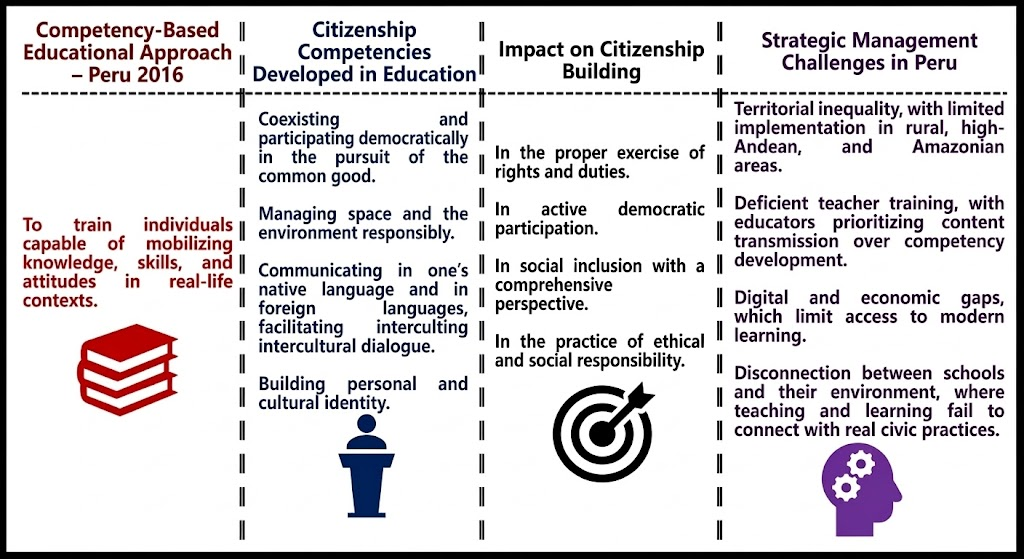
The CNEB defines competencies as the ability to mobilize knowledge, skills, and attitudes to act appropriately in diverse contexts. This paradigm shift seeks to overcome the rote-learning approach of previous decades and move toward integrated and applied learning. The curriculum promotes cross-cutting competencies aimed at: (1) coexisting and participating democratically in the pursuit of the common good; (2) managing space and the environment responsibly; (3) building personal and cultural identity; and (4) communicating effectively. These competencies are complemented by specific capacities such as critical thinking, problem-solving, and creativity.
Figure 1 illustrates the structure of the Peruvian education system under the competency-based approach, highlighting how the articulation between cross-cutting themes and specific capacities enables the comprehensive formation of individuals for their effective integration into public life.
Figure 1. Education in Peru
Source: Author’s own elaboration.
In this context, competency-based education constitutes a fundamental pillar for citizenship development (Zárate, 2018). This model fosters critical thinking by training students capable of analyzing reality, questioning inequalities, and proposing alternatives. Likewise, it promotes social commitment by linking academic training with ethical responsibility and solidarity, promotes inclusion by valuing the country’s multiple cultural and linguistic identities, and strengthens digital citizenship for the responsible exercise of rights in virtual environments. For this reason, this approach represents the primary driver for consolidating active civic participation in the country.
However, the strength of the Peruvian regulatory framework faces significant gaps in its strategic, tactical, and operational implementation. These shortcomings constitute a complex public issue, characterized by: (1) territorial inequalities that limit its implementation in rural, high-Andean, and Amazonian areas; (2) inadequate teacher training, where content transmission is prioritized over competency development; (3) digital and socioeconomic gaps; and (4) a disconnection between educational institutions and their environment, hindering the translation of learning into concrete civic practices
Table 3 presents the evolution of the budget allocated to the education sector during the 2023–2025 period, highlighting the annual percentage increase and the efficiency of expenditure execution aimed at closing learning gaps and improving national infrastructure.
Table 3
Education budget by fiscal year (2023–2025)
| Fiscal Year | Allocated Budget (Million Soles) | Increase from Previous Year | Main Expenditures | Budget Execution |
| 2025 | 20,400 | 12.5% | Salaries; teacher training; infrastructure; scholarships; and closing learning gaps | 48% (progress as of August 2025) |
| 2024 | 18,100 | 18% | Information pending specification | 93% |
| 2023 | 15,400 | 10% | Information pending specification | 90% |
Source: Ministry of Education (MINEDU 2024).
In this manner, the effectiveness of the competency-based approach is contingent upon overcoming the implementation barriers described above. It is imperative to capitalize on the sustained increase in the annual budget allocated to this sector, which should be directed not only toward improving salaries and infrastructure but primarily toward teacher training and closing learning gaps in vulnerable contexts.
Furthermore, citizenship development should not be confined to the educational sphere; on the contrary, it must be consolidated as a public policy of the Peruvian State that articulates educational institutions, families, communities, media, and the justice system. This synergy must also integrate the participation of the private sector, political organizations, and the FF.AA., among other civil actors. Only through this multisectoral coordination will it be possible to consolidate a responsible, competent, and participatory society capable of sustaining the democratic system and addressing the country’s enduring challenges.
Impact of Citizenship on National Security and Defense in Peru
SEDENA constitutes fundamental pillars of state development and stability. These concepts transcend the military domain and encompass a comprehensive system that ensures sovereignty, democratic governance, internal peace, the common good, and collective welfare. Within this framework, citizenship—understood as the conscious, responsible, and participatory exercise of rights and duties—emerges as a key element in consolidating both domains.
An informed, critical, and supportive population strengthens social cohesion and increases institutional trust. Conversely, an apathetic or uninformed citizenry erodes democracy, exacerbates insecurity, and hinders the state’s capacity for comprehensive protection. CEPLAN emphasizes that comprehensive security depends on the synergy between strong institutions and proactive citizens; thus, a weak citizenry hinders the allocation of resources and strategies, limiting the operational capabilities of the Armed Forces and the National Police of Peru to counter both external and internal threats.
Putnam (1993) and Habermas (1998) argue that democratic stability rests on social capital and informed civic participation—factors that legitimize the state, reduce the likelihood of constitutional breakdown, and strengthen the defense of national sovereignty.
Legal Definitions
Within the Peruvian legal system, national security and defense maintain a functional relationship, although they differ in scope and purpose. This distinction is essential for delimiting state and societal responsibilities in preserving sovereignty and constitutional order.
Law No. 30748 (2018) defines national security as the condition in which the state guarantees sovereignty, independence, territorial integrity, the common good, collective welfare, and fundamental rights, through the enforcement of constitutional order, democratic stability, and sustainable development, supported by collaboration between authorities and citizens in the face of internal and external risks.
The regulations of the aforementioned law establish that national defense comprises the set of permanent measures adopted by the state to ensure National Security against any threat. In this sense, it constitutes a strategic and operational instrument implemented through public policies, institutional capacities, and multisectoral coordination, under the leadership of the Ministry of Defense (MINDEF), the direction of the President of the Republic, and the participation of the Consejo de Seguridad y Defensa Nacional (COSEDENA) (National Security and Defense Council) (Supreme Decree No. 012-2018-DE, 2018).
National security represents an essential purpose of the state oriented toward balance, peace, and sovereignty; national defense, in turn, comprises the articulated actions designed to achieve and preserve that objective.
Articles 163 to 169 of the Political Constitution of Peru (1993) establish the institutional foundations of both concepts. This normative framework stipulates that the state guarantees Seguridad de la Nación y la Defensa Nacional (SNDN) (National Security and National Defense), while the Armed Forces are tasked with ensuring independence, territorial integrity, and constitutional order. However, defense is not an exclusive responsibility of the defense sector; rather, it is a comprehensive function involving the entire state apparatus and the citizenry, given that national security is directly linked to the common good, general welfare, and social cohesion.
Citizenship and Shared Responsibility in National Security
Citizenship plays a strategic role in the construction and sustainability of national security. Law No. 30748 establishes that national defense constitutes an integral function of the State and a duty of all Peruvians. This provision implies that the protection of the nation is not limited to the legitimate use of force but rather requires the informed, active, and responsible participation of the population.
National Security and National Defense are articulated through the National Defense System (SIDENA), regulated by Supreme Decree No. 012-2018-DE, which guides the planning, coordination, and implementation of public policies in this field. Accordingly, a proper understanding and institutional strengthening of this system are essential for consolidating democratic governance and preserving state stability in the face of contemporary challenges.
Within this framework, citizens not only benefit from security conditions but also assume direct shared responsibility for their consolidation. The level of civic commitment and respect for the legal order decisively influences the state’s capacity to prevent and respond to internal and external threats.
Contribution of the FF.AA. in Strengthening Citizenship: Military Duty
The famous statement attributed to Colonel Francisco Bolognesi Cervantes prior to the Battle of Arica in 1880— “We have sacred duties to fulfill, and we will fulfill them until the last cartridge is expended”—encapsulates a conception of duty grounded in responsibility, institutional loyalty, and commitment to the nation. This declaration, framed within a critical historical context, transcends the military episode and acquires a profound ethical and civic dimension. From a philosophical perspective, it can be analyzed at three levels: Kantian morality, existential freedom, and the communal projection of sacrifice. The determination to fulfill obligations to the utmost limit constitutes a paradigmatic expression of unconditional commitment.
In the tradition of Immanuel Kant, the ethics of duty are based on a moral obligation independent of outcomes, grounded instead in fidelity to moral law. The categorical imperative—to act in such a way that the maxim of the action may become a universal law—finds a clear parallel in Bolognesi’s conduct. The defense of the homeland was not conceived as a strategic option but as an absolute mandate that allowed for the cost of one’s life. This principle guides military formation, where mission fulfillment acquires an irrevocable character.
From another perspective, Jean-Paul Sartre argued in Being and Nothingness (1943) that human beings are “condemned to be free,” implying making decisions and assuming responsibility even under adverse conditions. Applied to the military sphere, this notion highlights that obedience does not eliminate freedom but rather commits it ethically to the preservation of constitutional order and state stability.
Similarly, Aristotle defined human beings as zoon politikon, that is, beings oriented toward life in community. Under this view, Bolognesi’s act is not an isolated decision but a service to the common good. The statement thus acquires pedagogical value: citizenship is not solely grounded in the possession of rights but in the assumption of shared responsibilities. Military duty is, therefore, projected as an eminent manifestation of civic commitment.
In Peru, the FF.AA. perform a strategic role in national defense and simultaneously contribute to citizenship formation by promoting discipline, responsibility, solidarity, and respect for constitutional order. T. H. Marshall (1998) emphasized that civic duties are essential to balance individual rights with general interest. From this perspective, service to the homeland represents a concrete manifestation of active participation in state protection.
During the training of officers, non-commissioned officers, and enlisted personnel, the institution strengthens ethical and social competencies aimed at comprehensive development. These include the internalization of norms, adherence to legitimate authority within the legal framework, and intercultural coexistence, as individuals from diverse regions, languages, and sociocultural backgrounds are integrated into a single institution. This process fosters national cohesion and strengthens collective identity.
The Voluntary Military Service (SMV) thus constitutes a permanent space for civic learning. Each year, approximately twenty thousand young individuals complete their service and return to society with new skills acquired during their training. This reality has generated academic debate regarding the possibility of making the service mandatory, as observed in certain states; however, any evaluation requires a rigorous legal and contextual analysis. The subsequent participation of retired and discharged service members in public administration—as constitutional presidents, legislators, subnational authorities, or public officials—demonstrates the social projection of this experience within the democratic framework.
In peacetime scenarios, the FF.AA. contribute logistical and organizational capabilities to national development and disaster risk management. They participate in infrastructure projects and respond to health emergencies through mobile social action platforms, both riverine and land-based, which enable essential services to be delivered to remote areas. These actions reinforce a model of solidarity-based citizenship oriented toward collective welfare.
Likewise, the institution contributes to the preservation of constitutional order (Perea, 2016). A recent example occurred in 2022, when then-president Pedro Castillo Terrones attempted to alter the democratic order, an event reported by national media outlets such as Radio Programas del Perú (RPP, 2022). In that context, the Joint Command and the general commanders reaffirmed their adherence to the Constitution, demonstrating institutional responsibility and a clear departure from the interventionist practices of the 20th century.
In sum, military duty constitutes a significant expression of active citizenship. Through territorial defense, education in values, support for development in non-war contexts, and the defense of the democratic system—always under civilian authority and with respect for human rights—the FF.AA. orient their actions toward service to the nation. In doing so, they strengthen national identity and promote a collective awareness grounded in the responsible fulfillment of shared obligations, as exemplified by Colonel Francisco Bolognesi in Arica.
Citizenship as a Public Issue in Peru: Current State Challenges
In Peru, a significant portion of the population does not fully exercise citizenship due to social, structural, and institutional factors that limit participation in public affairs. This situation affects governability, social cohesion, and economic development, while also undermining the legitimacy of democratic institutions. According to IPSOS (2024), only 7 percent of the population trusts the Congress of the Republic (Legislative Branch), and just 8 percent trusts the electoral system. Likewise, more than 70 percent express distrust toward the Judiciary and the Public Prosecutor’s Office—General Prosecutor of the Nation (MPFV) (Infobae, 2024). At the international level, the Edelman Trust Barometer (2025) places Peru at 37 points in the global trust index, ranking it among the countries with the lowest institutional credibility.
According to the methodological framework of CEPLAN, a public issue must be formulated in a structured, comprehensible, and verifiable manner, oriented toward policy and strategic planning design. The Guide to Institutional Strategic Planning and the guidelines of the National Strategic Planning System (SINAPLAN) establish five stages: (1) definition; (2) identification of the affected population; (3) empirical basis and magnitude; (4) causal analysis, and (5) validation. Thus, its formulation requires describing a current adverse situation, supported by objective evidence, and by identifying cause-effect relationships that necessitate state intervention.
From this perspective, citizenship development constitutes a collective concern, as it impacts society as a whole and the functioning of the democratic system. Rather than an isolated phenomenon, limited civic practice affects community cohesion, economic dynamism, political stability, and institutional legitimacy. This problem manifests in low social awareness, insufficient exercise of rights, weak fulfillment of duties, fragile civic culture, and limited participation in public decision-making.
The affected population includes: (1) young individuals eligible to exercise political rights; (2) residents of rural and marginal urban areas; (3) the economically active population (EAP); (4) leaders, administrators, and candidates for public office; and (5) public officials and civil servants at all levels of government. Indirectly, it also involves society as a whole, including children, older adults, and vulnerable populations, whose welfare must be guaranteed by the Peruvian State.
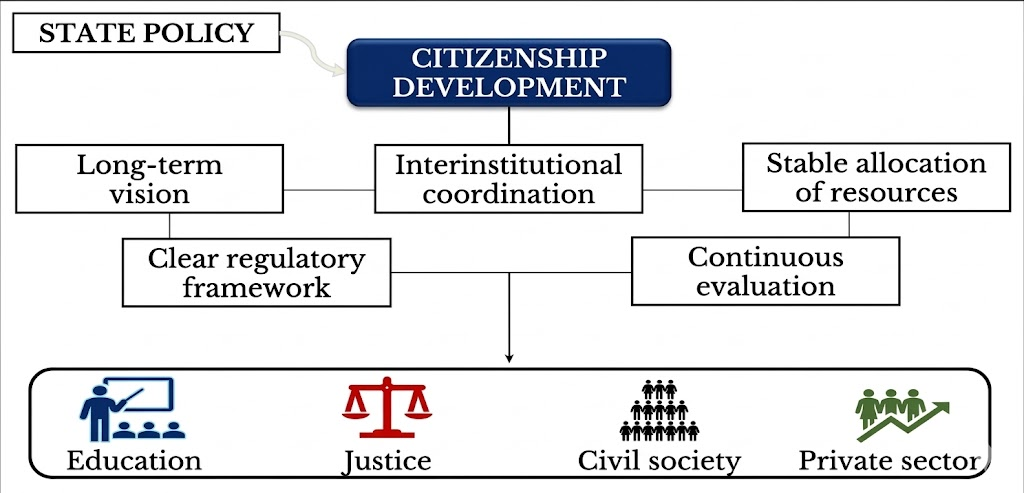
Before presenting Figure 2, it should be noted that the following diagram graphically synthesizes the relationship between structural factors, involved actors, and manifestations of civic engagement in the country.
Figure 2. Conceptual diagram of civic education in Peru
Source: Author’s own elaboration.
The National Office of Electoral Processes (ONPE) reported that voter turnout reached 25 percent in the 2022 regional elections (ONPE 2022). The Americas Barometer indicates that only 19 percent of the population declares itself satisfied with the functioning of democracy (Americas Barometer 2023). Likewise, IPSOS (2024) identifies the institutions with the lowest levels of trust as the Judiciary (22 percent), the Public Prosecutor’s Office (22 percent), the Executive Branch (17 percent), regional governments (17 percent), and the Congress of the Republic (7 percent). In contrast, the National Registry of Identification and Civil Status (RENIEC) (65 percent), the Central Reserve Bank of Peru (BCRP) (58 percent), and the Armed Forces (53 percent) register higher levels of credibility (IPSOS 2024).
The core of the problem is defined as the “low quality and scope of the exercise of citizenship in Peru.” Among the direct factors identified are: limited implementation of competency-based education, socioeconomic and territorial inequalities, discrediting of democratic institutions, reduced opportunities for political and community involvement; as well as insufficient exercise of rights accompanied by weak fulfillment of duties.
Among the indirect causes, the following stand out: (1) centralism in decision-making; (2) cultural and linguistic gaps affecting indigenous and native peoples; and (3) insufficient promotion of democratic values in the media and within the family sphere.
Based on the preceding analysis, Table 4 systematizes the structural and immediate factors that influence civic participation, as well as the consequences derived from its limited consolidation in the national context.
Table 4
Problem Tree: Low quality and scope of the exercise of citizenship in Peru
| Public Issue | Direct Causes | Effects |
| Low quality and scope of civic engagement in Peru | Low level of implementation of competency-based education. | Deficient civic culture and limited social awareness. |
| Distrust in democratic institutions. | Institutional delegitimization and widespread distrust in the state. | |
| Limited opportunities for citizen, political, and community participation. | Social exclusion, loss of community cohesion, and political apathy. | |
| Low exercise of rights and weak fulfillment of duties. | Weakening of democracy and governance, as well as increased voter turnout. |
Source: Author’s own elaboration.
The effects derived from this problem include: (1) fragile civic culture and reduced collective awareness; (2) restricted access to reliable information and quality public services, along with increased social conflict; (3) institutional delegitimization and growing skepticism toward the state; (4) social marginalization, weakening of the community fabric, and political apathy; and (5) erosion of democracy, reduced governability, and increased voter turnout.
The validation of the public problem is based on three fundamental criteria. First, it is of public interest insofar as it impacts democracy, governance, as well as national security and defense. Second, it allows for state intervention through policies aimed at civic education, competency-based educational approaches, social inclusion, and institutional strengthening. Third, it has national relevance, given that it directly affects the quality of the democratic system, the legitimacy of the state, the provision of public services, the capacity to respond to threats, economic growth, and the general welfare of the country.
Consequently, the type of citizenship that Peru requires faces complex challenges characteristic of the 21st century, framed within democratic, globalized, and technologically interconnected societies. These transformations not only impact the individual sphere but also demand renewed forms of participation, deliberation, and collective action.
Thus, in the face of democratic weakening, it is the responsibility of citizens to safeguard constitutional principles, demand transparency, and actively participate in civic processes. In the face of misinformation and media manipulation, it is essential to strengthen critical thinking, autonomous reflection, digital literacy, and ethical use of social media. Regarding climate change, the adoption of sustainable lifestyles and the demand for responsible environmental policies become imperative. Faced with the rise of individualism and public apathy, it is necessary to reaffirm social responsibility, the promotion of the common good, and community commitment. In a context of ethical standards crises, acting with coherence, integrity, solidarity, and a sense of justice are required. Likewise, in the face of growing global tensions, it is fundamental to cultivate empathy and humanitarian awareness, with the capacity to understand diversity and contribute to the construction of a more equitable society at the local, regional, national, and international levels. All of this constitutes a substantial challenge both for citizenship and for the state itself.
PNM Proposal and Strategic Roadmap for Strengthening the Exercise of Citizenship in Peru
Having defined the public problem as the low quality and scope of the exercise of citizenship, the following factors are identified as contributing causes: limited social awareness, fragile civic culture, restricted exercise of rights, weak fulfillment of duties, and reduced political participation. These conditions generate adverse consequences, including low participation in democratic processes, loss of institutional legitimacy, social marginalization, weakening of the social fabric, precarious governance, and increased social conflict (Latinobarómetro 2022; National Institute of Statistics and Informatics 2021).
Based on the strategic planning approach of the CEPLAN (2018), a PNM with a horizon to 2035 is proposed, accompanied by a strategic roadmap aimed at consolidating an active and responsible citizenship through the articulation of education, institutional frameworks, and public participation and communication.
Table 5 presents the Objectives Tree, formulated from the identified public issue, in which causes are transformed into strategic means and effects into expected outcomes, in accordance with CEPLAN’s strategic planning methodology.
Table 5
Objectives tree for strengthening the exercise of citizenship in Peru
| Means (Transformation of Causes) | Outcomes (Transformation of Effects) |
| Comprehensive implementation of competency-based education at all levels of the education system | Strong civic culture and increased social awareness |
| Strengthening the credibility of democratic institutions through transparency and accountability | Institutional legitimacy and effective public trust in the state |
| Creation of inclusive and accessible spaces for political and community participation | Social inclusion, collective cohesion, and active engagement in public affairs |
| Development of effective mechanisms for the exercise of rights and the responsible fulfillment of civic duties | Strengthened democracy, improved governance, and reduced voter turnout |
Source: Author’s own elaboration.
Despite ongoing efforts, the construction and consolidation of citizenship in Peru continue to face significant challenges: limited civic education, insufficient promotion of rights and responsibilities, declining credibility in public institutions, poor coordination among the state, civil society, and the private sector (INEI 2021), as well as limited opportunities for political engagement (Latinobarómetro 2022). These constraints result in low influence in the public sphere and widespread social apathy, factors that restrict citizens’ active role in collective affairs.
In line with the logical framework methodology applied by CEPLAN, Table 6 presents a programmatic proposal to 2035, designed to address identified gaps through specific objectives, monitoring indicators, and strategically articulated lines of intervention.
Table 6
Logical Framework Matrix of the PNM for strengthening citizenship by 2035
| Level | Narrative Summary | Verifiable Indicators | Means of Verification | Assumptions/ Risks |
| Goal | Strengthen democracy and social cohesion in Peru | 25% increase in trust in democratic institutions by 2035
20% reduction in social conflicts associated with misinformation |
Latinobarómetro, INEI, and IPSOS surveys; reports from the Ombudsman’s Office (DP) | Political stability and continuity of public policies |
| Purpose | Consolidate the full and active exercise of citizenship among the Peruvian population | 25% increase in participation in social oversight mechanisms and participatory budgeting by 2030
15% reduction in incivility in public spaces |
Reports from the Presidency of the Council of Ministers (PCM), ONPE, and local governments; INEI civic culture surveys | Sustained commitment from civil society and institutional support |
| Components | 1. Strengthened civic competencies 2. Reduction of socioeconomic and territorial gaps
3. Effective promotion of rights and responsibilities 4. Expanded participatory opportunities 5. Reinforced institutional transparency |
80% of educational institutions implement an active citizenship curriculum by 2030
Monetary poverty ≤15%, extreme poverty ≤3%, HDI ≥0.69 National Citizenship Observatory operational with annual reports 60% of municipalities implement youth councils 100% of ministries maintain updated open data portals |
MINEDU reports; Human Development Report—Peru, PCM reports; subnational government records; portals of transparency and Comptroller General | Budget availability, sustained economic growth, political will, active community participation, continuity of open government policies |
| Main Activities | 1. Update the national curriculum on citizenship and ethics
2. Train teachers and community leaders 3. Create the National Citizenship Observatory 4. Reactivate local and regional participatory mechanisms 5. Implement national transparency campaigns |
Curriculum document approved in year 1
30,000 teachers trained in five years Observatory operational by year 3 500 coordination councils active by 2030 At least three national campaigns annually |
Ministerial resolutions; training reports; creation decree; articles of incorporation; PCM and media reports | Effective interinstitutional coordination; sufficient allocation of resources; subnational collaboration; broad media coverage |
Source: Author’s own elaboration.
This logical framework highlights the need for a multisectoral approach that articulates various state sectors to strengthen citizenship. In this regard, the Ministry of Education (MINEDU) contributes through the active citizenship curriculum; the Ministry of Justice and Human Rights (MINJUSDH) promotes a culture of legality; regional and local governments foster youth councils and participatory budgeting; the PCM advances transparency mechanisms and open government; ONPE, the National Jury of Elections (JNE), and RENIEC strengthen electoral participation; the Ministry of Health (MINSA) contributes through nutrition and mental health initiatives; and the FF.AA. promote civic values and duties.
This vision responds to the principle of co-responsibility between the state and society (CEPLAN, 2018). Under this premise, the following strategic roadmap is proposed, linking objectives, actions, outputs, outcomes, and impacts on the population, as shown in the matrix below.
Table 7 shows the PNM Strategic Roadmap to 2035, linking objectives, actions, outputs, outcomes, and impacts on the population within a results-based management approach.
Table 7
PNM Strategic Roadmap for strengthening citizenship by 2035
| Specific Objective | Strategic Actions | Outputs and Services | Expected Results | Impact on the Population |
| Develop civic competencies | Implement an active and comprehensive citizenship curriculum at all educational system levels | Updated curriculum Teacher training programs Educational materials | Youth with stronger civic and social competencies | Population with critical thinking, ethical awareness, and civic commitment |
| Conduct mass civic education campaigns | National media and digital campaigns Radio and television programs | Increased knowledge of rights and duties | Strengthened civic culture | |
| Promote the exercise of rights and duties | Creation of the National Citizenship and Civic Culture Observatory | Citizenship indicator system | Evidence-based decision-making | Sustained improvement in civic engagement |
| Implement community leadership training programs | Civic leadership schools
Local leadership networks |
Strengthened community leadership | Greater social cohesion and organization | |
| Increase opportunities for citizen participation | Strengthen local, regional, and national coordination councils and participatory budgeting | Reactivated councils Validated citizen participation | Increased involvement in decision-making | More robust participatory democracy |
| Develop digital platforms for citizen participation | Web portals and mobile applications | Facilitation of citizen proposals, public complaints, and electronic voting | Expanded participation and digital inclusion | |
| Strengthen institutional trust | Enhance public management transparency through open government | Open data platforms for citizen Improved transparency portals | Increased perception of institutional legitimacy | Reduced distrust and political apathy |
Source: Author’s own elaboration.
In conclusion, strengthening citizenship in Peru constitutes a strategic, complex, and urgent task that requires a comprehensive, articulated, and multisectoral response. The proposed PNM for strengthening the exercise of citizenship by 2035 is conceived as a long-term policy instrument that integrates efforts in education, participation, institutional framework, and public communication.
Based on CEPLAN’s strategic planning approach, the proposal incorporates a situational diagnosis, clearly defined objectives, strategic actions, monitoring indicators, and the identification of responsible entities for its management, thereby ensuring coherence between planning and implementation. Its execution would contribute to consolidating a more participatory, critical, democratic, cohesive, and inclusive society under a results-oriented, multisectoral, multi-actor, and territorially grounded approach.
Conclusions
The construction and consolidation of citizenship in Peru constitute a public issue that limits democratic participation, weakens institutional legitimacy, and reduces social cohesion. This situation directly affects governance and compromises the stability of the political system.
Citizenship transcends its formal legal condition and is configured as an ethical, political, and social practice that requires the conscious exercise of rights and the responsible fulfillment of duties oriented toward the common good. Within this framework, social awareness and civic culture represent indispensable conditions for the formation of co-responsible and participatory citizens.
The empirical evidence analyzed—including indicators of institutional distrust and voter turnout—confirms the existing gap between the formal recognition of rights and their effective exercise, thereby requiring a strategic intervention at the national level.
Likewise, competency-based education, within the framework of the CNEB, constitutes a key instrument for strengthening critical thinking, public responsibility, and democratic commitment. However, territorial and operational gaps in its implementation limit its impact, which calls for coordinated and sustained action.
The relationship between citizenship and national security and defense is strategic. Weak civic participation reduces social resilience and limits the collective capacity to respond to internal and external risks. Therefore, strengthening the exercise of citizenship is integrated as an essential component of the National Defense System.
In this context, the Armed Forces, under constitutional subordination to civilian authority, contribute to the formation of values such as discipline, responsibility, and commitment to the Nation, thereby supporting the consolidation of social capital.
Consequently, the formulation and implementation of a PNM aligned with the methodology of the CEPLAN is required, integrating education, institutional framework, participation, and inclusion under a results-oriented strategic planning approach.
The adoption of a strategic roadmap with a horizon to 2035 will make it possible to consolidate an active and inclusive citizenship, strengthen institutional stability, and contribute to the sustainable development of the Peruvian State.
Endnotes
- T. H. Marshall, *Citizenship and Social Class* (Cambridge: Cambridge University Press, 1950).
- Political Constitution of Peru, 1993.
- Law No. 30748, National Defense System Act, Official Gazette El Peruano, 2018.
- Royal Spanish Academy, Dictionary of the Spanish Language, 23rd ed., s.v. “citizenship,” 2023, https://dle.rae.es/ciudadanía.
- Royal Spanish Academy, Dictionary of the Spanish Language, 23rd ed., s.v. “citizenship,” 2023,
- Political Constitution of Peru, 1993.
- Aristotle, Politics, trans. Manuel García Gual (Madrid: Gredos, 1998).
- T. H. Marshall, Citizenship and Social Class (Cambridge: Cambridge University Press, 1950).
- Adela Cortina, Citizens of the World: Toward a Theory of Citizenship (Madrid: Alianza Editorial, 1997).
- Gabriel A. Almond and Sidney Verba, The Civic Culture: Political Attitudes and Democracy in Five Nations (Princeton, NJ: Princeton University Press, 1963).
- Robert D. Putnam, Making Democracy Work: Civic Traditions in Modern Italy (Princeton, NJ: Princeton University Press, 1993).
- Marshall, Citizenship and Social Class.
- Jürgen Habermas, Facticity and Validity: On Law and the Democratic Rule of Law in Terms of Discourse Theory, trans. Manuel Jiménez Redondo (Madrid: Trotta, 1998).
- Political Constitution of Peru, 1993; National Center for Strategic Planning (CEPLAN), Methodological Guide for the Formulation of National Policies (Lima: CEPLAN, 2018).
- Ministry of Education (MINEDU), National Curriculum for Basic Education (Lima: MINEDU, 2016).
- Patricia Zárate, “Education, Competencies, and Citizenship: Challenges for Contemporary Peru,” Revista Peruana de Investigación Educativa 10, no. 2 (2018): 45–68.
- Ministry of Education (MINEDU), “Education Leads Budget Execution with a Historic Record of 93.6% in 2024,” 2024, https://www.gob.pe.
- National Center for Strategic Planning (CEPLAN), Methodological Guide for the Formulation of National Policies (Lima: CEPLAN, 2018).
- Robert D. Putnam, Making Democracy Work: Civic Traditions in Modern Italy (Princeton, NJ: Princeton University Press, 1993); Jürgen Habermas, Facticity and Validity: On Law and the Democratic Rule of Law in Terms of Discourse Theory, trans. Manuel Jiménez Redondo (Madrid: Trotta, 1998).
- Law No. 30748, National Defense System Act, Official Gazette El Peruano, 2018.
- Supreme Decree No. 012-2018-DE, Regulations of the National Defense System Act, 2018.
- Political Constitution of Peru, 1993, arts. 163–169.
- Law No. 30748.
- Supreme Decree No. 012-2018-DE.
- Immanuel Kant, Groundwork of the Metaphysics of Morals (1785).
- Jean-Paul Sartre, Being and Nothingness (Paris: Gallimard, 1943).
- Aristotle, Politics.
- Marshall, Citizenship and Social Class.
- Carlos Perea, Democracy and the Armed Forces in Latin America (Mexico: Fondo de Cultura Económica, 2016).
- Radio Programas del Perú (RPP), “Former Joint Command Chief Confirmed That the Armed Forces and the National Police Rejected the Coup Attempt,” December 2022.
- Ipsos Peru, institutional trust survey, 2024.
- Infobae, “Distrust in the Judiciary and the Public Prosecutor’s Office,” 2024.
- Edelman, Edelman Trust Barometer 2025 Global Report (New York: Edelman, 2025).
- National Center for Strategic Planning (CEPLAN), Methodological Guide for the Formulation of National Policies (Lima: CEPLAN, 2018).
- National Office of Electoral Processes (ONPE), Official Results of the 2022 Regional and Municipal Elections (Lima: ONPE, 2022).
- Barometer of the Americas, 2023 Report.
- Ipsos Peru, Institutional Trust Survey, 2024.
- Latinobarómetro, Latinobarómetro Report 2022 (Santiago, Chile: Latinobarómetro Corporation, 2022); National Institute of Statistics and Informatics (INEI), official statistical data, 2021.
- National Center for Strategic Planning (CEPLAN), Methodological Guide for the Formulation of National Policies.
- CEPLAN, Methodological Guide for the Formulation of National Policies.
- National Institute of Statistics and Informatics (INEI), official statistical data, 2021.
- Latinobarómetro, Latinobarómetro Report 2022.
- CEPLAN, Methodological Guide for the Formulation of National Policies.