

Abstract
In Peru, the National Policy for the Modernization of Public Management (PNMGP) encourages state entities to provide efficient, effective, and citizen-oriented services through the adoption of a process management approach. Within this framework, the Peruvian Army, as a state institution, participates in this modernization process. However, the Major Service Units (GUS) maintain a traditional functional organizational structure that limits the efficiency and timeliness of their service delivery. Given this problem, the study aimed to determine the relationship between the implementation of process management and service quality in the GUS’s of the Peruvian Army. The research adopted a quantitative approach with a correlational scope and cross-sectional design and used a semi-structured questionnaire for data collection, which was processed and analyzed using statistical software SPSS. The results show a direct, positive, and statistically significant relationship (ρ = 0.528; p < 0.05) between process management and service quality, confirming the hypothesis and reinforcing the methodological consistency of the study.
Keywords: process-based management; service quality; institutional modernization; military organization; defense sector
Introduction
In 2002, Peru initiated a formal modernization process with the enactment of Law No. 27658, the Framework Law on the Modernization of State Management, whose purpose was to optimize the functioning of the public sector and promote the efficient use of state resources. This legislation led the public administration to undertake a modernization process in all its entities, with the aim of consolidating decentralized public management oriented toward citizen service (El Peruano, 2002).
Subsequently, in 2013, Supreme Decree No. 004-2013-PCM the PNMGP was approved to promote the transition toward a results-based administration focused on generating public value for the well-being of the population. To achieve this objective, five fundamental pillars were established, including process-based management, administrative simplification, and institutional strengthening as essential mechanisms for improving the performance of state entities (El Peruano, 2013).
Along the same lines, on August 19, 2022, the PNMGP 2030 was approved, establishing the roadmap for consolidating a modern, efficient, transparent, and decentralized state. This policy reaffirms that people are at the heart of public action and sets as its objective the construction of a more just and inclusive society, supported by results-oriented institutions and the generation of public value. (Gob.pe, 2023).
For its part, the Ministry of Defense (MINDEF), in its Regulations on Organization and Functions (ROF), approved by Supreme Decree No. 006-2016, establishes that the Organizational Development Directorate (DDO) is responsible for conducting and leading the institutional modernization process in accordance with current regulations; it also oversees its implementation at the sectoral level.
Within the scope of the Peruvian Army and in accordance with the provisions of Legislative Decree No. 1137, Law of the Peruvian Army, the Army Planning Directorate (DIPLANE) is responsible for proposing regulations, providing technical advice, and managing initiatives aimed at administrative modernization, ensuring the proper functioning of the Public Management Modernization System within the institution.
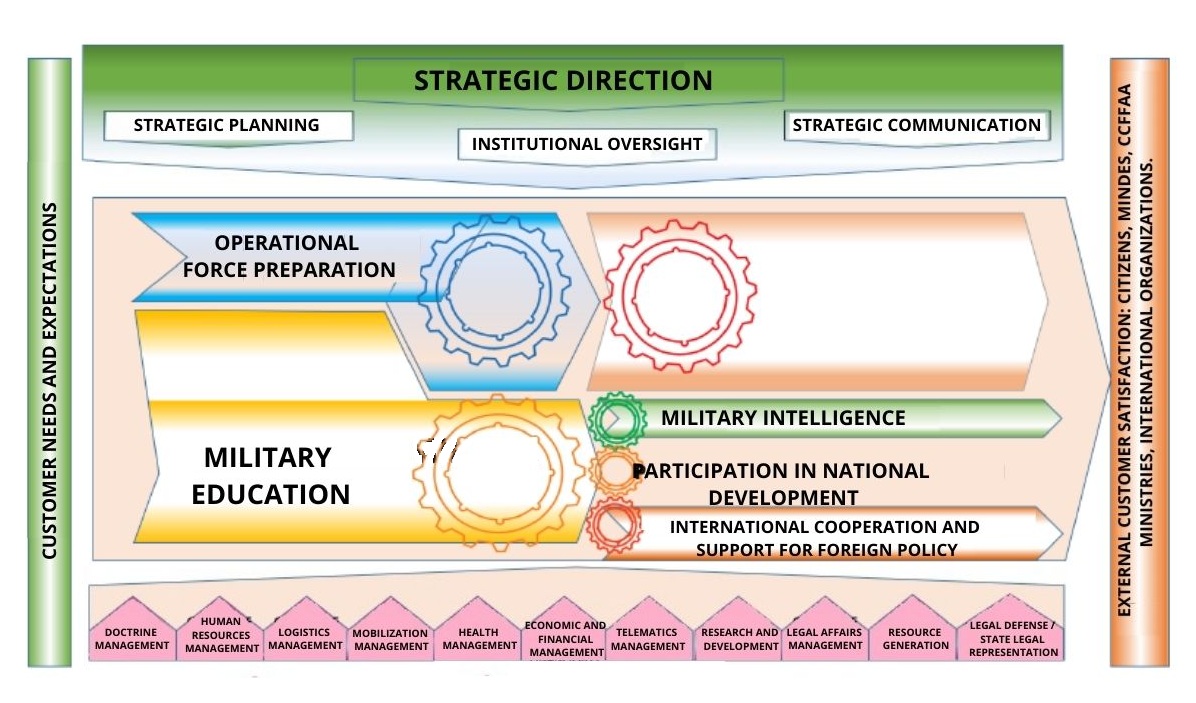
In line with this regulatory framework, the Peruvian Army, aligned with the PNMGP to 2021 and specifically with the third pillar referring to process-based management, developed, through DIPLANE, its Process Map, version 1, approved on May 25, 2016. This instrument adopted a process-based approach, covering all institutional departments and units (DIPLANE, 2016).
The Process Map, version 1, presented a general organizational structure in which strategic, mission, and support processes were identified, facilitating their understanding at different hierarchical levels for their execution and control. Likewise, the document incorporated indicators designed to measure performance and quality in each process, constituting an essential element for continuous improvement (DIPLANE, 2016).
Regarding mission processes, these are related to the fundamental mission of the Peruvian Army, in accordance with Articles 165 and 171 of the Political Constitution of Peru, and include force preparation, military operations and actions, military training, intelligence, support for national development, and international cooperation. The strategic processes focus on leadership, planning, control, and strategic communication. Finally, support processes sustain the functioning of mission processes and include the management of human resources, logistical resources, mobilization, health, doctrine, financial resources, and telematics, and research and development. (DIPLANE, 2016).
Figure 1 presents the structural representation of the institutional processes identified in the first version of the map.
Figure 1. Process Map of the Peruvian Army – Version 1
Source: DIPLANE (2016).
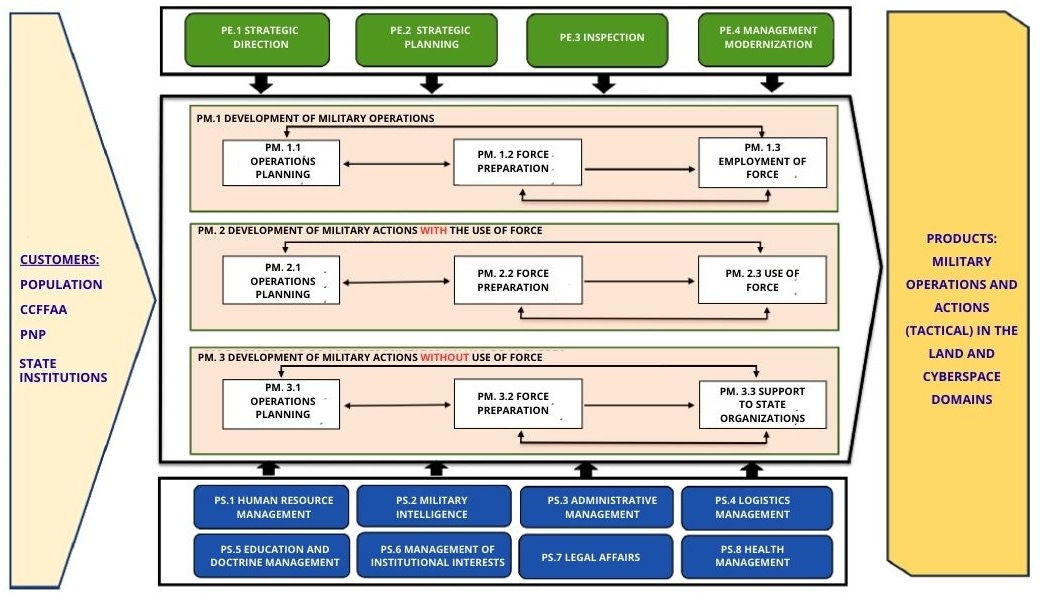
Within the framework of continuous improvement, Army General Command Resolution No. 797-CGE/DIPLANE, dated December 15, 2022, approved the Army Process Map – Version 2. In its development, among other references, the guidelines established in Legislative Decree No. 1142, the Framework Law for the Modernization of the Armed Forces, were considered. This regulation establishes that the modernization of the Armed Forces is integrated into the transformation process of the Peruvian State, with the objective of achieving optimal levels of efficiency and effectiveness both in institutional management and in the operational domain (DIPLANE, 2022).
This new version defines strategic, mission, and support processes corresponding to levels 0 and 1 of the Peruvian Army, aimed at delivering quality services through the optimization of allocated resources for the benefit of internal and external users. The document encompasses all institutional dependencies and presents significant changes compared to the previous version due to the methodology used in its formulation (DIPLANE, 2022).
Figure 2 shows the updated structure of the institutional processes in accordance with the new methodology adopted.
Figure 2. Process Map of the Peruvian Army – Version 2
Source: DIPLANE, 2022.
In relation to the object of study, the Service Brigades or Major Service Units (GUS) have the mission of providing logistical and personnel support to the Army of Operations (JDOCE, 2016). However, their organizational structure maintains a functional approach characterized by specialized and hierarchical areas. Although this model defines responsibilities, it generates fragmentation in management, limits the cross-functional integration of processes, and reduces the capacity to respond to the demands of internal and external users, which may affect operational performance and the quality of the services provided by these units.
Process-based management constitutes a key approach for strengthening institutional performance in the public sector. At the international level, several studies highlight its impact on improving efficiency and service quality. Quintanilla (2017) argues that modern public management has become a doctrinal reference for the Colombian State by enabling the design and implementation of strategies aimed at measuring performance and optimizing administrative efficiency, reinforcing the premise that a process-based approach not only improves internal management but also influences the quality of the services provided.
Complementarily, Guanín and Andrango (2015) proposed a process-based management model applied to the emergency service of General Hospital No. 1 in Quito, with the aim of optimizing the structure and performance of its internal processes. The authors concluded that its implementation increased operational effectiveness and efficiency, strengthened internal control mechanisms, and improved the use of available resources. In addition, it facilitated the work of human talent through management support instruments.
Similarly, the transition from bureaucratic models to process-oriented approaches constitutes a necessary condition for modernizing public management. Carrasco (2011) noted that BancoEstado of Chile exhibited characteristics typical of a bureaucratic and inefficient system, highlighting the need to transform its administrative performance. Consequently, the author proposed transitioning toward a process-based approach focused on generating added value and consolidating new organizational practices, emphasizing the importance of strengthening institutional control, organizational commitment, and cultural change management.
At the national level, process-based management has become a strategic tool for improving organizational performance and service quality in public institutions. Andaluz (2020) highlighted the need to implement this approach in the dependencies of the Peruvian Army in order to strengthen administrative efficiency and ensure the achievement of its institutional objectives. Likewise, García and Ledesma (2019) determined that process-based management significantly influences the quality of service in the company Servicios Generales y Turismo Milagritos SAC, demonstrating a statistically significant relationship at the 5% level.
At the ministerial level, Aranda et al. (2018) identified within the Ministry of Agrarian Development and Irrigation (MIDAGRI) a functional structure characterized by duplication of functions and coordination limitations, proposing process-based management as a strategy to improve institutional articulation. In line with this, Carranza et al. (2016) indicated that the regulations issued by the Public Management Secretariat, the Ministry of Education (MINEDU), and the Ministry of Defense (MINDEF) establish the application of this approach in academic centers of the Armed Forces. In turn, Calderón (2016) concluded that its implementation is viable in public institutions provided that processes are correctly identified and represented through a process map.
On the other hand, Alonso (2021) conducted a study in a Service Brigade of the Peruvian Army stationed in the Iquitos garrison, showing that the implementation of process-based management is significantly associated with higher levels of service quality. Through a quantitative design, the study determined a positive relationship between process-based management and the satisfaction of internal and external users, highlighting the relevance of this approach for a more efficient and results-oriented administration.
The research was based on the theory of William Edwards Deming, a renowned pioneer of total quality management. His proposal is based on fourteen principles applicable to any organization and aimed at generating sustainable benefits for shareholders, employees, customers, society, and the environment. Deming emphasizes the need for a shared purpose and continuous improvement in order to ensure sustainable long-term results (De la Torre Tejada, 2005).
Similarly, the service quality model of Christian Grönroos (1988) was considered. As a representative of the Nordic School, he argues that quality is perceived subjectively and depends both on the outcome of the service (technical quality) and on the process through which it is delivered (functional quality), in accordance with user expectations.
In this context, the research aimed to determine the relationship between process-based management and service quality in the GUS of the Peruvian Army. The study proposed the hypothesis that a direct and significant relationship exists between these variables, and the results constitute a relevant technical input for decision-making aimed at institutional modernization, with the purpose of strengthening service quality and contributing to the fulfillment of the mission assigned to these units.
Process-Based Management
Process-based management primarily aims to increase organizational productivity through efficiency and the generation of value for users (Bravo, 2011). From a systemic perspective, this approach allows organizations to control key management variables such as time, quality, and cost, while integrating factors such as organizational change, social responsibility, risk analysis, and the articulation between strategy, people, processes, structure, and technology (Bravo, 2009). Despite its benefits, its implementation often faces resistance due to the deeply rooted functional and vertical structures that have historically characterized many organizations (Medina et al., 2019).
Mallar (2010) argues that process-based management constitutes an organizational model oriented toward horizontal and interrelated structures, in contrast to the traditional vertical organization. From this perspective, González et al. (2019) emphasize that organizations must dynamically adapt to environmental changes, which justifies the adoption of process-based management with a results-oriented approach and strong institutional leadership.
In the public sector, the Presidency of the Council of Ministers (PCM), through Supreme Decree No. 004-2013-PCM, promotes the implementation of process-based management, complemented by administrative simplification, with the aim of improving the quality of services provided to the population. Likewise, the Secretariat of Public Management (SGP/PCM 2014, 2018) argues that this approach overcomes the traditional functional and hierarchical perspective by promoting a modern administration oriented toward results, the provision of quality goods and services, and citizen satisfaction.
From a conceptual perspective, process-based management proposes a comprehensive view of the organization in which processes cut across all functions and are structured into macroprocesses, processes, activities, and tasks, transforming inputs into products or services with added value (Quintero & Sánchez, 2006). This approach facilitates the alignment of the results of each process with the organization’s strategic objectives (UC, 2016).
In operational terms, process-oriented management is not limited to the development of maps or diagrams; rather, it implies a strategic and cultural transformation that requires leadership, staff participation, and continuous managerial oversight. Its implementation includes phases such as process identification, the development of the corresponding process map, detailed description, measurement, monitoring, and continuous improvement, thereby contributing to greater organizational efficiency, effectiveness, and sustainability (Mallar, 2010; UC, 2016).
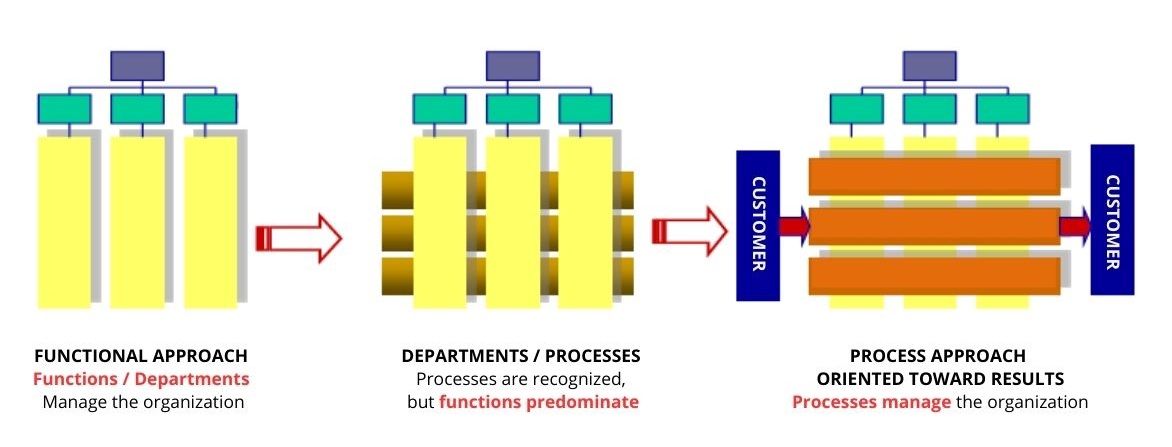
Figure 3 illustrates the transition from a vertical functional model to a horizontal process-based approach focused on achieving results
Figure 3. From the Traditional Functional Approach to a Results-Oriented Process Approach
Source: Public Management Secretariat.
Service Quality
Dessler (2009) distinguishes the concept of service quality by noting that quality represents the level of efficiency with which an organization seeks to satisfy its users, whereas service comprises the set of activities that accompany the provision itself. From this perspective, Brady and Cronin (2001) argue that service quality is evaluated by the customer based on three dimensions: functional quality (interaction between employee and user, attitude, and behavior), service environment (physical and environmental conditions), and technical quality (the final outcome of the service).
For González and Aranda (2022), service constitutes the central axis of organizational management due to its direct impact on user satisfaction. In the same vein, Rojas-Martínez et al. (2020) indicate that organizations must assume service quality as a permanent institutional commitment, linking it to productivity, competitiveness, and effectiveness.
From a historical perspective, Larrea (1991) argues that quality should not be inspected but rather produced, promoting continuous improvement programs instead of relying solely on limited final control. Based on this approach, Fontalvo et al. (2020) emphasize the importance of measuring quality through indicators that make it possible to evaluate service performance.
Grönroos (1994) states that quality is perceived by comparing the expected service with the perceived service, distinguishing between technical quality (“what is delivered”) and functional quality (“how it is delivered”). In the field of public management, the Secretariat of Public Management (SGP/PCM 2014) defines service as the result of a process aimed at satisfying citizens’ needs, while Dulanto (2019) conceptualizes it as a direct or indirect activity intended to generate satisfaction without necessarily producing a tangible good.
From an integrative perspective, service quality is related to the institutional capacity to respond to the needs of users, who demand reliable, accessible, timely, and efficient services.
Method
The study was conducted under a quantitative approach, based on the hypothetical-deductive method, aimed at testing the hypothesis regarding the relationship between process-based management and service quality in the GUS of the Peruvian Army. The research was basic in nature, with a correlational scope and a non-experimental cross-sectional design, since the variables were observed in their natural context without direct manipulation.
The population consisted of 50 military personnel, including officers, technical personnel, and non-commissioned officers, constituting a population census. Data collection was carried out using a semi-structured questionnaire with a five-point Likert scale (1 = Very low; 5 = Very high), designed to measure both variables.
For data analysis, descriptive statistics were used, specifically frequencies and cross-tabulations, as well as inferential statistics. Hypothesis testing was performed using the Spearman’s Rho correlation coefficient, considering a significance level of 0.05.
Statistical processing was conducted using IBM SPSS software. Data collection was carried out in 2021, at a single point in time, which confirms the cross-sectional nature of the study.
Results
Table 1 presents the cross-distribution of respondents according to the levels of process-based management and service quality, allowing the identification of the trend of association between both variables.
Table 1
Distribution of respondents according to the level of process-based management and service quality
| Service Quality | Total | |||||
| Low | Moderate | High | ||||
| Process-Based
Management |
Low | Count | 11 | 4 | 2 | 17 |
| % of total | 22.0% | 8.0% | 4.0% | 34.0% | ||
| Moderate | Count | 3 | 7 | 7 | 17 | |
| % of total | 6.0% | 14.0% | 14.0% | 34.0% | ||
| High | Count | 2 | 3 | 11 | 16 | |
| % of total | 4.0% | 6.0% | 22.0% | 32.0% | ||
| Total | Count | 16 | 14 | 20 | 50 | |
| % of total | 32.0% | 28.0% | 40.0% | 100.0% | ||
Source: Adapted from Alonso (2021).
According to the results, 22% of the total respondents are simultaneously located at the high level of process-based management and the high level of service quality. Similarly, 22% are concentrated at the low level of both variables. These findings reveal a trend of direct correspondence between the levels of process-based management and service quality, suggesting a positive association between both variables in the GUS.
Inferential Analysis
General Hypothesis
H₀: There is no significant relationship between process-based management and service quality in the Major Service Units of the Army.
H₁: There is a significant relationship between process-based management and service quality in the Major Service Units of the Army.
Table 2 presents the results of the Spearman’s Rho correlation test.
Table 2
Results of the Spearman’s Rho correlation between process-based management and service quality
| Process-Based Management | Service Quality | |||
| Spearman’s Rho | Process-based Management | Correlation coefficient | 1.000 | 0.528** |
| Sig. (2-tailed) | 0.000 | |||
| N | 50 | 50 | ||
| Service Quality | Correlation coefficient | 1.000** | 1.000 | |
| Sig. (2-tailed) | 0.000 | |||
| N | 50 | 50 | ||
Note: The correlation is significant at the 0.01 level (two-tailed).
Source: Adapted from Alonso.
The inferential analysis shows a positive correlation of moderate magnitude between process-based management and service quality (ρ = 0.528). The significance value obtained was p = 0.000, which is lower than the established level of 0.05, allowing the rejection of the null hypothesis and the acceptance of the alternative hypothesis. Therefore, it is concluded that there is a statistically significant relationship between both variables in the GUS of the Peruvian Army.
Discussion
The results obtained show that process-based management is statistically significantly associated with service quality in the GUS of the Peruvian Army, confirming the relevance of the systemic approach in public organizations of a military nature. This finding supports the postulates of William Edwards Deming regarding continuous improvement as a foundation of organizational performance, and it is particularly relevant in traditionally hierarchical and functional structures, where the fragmentation of responsibilities may limit operational efficiency.
Compared with studies conducted in civilian institutions, the implementation of process-based management in the military context faces additional challenges, including vertical organizational culture, regulatory rigidity, and the predominance of a functional approach. Under this consideration, the results suggest that the transition toward a process-based model requires not only a technical restructuring, but also a cultural transformation oriented toward cross-functional integration and the generation of institutional value.
The findings are consistent with Zamora (2017), who identifies process-based management as a strategy aimed at achieving improved institutional results. Similarly, Flores and Núñez (2021) emphasize that this organizational model promotes staff participation and directs management toward users, thereby strengthening institutional performance. In the same sense, empirical evidence supports Bravo (2009) by demonstrating that a systemic process-based vision contributes to increased productivity and to the control of key variables such as time, quality, and costs.
With regard to service quality, the results align with the approach proposed by Christian Grönroos, who argues that it depends on the organizational capacity to adequately and timely meet user expectations. In the field of public management, this implies directing processes toward the achievement of measurable results, aligned with institutional objectives and the real needs of society.
From a strategic perspective, service quality constitutes a determining factor in organizational performance and institutional sustainability. Consequently, organizations seeking to strengthen their positioning must optimize their internal processes and consolidate relationships of trust with users through the provision of efficient and reliable services.
The results coincide with the conclusions of Calderón (2016), who highlights the need to implement process-based management in public entities, particularly those oriented toward service provision. In the same line of argument, Carranza et al. (2016) maintain that the current regulatory framework promotes the adoption of this approach in institutions within the defense sector. However, Flores and Núñez (2021) warn that, despite its regulatory recognition, process-based management still faces limitations in its application, mainly associated with the limited knowledge and experience of personnel, which restricts its impact on the improvement of institutional management.
In contrast to previous studies conducted in civilian or academic contexts, the present study provides empirical evidence from an operational military organization, characterized by a strictly hierarchical and normative structure. From this perspective, the results expand the scope of the literature on process-based management by demonstrating that this approach is applicable and relevant even in institutions traditionally organized under functional models, such as the GUS of the Peruvian Army.
Conclusions
The results of the inferential analysis demonstrate the existence of a direct, positive, and statistically significant relationship between process-based management and service quality in the Major Service Units of the Peruvian Army (GUS of the Peruvian Army) (ρ = 0.528; p < 0.05). Empirically, a higher level of implementation of the process-based approach is associated with better perceived levels of service quality, confirming the proposed hypothesis and validating the correlational scope of the study.
The adoption of process-oriented management is associated with the strengthening of essential service dimensions, such as the availability of tangible resources, reliability in service delivery, responsiveness to requests and contingencies, as well as the generation of trust among internal and external users. These factors are closely related to the perception of service quality and organizational performance, reaffirming the relevance of this approach in institutional contexts of a military nature.
The incorporation of tools such as the Process Map (MAPRO) facilitates the identification, articulation, and control of institutional procedures, promoting the gradual transition from a traditional functional model toward a results-oriented administration aligned with the National Policy for the Modernization of Public Management (PNMGP). In the defense sector, this approach emerges as a strategic mechanism for consolidating organizational efficiency and strengthening institutional governance.
From a strategic perspective, the findings expand the available empirical evidence on process-based management in operational military organizations, which are traditionally structured under hierarchical and functional schemes. Consequently, the study provides technical support for administrative modernization in the logistical units of the Peruvian Army, in accordance with the current regulatory framework.
Future research could develop comparative studies among different military units, conduct longitudinal analyses to evaluate the evolution of the model over time, and the incorporation of mediating variables—such as organizational culture, strategic leadership, or personnel training—in order to deepen understanding of the identified relationship and strengthen the scientific basis for institutional decision-making.
Endnotes
- Roberto Carlos Alonso, Implementación de la gestión por procesos en la 5a Brigada de Servicios del Ejército del Perú para la mejora de la calidad del servicio (Tesis de maestría, Universidad Continental, 2021), https://hdl.handle.net/20.500.12394/9972.
- César Andaluz Salaverry, Mejoramiento del proceso de gestión de la munición en el Ejército del Perú (Tesis de maestría, Universidad del Pacífico, 2020), https://repositorio.up.edu.pe/handle/11354/16.
- Merly Fiorela Aranda Silva, Luis Ordoñez Guzmán y Carola Gabriela Peralta Carrera, La gestión por procesos como medio para mejorar la eficacia en el cumplimiento de objetivos institucionales del MINAGRI (Tesis de maestría, Universidad del Pacífico, 2018), https://repositorio.up.edu.pe/item/64b56193-26f9-4e8d-8e53-0da4d5be0e09.
- M. K. Brady y J. M. Cronin Jr., “Some New Thoughts on Conceptualizing Perceived-Service Quality: A Hierarchical Approach”, Journal of Marketing 65, no. 3 (2001): 34–49, https://doi.org/10.1509/jmkg.65.3.34.18334.
- César Bravo, Gestión de procesos (con responsabilidad social): Desde la mejora hasta el rediseño (Santiago: Evolución, 2009).
- César Bravo, Gestión de procesos, 4.ª ed. (Santiago: Evolución, 2011).
- Gilmer Iván Calderón Montoya, Estudio exploratorio: Rediseño de la estructura orgánica del Ministerio de Salud aplicando gestión por procesos (Tesis de maestría, Universidad del Pacífico, 2016), https://repositorio.up.edu.pe/item/69ae0ab9-1bef-4219-a167-53eb3d82a2bf.
- Luis Carranza Vilahur, Juan Valverde Vírhuez y Jesús Vera Ipenza, Implementación de la gestión por procesos en la Escuela Militar de Chorrillos Coronel Francisco Bolognesi (EMCH CFB) (Tesis de maestría, Universidad del Pacífico, 2016), https://repositorio.up.edu.pe/item/c217feed-9f13-44c4-9744-1b59e4aa745f.
- F. Carrasco Zanoco, Estudio sobre implementación de gestión basada en procesos en BancoEstado (Tesis de maestría, Universidad de Chile, 2011), http://repositorio.uchile.cl/handle/2250/102690.
- Alberto De la Torre Tejada, “Calidad total como herramienta de gestión,” Cultura 19 (2005): 154–165.
- Gary Dessler, Administración de personal (México: Prentice-Hall, 2009).
- Dirección de Planeamiento del Ejército (DIPLANE), Mapa de procesos del Ejército del Perú – Versión 1 (Lima: Ejército del Perú, 2016).
- DIPLANE, Mapa de procesos del Ejército del Perú – Versión 2 (Lima: Ejército del Perú, 2022).
- Francisco Dulanto, Gestión administrativa y la calidad de servicio de la Municipalidad Distrital de Chancay, período 2018 (Tesis de pregrado, Universidad Nacional José Faustino Sánchez Carrión, 2019), https://repositorio.unjfsc.edu.pe/handle/20.500.14067/3192.
- Ejército del Perú, Directiva Nº 008-H1.c: Para la implementación de la gestión por procesos en el Ejército del Perú (Lima, 2016).
- Perú, Ley Nº 27658, Ley Marco de Modernización de la Gestión del Estado, 30 de enero de 2002, https://www2.congreso.gob.pe/sicr/cendocbib/con4_uibd.nsf/BCE7AB2E6434B55305257B890053B271/$FILE/02A08.pdf.
- Perú, Decreto Supremo Nº 004-2013-PCM, Política Nacional de Modernización de la Gestión Pública, 9 de enero de 2013, https://www.minsa.gob.pe/presupuestales/doc2021/Normas/Decreto-Supremo_004-2013-PCM.pdf.
- Rodrigo Faúndez Vergara, ¿Democratizar la gestión pública? Factores institucionales claves para impulsar la participación ciudadana en la gestión pública en Chile (Tesis de maestría, Universidad de Chile, 2018), http://repositorio.uchile.cl/handle/2250/167761.
- Sergio Flores y Luis Núñez, “Gestión por procesos en el marco de la modernización de la gestión pública,” Revista de Investigación Científica y Tecnología Alpha Centauri 2, no. 3 (2021): 140–164, https://doi.org/10.47422/ac.v2i3.54.
- T. Fontalvo, E. De la Hoz-Domínguez y D. Hoz, “Método de evaluación de la calidad del servicio en una empresa de agua”, Información Tecnológica 31, no. 4 (2020): 27–34, https://doi.org/10.4067/S0718-07642020000400027
- Pedro García y Giordano Ledesma, Gestión por procesos y su influencia en la calidad de servicio de la empresa Servicios Generales y Turismo Milagritos S.A.C. (Tesis de pregrado, Universidad Privada Antenor Orrego, 2019), http://repositorio.upao.edu.pe/bitstream/upaorep/5653/1/RE_ADMI_JHOSELYN.GARC%C3%8DA_GIORDANO.LEDESMA_GESTI%C3%93N.POR.PROCESOS_DATOS.PDF.
- Presidencia del Consejo de Ministros (PCM), Política Nacional de Modernización de la Gestión Pública al 2030 (Lima: PCM, 2023), https://www.gob.pe/32166-politica-nacional-de-modernizacion-de-gestion-publica-a-2030.
- Gonzalo A. González, Luis Leal, David Martínez y Daniel Morales, “Herramientas para la gestión por procesos”, Cuadernos Latinoamericanos de Administración 15, no. 28 (2019): 1–14, https://doi.org/10.18270/cuaderlam.v15i28.2681.
- Gonzalo González y Manuel Aranda, “Concepto de servicio de calidad en la gestión hotelera”, Revista Venezolana de Gerencia 27, no. 97 (2022): 212–230, https://doi.org/10.52080/rvgluz.27.97.15.
- Christian Grönroos, “A Service Quality Model and Its Marketing Implications”, European Journal of Marketing 18, no. 4 (1984): 36–44, https://doi.org/10.1108/EUM0000000004784.
- Christian Grönroos, “Service Quality: The Six Criteria of Good Perceived Service”, Review of Business 9, no. 3 (1988): 10–13.
- Christian Grönroos, Marketing y gestión de servicios (Madrid: Díaz de Santos, 1994).
- Miguel Guanín y Carlos Andrango, Propuesta de un modelo de gestión por procesos en la atención de enfermería en el servicio de emergencias del Hospital Militar (Tesis de maestría, Escuela Politécnica Nacional, 2015), https://bibdigital.epn.edu.ec/bitstream/15000/10592/1/CD-6270.pdf.
- Roberto Hernández Sampieri, Carlos Fernández Collado y Pilar Baptista Lucio, Metodología de la investigación, 6.ª ed. (México: McGraw-Hill, 2014).
- Jefatura del Departamento de Operaciones del Ejército (JDOCE), Brigada de Servicios ME1-410 (Lima: Ejército del Perú, 2016).
- Pablo Larrea, Calidad de servicio: Del marketing a la estrategia (Madrid: Díaz de Santos, 1991).
- Perú, Ley Nº 27658.
- Miguel Mallar, “La gestión por procesos: Un enfoque de gestión eficiente”, Visión de Futuro 13, no. 1 (2010), https://www.redalyc.org/pdf/3579/357935475004.pdf.
- Luis A. Medina, Rafael D. Nogueira, Alejandro Hernández-Nariño y Ricardo R. Comas, “Procedimiento para la gestión por procesos”, Ingeniare. Revista Chilena de Ingeniería 27, no. 2 (2019): 328–342, https://www.scielo.cl/scielo.php?pid=S0718-33052019000200328&script=sci_arttext.
- Henry Mintzberg, La estructuración de las organizaciones (Madrid: Ariel, 1995).
- Héctor Murillo, “La investigación científica”, documento en línea, 2009, http://docencia.fca.unam.mx/~mvazquez/archivos/WebquestTMCSIcientifica.pdf.
- G. Navarro, Gestión por procesos y su relación con la calidad de servicio en el área de obstetricia del centro de salud del distrito de Andahuaylas, 2016 (Tesis de pregrado, Universidad Nacional José María Arguedas, 2017), http://repositorio.unajma.edu.pe/handle/123456789/306.
- Juan A. Pérez Fernández de Velazco, Gestión por procesos (Madrid: ESIC, 2010).
- Presidencia del Consejo de Ministros, Metodología para la implementación de la gestión por procesos en las entidades de la administración pública (Lima: El Peruano, 2013), https://sgp.pcm.gob.pe/wp-content/uploads/2015/06/DS-004-2013-PCM-Aprueba-la-PNMGP.pdf.
- Diego A. Quintanilla Ortiz, La reforma de la gestión pública en Colombia: Una aproximación a los procesos de rendición de cuentas y análisis de los indicadores de eficiencia del gasto público propuestos (Tesis de maestría, Universidad Nacional de Colombia, 2017), http://www.bdigital.unal.edu.co/57241/7/diegoalexanderquintanillaortiz.2017.pdf.
- Juan Quintero y José Sánchez, “La cadena de valor: Una herramienta del pensamiento estratégico”, Telos 8, no. 3 (2006): 377–389, https://www.redalyc.org/articulo.oa?id=99318788001.
- C. Rojas-Martínez, W. Niebles-Nuñez, C. Pacheco-Ruíz y H. Hernández-Palma, “Calidad de servicio como elemento clave de la responsabilidad social en pequeñas y medianas empresas”, Información Tecnológica 32, no. 4 (2020): 221–232, https://doi.org/10.4067/S0718-07642020000400221.
- Secretaría de Gestión Pública, Norma técnica para la implementación de la gestión por procesos en las entidades de la administración pública (Lima: PCM, 2018), https://sgp.pcm.gob.pe/wp-content/uploads/2015/03/RSGP-N-006-2018-PCM-SGP.pdf.
- Secretaría de Gestión Pública de la Presidencia del Consejo de Ministros (SGP/PCM), Metodología para la implementación de la gestión por procesos en las entidades de la administración pública en el marco del D.S. Nº 004-2013-PCM (Lima: El Peruano, 2014), https://sgp.pcm.gob.pe/wp-content/uploads/2015/03/Metodologia_de_GxP.pdf.
- Universidad de Cantabria, Manual de gestión por procesos (Santander, 2016).
- Beatriz X. Vargas, ¿Cómo hacer investigación cualitativa? (México: ETXETA, 2011).
- María Zamora, Teoría de la gestión por procesos: Un análisis del Centro de Fórmulas Lácteas del Hospital Sor María Ludovica (Tesis de maestría, Universidad Nacional de La Plata, 2017).