
Abstract
This article analyzes the implications of hybrid threats and cognitive warfare for Peru’s National Security, with the aim of identifying the main strategic vulnerabilities affecting the stability, governance, and state leadership capacity. The research employed a qualitative, analytical, and documentary approach based on a review of specialized literature and doctrine on hybrid threats, cognitive warfare, National Security, and strategy. The analysis confirms that contemporary transformations in conflict do not alter its political nature, but rather the instruments used to influence the will, legitimacy, and capacity of States to act. In the Peruvian case, the convergence of social unrest, illicit economies, disinformation, narrative manipulation, impacts on strategic infrastructure and corridors, and institutional weaknesses creates a scenario of high strategic vulnerability for National Security. As its main contribution, the study proposes an analytical framework that integrates political, social, economic, territorial, informational, and cognitive variables to support the interpretation of contemporary conflict scenarios from a systemic perspective. The study concludes that strengthening strategic anticipation, intelligence, interinstitutional interoperability, the protection of infrastructure and essential functions, as well as cognitive resilience, is fundamental to increasing the State’s adaptive capacity in hybrid scenarios and preserving democratic governance.
Keywords: hybrid threats; cognitive warfare; national security; strategic vulnerability; strategic anticipation; cognitive resilience; strategic leadership
Introduction
Conflict dynamics in the twenty-first century reveal a gradual transformation in the threats faced by States. Unlike traditional scenarios, characterized by clearly identifiable hierarchical structures and predominantly military or territorial objectives, these dynamics take more ambiguous, dispersed, and multidimensional forms. This evolution has changed the instruments employed, the arenas of competition, and the mechanisms through which such threats can affect institutions, political stability, and social cohesion.1
New forms of confrontation develop simultaneously across the physical, digital, informational, and cognitive domains through a combination of political, social, technological, and communication instruments that increase the complexity of the strategic environment. This reduces the explanatory power of classical analytical categories when confronted with phenomena characterized by fragmentation, decentralization, and a high degree of adaptability.2
A gradual weakening of traditional mechanisms for the mediation of power can be observed, as political parties, social organizations, and other institutional spaces have seen their ability to channel demands, process conflicts, and build consensus diminish. As a result, social mobilization tends to reorganize through more horizontal and distributed structures, supported by digital environments capable of accelerating narrative construction and the coordination of collective action.3
At the same time, rapid technological development and the expansion of digital ecosystems have increased the strategic value of narratives and information management in crisis contexts. The speed at which information circulates and the competition for control of the information environment have turned this domain into one of the main arenas of contemporary confrontation. In many cases, the construction of perceptions can produce political and social effects greater than those of certain material actions by shaping decision-making and progressively eroding institutional trust.4
In addition, decentralized forms of action have emerged whose lack of visible leadership structures makes it difficult to apply responses based exclusively on conventional security approaches. This condition increases the complexity of conflict and requires the State to understand the interaction among multiple factors in order to anticipate risk scenarios and guide strategic responses.5
Under these conditions, governance can deteriorate without the need for conventional military confrontation, through persistent mechanisms of political, psychological, and informational pressure. In the Peruvian case, the convergence of political, social, informational, and illicit-economy dynamics creates a context of high strategic vulnerability capable of affecting institutional legitimacy, political stability, and the continuity of the State’s essential functions.6
Against this backdrop, the present study is based on an analysis of specialized literature and doctrine, complemented by the author’s professional experience in operations conducted in environments affected by illicit economies, social unrest, and threats to National Security. This makes it possible to contrast theoretical approaches with operational realities observed in different regions of the country. On this basis, the article examines the main manifestations of hybrid conflict and cognitive warfare in the Peruvian environment, identifying the strategic vulnerabilities they generate for the State and its governance.
To this end, the article proposes an integrative analytical framework for interpreting hybrid conflict scenarios in Peru by bringing together political, social, informational, territorial, and institutional variables from a National Security perspective. This framework seeks to facilitate understanding of the State’s strategic vulnerabilities and provide criteria for analyzing the requirements for doctrinal and operational adaptation in response to contemporary threats.
The Transformation of Conflict in the Contemporary Strategic Environment
From Conventional Conflict to Multidimensional Confrontation
For much of the twentieth century, conventional warfare was associated with the mass employment of organized military forces, territorial control, and direct engagements between clearly identified regular forces. However, current conflicts reveal multidimensional forms of confrontation in which military and non-military instruments converge.7
In this context, concepts such as hybrid warfare, cognitive warfare, and information warfare are becoming increasingly relevant for interpreting transformations in contemporary conflict. Hybrid threats have been described as combining conventional capabilities, irregular tactics, and non-military tools, making it difficult to distinguish between peace, crisis, and open conflict.8
Under this logic, state and non-state actors resort to disinformation, economic coercion, political pressure, operations in cyberspace, social mobilization, and psychological operations to generate institutional attrition, affect governance, and influence State decision-making processes beyond the direct use of military force.9
Contemporary strategic competition incorporates the cognitive domain as an arena in which influence over perceptions, emotions, and decision-making processes acquires a value comparable to that of other instruments of power.⁴ In this context, the narrative ceases to serve merely a complementary function and becomes an active instrument of strategic influence.
Processes of digital radicalization, information polarization, and emotional manipulation increase the ability of certain actors to exploit social crises or politically sensitive tensions. Various studies by the North Atlantic Treaty Organization (NATO) on cognitive warfare argue that contemporary strategic competition is progressively shifting toward psychological and cognitive dimensions aimed at influencing perception, behavior, and societal decision-making processes.1011
Accordingly, contemporary confrontation cannot be interpreted exclusively through conventional military parameters, but rather as a multidimensional process of pressure and attrition that requires political, social, technological, cognitive, and informational variables to be integrated into National Security strategic analysis.
Institutional Attrition as a Strategic Objective
In hybrid confrontation scenarios, disrupting the continuity of the State’s essential functions constitutes one of the main strategic objectives. Unlike conventional warfare, whose central instrument is the use of military force, hybrid threats seek to erode state authority, institutional legitimacy, and political leadership capacity. In this regard, it has been argued that contemporary strategic competition retains the political purpose described by Clausewitz, while incorporating non-military instruments capable of producing strategic effects on the stability and functioning of the State.12
These dynamics often manifest through political, social, economic, and psychological actions aimed at saturating institutional response mechanisms. As a result, the paralysis of strategic activities, the interruption of essential services, or the simultaneous generation of multiple pressure points can produce instability scenarios even without direct military confrontation.13
Social fragmentation and the erosion of institutional trust increase the State’s internal vulnerabilities, particularly in contexts of political polarization, institutional weakness, and expanding illicit economies. Under these conditions, perceptions of improvisation, loss of control, or governmental incapacity can accelerate the deterioration of governance by weakening public confidence in the State’s ability to respond effectively to crisis scenarios.14
Thus, contemporary strategic competition has partially shifted its center of gravity from the predominance of military force toward the preservation of institutional legitimacy, continuity of the State’s essential functions, and effective control of strategic spaces.
The Continued Relevance of Clausewitzian Logic in Contemporary Conflicts
Clausewitz argued that war is an instrument subordinated to political ends and that its use responds to objectives defined by political leadership. Although the means of confrontation have diversified as a result of changes in today’s strategic environment, this premise remains fully relevant.1516
In different contemporary settings, confrontation does not develop exclusively through conventional armed operations, but also incorporates political, psychological, economic, informational, and narrative instruments intended to influence perceptions and condition State decisions.17
It has been argued that this transformation does not replace traditional forms of warfare, but rather adds complementary modes of confrontation that increase the complexity of the contemporary strategic environment. From this perspective, contemporary confrontation tends to take the form of a persistent process of pressure and attrition, in which institutional erosion can produce strategic effects as decisive as those resulting from conventional military confrontation.18
Within this framework, political, narrative, and informational competition constitutes a contemporary expression of Clausewitzian logic insofar as it employs non-conventional instruments to achieve political objectives without relying exclusively on the direct use of military force.
Dispersed Molecular Revolution and Fragmented Conflict
Conceptual Approach
The concept of Dispersed Molecular Revolution (RMD) has gained increasing relevance in debates on new forms of social unrest and decentralized mobilization. Nevertheless, its use remains subject to academic debate due to the lack of doctrinal consensus regarding its conceptual scope and theoretical validity in strategic and security studies.19
Analytically, the concept seeks to describe scenarios characterized by fragmented actions, the absence of visible hierarchical leadership, and multiple centers of political, social, and communication pressure. This configuration makes it difficult to identify traditional mechanisms of leadership, since collective actions are often coordinated through flexible communication and interaction networks in social and digital spaces.20
Its application requires a critical and methodologically rigorous approach capable of distinguishing useful analytical categories from ideological or overly general interpretations. Therefore, this category alone cannot establish the origin, nature, or degree of coordination of a protest or social mobilization; interpreting such phenomena requires a comprehensive assessment of the context and the convergence of multiple variables.
Beyond the conceptual controversies, the analytical value of this approach lies in facilitating the study of situations in which multiple forms of political, social, communication, and informational pressure converge, with effects that may affect State stability. The interaction among the physical, informational, and cognitive domains increases the complexity of contemporary conflicts, making it more difficult for States to respond to highly adaptable, decentralized dynamics and the rapid dissemination of content.21
To this end, the article proposes an analytical framework based on indicators that integrate political, social, territorial, economic, informational, and cognitive variables to support the systematic analysis of hybrid conflict scenarios in Peru. It incorporates RMD as a complementary category and does not, by itself, seek to establish causal relationships or provide an exhaustive explanation of the nature of the phenomena observed.
The proposed analytical framework guides the systematic interpretation of scenarios in which the convergence of multiple indicators may suggest dynamics of fragmented conflict requiring deeper examination from a National Security perspective. Table 1 presents the main observable indicators, their contribution to the analysis, and the importance of an integrated assessment in the Peruvian case.
Table 1. Analytical Indicators in Hybrid Conflict Scenarios
| Analytical indicator | Observable manifestation | Contribution to the analysis | Is it sufficient on its own? |
| Social mobilization | Marches, protests, or gatherings | Makes it possible to identify initial conflict processes. | No |
| Simultaneous blockade of strategic routes | Coordinated interruption of logistical corridors | Makes it possible to assess disruption of critical functions. | No |
| Narrative synchronization | Slogans and messages disseminated concurrently | Provides evidence of possible communication coordination processes. | No |
| Disinformation | Mass circulation of false or manipulated content | Makes it possible to analyze pressures on the cognitive domain. | No |
| Illicit financing | Participation of illegal economies or irregular financial flows | Makes it possible to identify factors sustaining the conflict. | No |
| Localized violence | Selective attacks, vandalism, or intimidation | Assesses escalation of conflict. | No |
| International amplification | International coverage or transnational digital campaigns | Makes it possible to assess the strategic projection of the conflict. | No |
| Convergence of indicators | Joint assessment of the context | Provides a criterion for deepening the analysis. | Yes, only through integrated assessment. |
Source: Author’s own work.
The proposed framework makes it possible to interpret hybrid conflict scenarios through the integrated assessment of political, social, territorial, and economic indicators, as well as informational and cognitive dimensions. In this way, it provides a systematic criterion for examining the convergence of multiple factors, avoiding simplistic interpretations, and strengthening the strategic analysis of complex situations from a National Security perspective, without itself attributing causal relationships.
Main Characteristics of Fragmented Conflict
One of the main features of fragmented conflict is the absence of visible hierarchical structures and clearly identifiable leadership. Unlike traditional administrative, political, or military organizations, these dynamics are often characterized by multiple relatively autonomous centers of action capable of acting simultaneously without requiring centralized coordination. This configuration makes it difficult to identify decision-making centers and increases the complexity of strategic analysis; however, the mere absence of visible leadership is not sufficient evidence to infer the existence of a covert organization, as it may also occur in spontaneous processes of social mobilization.22
This configuration increases the complexity of the State’s response by making it more difficult to identify decision-making centers and leadership structures. Hybrid threats are said to reduce the effectiveness of responses designed to address traditional organizational structures by combining different mechanisms of pressure. Consequently, conventional approaches may prove insufficient when faced with more dispersed, adaptable, and changing dynamics.2324
Moreover, these forms of confrontation display high levels of tactical adaptability, particularly through intensive use of social networks and the rapid digital dissemination of content. This adaptability facilitates the continuous reconfiguration of collective actions in response to State measures, increasing operational complexity and reducing the State’s room for anticipation.2526
Another relevant element is the potential for institutional saturation resulting from simultaneous actions carried out in different domains. The coexistence of protests, blockades, digital campaigns, localized confrontations, and dispersed episodes of violence can create situations of high operational demand for the State by forcing it to distribute capabilities and resources across multiple fronts. However, the concurrence of these elements must be analyzed according to the specific context and available evidence, avoiding automatic causal inferences about their origin or degree of coordination.27
In this context, one of the main risks is to underestimate these dynamics doctrinally because of their apparent dispersion or lack of traditional leadership structures. Proper understanding requires a comprehensive, contextualized, and evidence-based analysis capable of distinguishing spontaneous mobilization processes from scenarios in which the convergence of indicators suggests patterns of coordination compatible with fragmented conflict dynamics.
Pressure Mechanisms
Fragmented conflict dynamics often manifest through simultaneous actions aimed at generating political, economic, social, and psychological impacts on the State. Their effectiveness lies in the convergence of their effects, intended to influence State functioning, amplify crisis scenarios, and condition decision-making.
Among the most recurrent mechanisms are blockades of strategic routes, logistical disruptions, and impacts on critical infrastructure, which can generate significant effects on transportation, supplies, trade, and other essential State functions, thereby increasing pressure on its response capacity. Prolonged disruption of strategic corridors can produce effects that extend beyond the local level and affect perceptions of institutional stability.28
Certain dynamics also incorporate actions with high symbolic impact, localized episodes of violence, and confrontational actions intended to maximize their strategic effects. Dissemination of these actions amplifies effects beyond their immediate material scope, increases pressure on the State’s response capacity, and conditions decision-making processes.2930
Digital platforms and accelerated content-distribution processes play an increasingly important role in amplifying conflict scenarios by facilitating the rapid spread of pressure mechanisms, expanding their reach, and increasing their impact across different areas of action.31
Under these conditions, fragmented and apparently isolated actions can generate strategic effects on the economy, governance, and institutional stability, especially when multiple pressure mechanisms converge across different areas of action.
Narrative Warfare, Perception, and Legitimacy
Strategic narrative has become one of the main instruments of competition in contemporary conflicts because of its ability to influence the construction of collective perceptions, strengthen or weaken the legitimacy of the actors involved, and shape the formation of public opinion. In this context, strategic communication plays an essential role in preserving institutional legitimacy and strengthening the State’s capacity to act during crises and conflict scenarios.
Highly emotional narratives constitute an increasingly relevant mechanism. Their effectiveness lies in their ability to influence the interpretation of events and, consequently, guide public decision-making processes.32
International media pressure and the rapid digital dissemination of highly sensitive events can directly influence the legitimacy of the State’s response. Under such circumstances, strategic public communication management becomes especially important for preserving institutional trust and strengthening the legitimacy of State action during crises.33
In certain scenarios, the State’s ability to preserve the legitimacy of its actions and guide the public narrative in a timely manner can condition the effectiveness of measures intended to restore order and effective territorial control. Strategic narrative management does not replace action on the ground, but it can strengthen its legitimacy and improve the effectiveness of the measures adopted. Table 2 presents an analytical typology of conflict scenarios and their risk levels, intended to facilitate systematic assessment of the different forms of pressure on the State and their possible effects on strategic vulnerability and governance.34
Table 2. Conflict Scenarios and Risk Levels
| Level | Characteristics | Risk |
| I. Legitimate social protest |
|
Low |
| II. Conflict with illicit infiltration |
|
Medium |
| III. Hybrid conflict |
|
High |
| IV. Complex hybrid scenario |
|
Critical |
Note. The proposed classification is an analytical tool. The levels described should be assessed in an integrated and contextual manner, in accordance with the available evidence.
Source: Author’s own work.
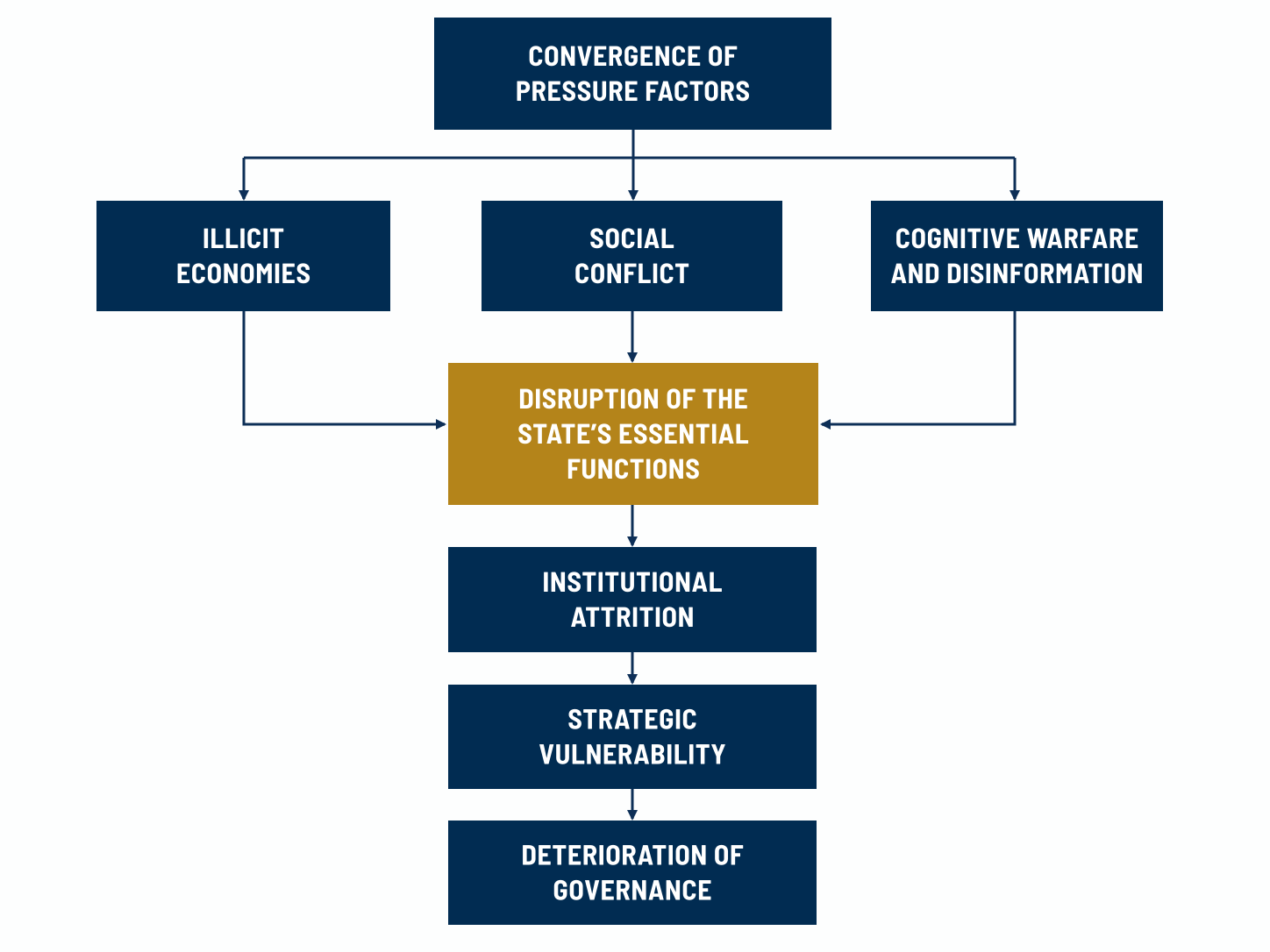
Hybrid conflict scenarios are characterized by the convergence of political, social, economic, informational, and cognitive factors whose interaction increases the State’s strategic vulnerability. On this basis, the present study proposes a convergence model that integrates the main relationships identified throughout the study and explains how this interaction can progressively affect the State’s response capacity and governance.
Figure 1 summarizes the proposed analytical model, showing how the interaction of political, social, economic, informational, and cognitive factors can progressively increase the State’s strategic vulnerability and undermine its ability to preserve governance. It does not represent a rigid or linear sequence, but rather an interpretive framework intended to facilitate the integrated analysis of hybrid conflict scenarios.
Figure 1. Convergence Model of Pressure Factors and the State’s Strategic Vulnerability
Source: Author’s own work.
Contemporary Conflict Scenarios and Strategic Vulnerability in Peru
Strategic Corridors and State Vulnerability
The growing complexity of contemporary conflict scenarios is particularly relevant in the Peruvian case because of the existence of strategic corridors and infrastructure whose functioning is essential to economic activity, logistical connectivity, and the country’s territorial integration. From a National Security perspective, their protection is a strategic priority. Under these conditions, the country’s high dependence on certain transportation routes, energy infrastructure, port nodes, and export corridors increases its exposure to prolonged disruptions or actions capable of affecting the continuity of the State’s essential functions.35
One of the most sensitive areas is the southern mining corridor, which serves as a logistical connectivity axis and supports national exports. Preserving these corridors is an essential component of National Security because of their impact on economic activity and the State’s response capacity. Sustained disruption of these routes can affect production, supplies, investment, and economic stability, with repercussions that extend beyond the local level and reach the national scale.36
Strategic ports, airports, and energy infrastructure are critical components for the continuity of national and international supply chains. Their protection is essential against hybrid threats because of the high degree of interdependence among the State’s strategic systems. Prolonged disruption of these assets can generate impacts that extend beyond the sectoral level and compromise their ability to function.3738
The extensive network of logistical corridors also increases the country’s exposure to territorial disruption actions capable of affecting mobility, supplies, and national connectivity. When such disruptions affect sectors linked to mining, energy, exports, or foreign trade, their effects can quickly extend beyond the local level and put the functioning of the State at risk on a national scale.39
Under these conditions, one of the main risks for Peru lies in the high strategic sensitivity of certain critical areas, whose prolonged paralysis could trigger political, economic, and social effects capable of undermining internal stability, national cohesion, and the State’s response capacity.
Illicit Economies and Radicalized Conflict
The expansion of illicit economies is one of the main factors contributing to the deterioration of security and governance in various regions of Peru. Illegal mining, drug trafficking, smuggling, and other forms of transnational organized crime have developed territorial expansion, financing, and coordination capabilities by exploiting structural weaknesses in the State and high levels of informality. The convergence of illicit economies and radicalization processes increases the complexity of the threats facing the Peruvian State, although this interaction must be analyzed contextually and supported by available evidence.40
In certain areas of the country, these illegal economies have consolidated local power structures capable of influencing economic activities, social relations, and informal mechanisms of territorial control. It has been argued that this situation facilitates interaction between criminal interests and social conflict scenarios, making it difficult to clearly distinguish legitimate demands, political pressure actions, and activities promoted by illicit organizations. Cases observed in La Rinconada (Puno), La Pampa (Madre de Dios), Pataz (La Libertad), Alto Molino (Arequipa), and, during certain periods, the southern mining corridor show how the convergence of illicit economies, social conflict, and limited State capacity can create highly complex environments, although each setting has its own actors, motivations, and dynamics requiring differentiated analysis.41
Illegal mining is one of the main expressions of illicit economies because of its capacity to mobilize resources outside State control and foster dynamics of violence, corruption, environmental degradation, and the consolidation of criminal structures. Likewise, drug trafficking and smuggling strengthen clandestine financing networks and parallel economies that weaken the State’s presence in various territories of the country.42
The persistence of structural informality facilitates the expansion of illicit activities and hinders the consolidation of effective control mechanisms. In many cases, these illicit economies become embedded in local productive dynamics, creating economic dependence and increasing vulnerability in prolonged instability scenarios.43
Beyond their criminal dimension, these dynamics constitute a strategic challenge because of their ability to condition local governance, erode State authority, and foster the consolidation of areas in which illicit actors acquire political, economic, and social influence. Understanding them requires an integrated approach linking security, development, governance, and strategic intelligence while avoiding linear or monocausal interpretations.
Disruption of Critical Functions and Erosion of Governance
Prolonged disruptions to logistical corridors, essential services, and strategic infrastructure can generate economic, social, and political effects at the national level. From a National Security perspective, preserving the continuity of the State’s essential functions is indispensable to ensuring its ability to act against threats that affect its response capacity. Disruption of these functions can simultaneously compromise supplies, connectivity, productive activity, and the normal conduct of daily life.44
In various recent scenarios, these disruptions have demonstrated their capacity to alter supply chains, affect exports, restrict the transportation of essential goods, and generate economic losses within relatively short periods. Beyond their economic consequences, they can affect the State’s capacity to act, especially when they impact strategic activities or essential services for the population, whose effects can rapidly extend beyond the area where they originate.45
Such situations require sustained crisis-management capabilities and interinstitutional coordination to restore normal conditions in a timely manner. However, when these disruptions occur simultaneously at different points across the country or persist for extended periods, they can create operational overload, reduce the effectiveness of the State response, erode institutional trust, and foster perceptions of loss of control and governmental incapacity.46
Prolonged disruption of essential services and economic activities directly affects people’s daily lives, and its effects can extend beyond the material sphere into the social and political dimensions. In such circumstances, community resilience is a strategic factor for mitigating the effects of prolonged crises, preserving institutional trust, and strengthening social cohesion, particularly when essential services and State response capacity are persistently compromised.4748
Therefore, sustained disruption of the State’s essential functions constitutes a strategic vulnerability for governance, particularly when it compromises supplies, connectivity, productive activity, or the provision of essential services. This highlights the need to strengthen institutional resilience, cross-sector coordination, and State capacity to ensure the functioning of essential systems in complex conflict scenarios.
Digital Manipulation and Narrative Amplification
The digital environment has become one of the main spaces for the expansion of contemporary conflict. Recommendation and targeting algorithms promote differentiated exposure to information, amplify the circulation of certain content, and can reinforce divergent perceptions of the same event. In this environment, digital platforms accelerate the dissemination of narratives capable of intensifying social and political tensions in contexts of high public sensitivity.49
The rapid circulation of content facilitates the spread of disinformation, information manipulation, and distorted narratives. In crisis or social conflict scenarios, this phenomenon can increase collective uncertainty and deepen social polarization. Various studies argue that post-truth constitutes a mechanism capable of influencing public perception and contemporary political debate.5051
Algorithmic segmentation and digital radicalization processes reinforce dynamics of informational confrontation, making it more difficult to build minimum consensus and widening political, social, and cognitive divides. Cognitive warfare is understood to exploit these conditions to influence perceptions and decision-making processes through the systematic use of information, thereby consolidating the cognitive domain as an arena of strategic competition.52
In the Peruvian case, various episodes recorded during the national protests that took place between 2022 and 2023 showed the dissemination of narratives, audiovisual content, and information campaigns that attracted broad national and international public attention. Without automatically attributing these events to a dynamic of fragmented conflict, such scenarios make it possible to identify the convergence of several analytical indicators proposed in this study, including the decentralization of actions, the synchronization of certain narratives, digital amplification, and the simultaneous disruption of the State’s essential functions.53
Additionally, there is a growing capacity to project local events into the international arena. The global circulation of content can increase pressure on State decision-making and broaden the political impact of events originally confined to specific areas. Under these conditions, strategic information management, institutional communication, and the strengthening of cognitive resilience are essential components for preserving public trust and strengthening the State’s response capacity in complex conflict scenarios. Table 3 brings together different national scenarios in which relevant conflict patterns can be observed, providing useful material for strategic analysis and the assessment of State vulnerabilities.54
Table 3. National Scenarios and Application of the Analytical Framework
| Scenario | Observable analytical indicators | Usefulness for strategic analysis |
| National protests (2022–2023) | Decentralized mobilization, digital amplification, disruption of strategic corridors, pressure on essential State functions | Makes it possible to analyze the interaction among social conflict, narratives, and disruption of the State’s critical functions without automatically attributing a hybrid-conflict dynamic. |
| Southern mining corridor | Prolonged interruption of logistical corridors, pressure on strategic infrastructure, national economic impact | Illustrates the vulnerability of essential State functions whose disruption extends beyond the local level and compromises governance. |
| La Rinconada (Puno) | Illegal mining, illicit economies, limited State response capacity, recurrent conflict | Facilitates analysis of the convergence of illicit economies, institutional weakness, and territorial vulnerability. |
| La Pampa (Madre de Dios) | Territorial control by illicit economies, State intervention, recovery of institutional control | Makes it possible to examine processes of restoring State control over consolidated criminal structures. |
| Pataz (La Libertad) | Violence associated with illegal mining, dispute over territorial control, impact on public security | Shows how illicit economies can create instability scenarios and undermine State authority. |
Note. The scenarios included are intended exclusively for analytical and methodological purposes. Their inclusion does not imply attributing the same causal nature to all cases or asserting the existence of hybrid or fragmented conflict dynamics without a contextual analysis supported by available evidence. Source: Author’s own work.
The cases presented are exclusively analytical and methodological. Their purpose is to illustrate the applicability of the proposed analytical framework to national scenarios with differentiated characteristics. Therefore, their interpretation requires a contextual analysis supported by available evidence before conclusions are drawn about their origin, degree of coordination, or implications for National Security.
Doctrinal Adaptation to Hybrid Threats
Protection of Critical Infrastructure
In scenarios characterized by high volatility, prolonged interruptions of essential services, or impacts on strategic areas, the Armed Forces (FF. AA.) play a relevant role in protecting critical national infrastructure and assets, particularly when the scale of the crisis exceeds the State’s ordinary response capabilities. In such situations, their actions should be aimed at ensuring the continuity of the State’s essential functions and the normal functioning of the country.55
This responsibility requires consolidating capabilities for preventive planning, anticipation, risk assessment, and interinstitutional coordination in scenarios involving the simultaneous disruption of critical infrastructure. Likewise, the growing interdependence among critical infrastructures makes it necessary to strengthen preparedness, operational sustainment, and coordination with the institutions responsible for their protection.56
Similarly, it is necessary to develop specific procedures for protecting strategic infrastructure against contemporary conflict scenarios. The protection of these assets should not be conceived solely as a response to crises, but as a permanent State capability aimed at preserving the continuity of essential functions, strengthening national resilience, and reducing vulnerabilities that may compromise National Security.
Strategic Territorial Control
Strengthening strategic territorial control is fundamental to preserving an effective State presence in areas of high sensitivity for national security. In environments marked by the convergence of illicit economies, organized crime, and persistent conflict, it is essential to develop permanent capabilities for surveillance, interinstitutional coordination, and comprehensive State presence.
Territorial control goes beyond the strictly operational dimension and incorporates governance, connectivity, and effective access to public services. Consequently, recovering vulnerable areas requires sustained State action that links security, development, and institutional presence in order to prevent governance gaps that may facilitate the consolidation of illicit structures or parallel forms of authority.57
The FF. AA. play an important role in monitoring strategic areas, protecting borders, and supporting operations aimed at preserving territorial integrity, always in accordance with the constitutional and legal framework in force. However, the effectiveness of strategic territorial control depends on its integration with coordination mechanisms among the security, intelligence, territorial development, and infrastructure sectors. In this context, strategic territorial control should be understood as indispensable to preserving sovereignty, ensuring governance, and limiting the expansion of hybrid threats in areas of high sensitivity for National Security.58
Stabilization Operations and Support to Internal Order
Contemporary conflict scenarios require strengthening the State’s capabilities to manage complex crises and promptly restore the conditions necessary for institutions and essential services to function. Stabilization operations constitute an exceptional instrument for integrating State resources and means under political direction, with the purpose of progressively recovering institutional control and normal conditions.59
In this context, the FF. AA. may provide support to internal order in accordance with the constitutional and legal framework in force. Their actions must be carried out in a complementary manner with the National Police of Peru (PNP), under political direction and with full respect for the constitutional distribution of responsibilities.6061
Peru’s experience offers precedents that, although not doctrinally conceived as stabilization operations, incorporated several of their functional components. These include operations conducted in the Apurímac, Ene, and Mantaro River Valley (VRAEM) between 2012 and 2016, as well as Operation Mercury conducted in La Pampa (Madre de Dios) in 2019. Both cases show that sustained recovery of effective State control requires security measures to be complemented by stronger institutional presence, provision of public services, and reactivation of formal economic activities. Stabilization does not depend exclusively on the use of force, but on the State’s ability to consolidate sustainable conditions of governance in the territories where it intervenes.
Stabilization operations require mobility, timely deployment, logistical sustainment, and protection of critical infrastructure when these are indispensable to the functioning of the country. Their effectiveness depends on the integration of planning, intelligence, logistics, and interinstitutional coordination, which facilitates the gradual recovery of the State’s civilian functions.62
The limited doctrinal incorporation of the concept of stabilization at the national level is explained by the historical predominance that Peruvian law has given to the notion of support to internal order during states of emergency. Within this normative context, the growing complexity of hybrid threats demonstrates the need to develop these operations doctrinally through clear criteria for their planning, conduct, and interinstitutional coordination.63
Ultimately, stabilization operations represent an essential component of the State’s doctrinal adaptation to contemporary conflict scenarios by facilitating the recovery of institutional control and the consolidation of sustainable governance conditions in affected territories.
Intelligence and Strategic Anticipation
The evolution of contemporary threats requires strengthening the Peruvian State’s intelligence and strategic anticipation mechanisms. Strategic intelligence reduces uncertainty by producing knowledge useful for decision-making in complex environments, thereby strengthening the State’s ability to identify risk scenarios in a timely manner.64
Within strategic anticipation, foresight intelligence is particularly important for identifying risk factors, radicalization trends, illicit coordination processes, and possible scenarios affecting national capabilities and strategic assets at an early stage. Its main contribution is to transform dispersed data into strategic knowledge that reduces uncertainty and facilitates timely decision-making.65
Continuous monitoring of tension points, network analysis, tracking of narrative trends, and digital mobilization dynamics are essential tools for understanding the evolution of complex scenarios and detecting risks to national stability in a timely manner. Their effectiveness depends on integrating technological capabilities, territorial analysis, interinstitutional coordination, and the joint processing of political, economic, social, and territorial information to build prospective scenarios that strengthen strategic planning and the formulation of preventive policies.6667
Consequently, the main challenge for the Peruvian State is not merely to improve its intelligence capabilities, but to institutionalize strategic anticipation as a permanent component of planning and strategic leadership in response to contemporary conflict scenarios.
Interinstitutional Interoperability and Strategic Leadership
The complexity of contemporary threats requires strengthening permanent interoperability mechanisms among the FF. AA., the PNP, and other State institutions. In scenarios of prolonged conflict, disruption of essential functions, or expansion of illicit economies, the effectiveness of the State response depends on integrating institutional capabilities and leadership processes in security, intelligence, logistics, crisis management, and government action.
At the operational and institutional levels, interoperability must be based on common procedures, timely information sharing, unified multisectoral planning, and coordination mechanisms. This integration optimizes the use of resources, prevents duplication, and strengthens the State’s response capacity through shared assessments that help reduce institutional fragmentation during crisis management.68
The development of shared information systems, coordination centers, and joint-action protocols is essential for anticipating risks and facilitating timely responses to multidimensional threats. At the same time, integrating information from different State agencies improves the characterization of conflict scenarios and makes it possible to distinguish more accurately among legitimate manifestations, criminal activities, illicit economies, and processes of instrumentalization by violent actors. This analytical capability reduces attribution errors, strengthens the legitimacy of State action, and promotes proportionate responses in accordance with the constitutional framework and the rule of law.69
Thus, interoperability among the FF. AA., the PNP, and other institutions is a decisive factor in strategic leadership, integrating information, capabilities, and processes that enable more timely and effective decision-making in complex conflict scenarios.
Cognitive Warfare and the State’s Narrative Defense
Contemporary confrontation dynamics require the State to strengthen its capabilities to protect social cohesion, public trust, and national resilience against campaigns of information manipulation, disinformation, and digital radicalization. To this end, permanent prevention, monitoring, and response mechanisms are needed to reduce vulnerabilities in the cognitive domain to influence operations and preserve public trust during crisis scenarios.70
For this purpose, it is essential to strengthen strategic communication, information-crisis management, and the timely dissemination of public information. Communication based on coherent, transparent, and timely messages helps reduce vulnerabilities to disinformation campaigns, uncertainty, or social polarization. This does not mean competing for public space through official narratives, but rather strengthening the State’s ability to communicate legitimately, build trust, and preserve institutional credibility during crises.71
Along these lines, strengthening digital literacy and critical thinking is essential to increasing social resilience to manipulated content or distorted narratives. The public’s ability to identify false information, verify sources, and understand mechanisms of digital influence contributes to strengthening the resilience of the information environment.7273
Consequently, cognitive defense is a shared responsibility between the State and citizens, aimed at strengthening resilience against influence operations, disinformation, and information manipulation.
Conclusions
1. The analysis developed here supports the conclusion that contemporary conflict has expanded traditional arenas of confrontation by incorporating political, social, economic, informational, and cognitive dimensions that converge in the stability of States. In this context, hybrid threats complement conventional forms of conflict through persistent mechanisms of pressure aimed at progressively eroding institutional legitimacy, social cohesion, and political leadership capacity, without necessarily requiring predominant use of military force. This evolution demonstrates the need to move beyond sectoral approaches and adopt systemic frameworks capable of understanding the convergence of multiple vulnerability factors.
2. The analysis confirms the continued relevance of Clausewitzian logic in the contemporary strategic environment. Although the instruments of confrontation have diversified as a result of technological, social, and informational transformations, the political purpose of conflict remains unchanged. In this regard, understanding cognitive warfare, narrative competition, and new forms of strategic pressure requires broadening the analysis of the means of confrontation without overlooking the fact that these remain subordinate to essentially political objectives.
3. In the Peruvian case, the main strategic vulnerability does not arise from an isolated factor, but from the convergence of social conflict, illicit economies, impacts on strategic infrastructure and corridors, disinformation, narrative manipulation, and institutional weaknesses. This convergence creates highly complex scenarios requiring comprehensive National Security approaches supported by intelligence, strategic anticipation, interinstitutional interoperability, and territorial control.
4. The expansion of the cognitive domain confirms that contemporary confrontation also takes place in the realm of perceptions, identities, and narratives. In this context, strengthening critical thinking, digital literacy, rigorous knowledge of history, and a culture of National Security and Defense is essential to increasing cognitive resilience, social cohesion, and democratic legitimacy in the face of contemporary influence dynamics.
5. Ultimately, transformations in contemporary conflict do not alter the political essence of confrontation, but rather the means through which actors seek to influence the will, legitimacy, and leadership capacity of States. From this perspective, the State’s main strategic strength lies not only in responding effectively to crises, but in understanding them before they evolve into scenarios in which the convergence of multiple factors simultaneously compromises institutional legitimacy, essential functions, and democratic governance.