

Summary
The increase of social conflict in Peru has prompted political decisions on the possible participation of the Armed Forces (Armed Forces), particularly the Peruvian Army (EP), in complex scenarios. It should be noted that there is a legal framework, Legislative Decree Nº 1095, which regulates such intervention through the declaration of a State of Emergency. However, regulatory gaps are identified related to the nature of the support to the National Police of Peru (PNP) and the specific tasks performed during the Emergency Regime contemplated in Article 137 of the Political Constitution of Peru (CPP). In this context, a theoretical review of the intervention of the Armed Forces in the control and reestablishment of internal order is carried out, based on a legal and conceptual analysis of current regulations. Likewise, key differences are established between Critical National Assets (CNA), strategic facilities, essential resources and Essential Public Services (SSPPEE), with the aim of proposing alternatives for a more effective participation in scenarios that could be recurrent. The proposal seeks to guarantee inter-institutional coordination between the Armed Forces, the PNP and other entities, optimizing military capabilities such as logistics, protection and technical support to face exceptional situations.
Keywords: Internal order, PNP support, ACN protection, key resources, strategic installations, PNP overstretched, participation of the Armed Forces.
Introduction
During the last decade, social phenomena related to internal order in Peru have experienced a notable increase. DL 1095 defines these events, which include Illicit Drug Trafficking (TID), terrorism, the affectation of SSPPEE and strategic installations. Faced with these scenarios, characterized by recurrent threats and concerns, it has been decided to use the Armed Forces to collaborate with the PNP in the restoration of internal order or, alternatively, to take control of it, after declaring a State of Emergency. However, questions arise that are not foreseen in the normative framework and need to be clarified based on lessons learned or by adopting models from other countries in the region. In this context, the first conceptual gap concerns the assistance provided by the Armed Forces to the PNP. For this reason, the term support has been conceptualized in order to establish categories and indicate precisely the elements that constitute it. In addition, the regulations are conceptually and structurally imprecise, which makes it difficult to clearly identify the agencies or institutions responsible for defining and clarifying which resources and infrastructure are classified as ACN, key resources, strategic facilities and SSPPEE. Finally, it is necessary to establish concretely in what way the PNP has been overstretched and what indicators demonstrate this.
Conceptualization of the Support of the Armed Forces to the PNP
Support, as a command function and authority in the military field, is established between a superior commander and his subordinates to assist, protect, complement or sustain another force.[1] In this sense, such action is primarily associated with the concept of aid. It is understood, therefore, that any activity that involves the provision of means or tangible elements, in order to collaborate with a specific entity or purpose, constitutes an act of support.
Within military terminology, this function acquires special relevance during operations and actions, since the available means are assigned to decisive initiatives or major efforts.[2] In this context, the Colombian National Army defines support as the establishment or creation of essential conditions for the optimal functioning of the instruments of national power.[3] Excluding the strategic character inherent in the definition, it follows that the action of supporting is directly linked to the creation of conditions conducive to success in the execution of a given mission, which requires the integral provision of the necessary resources to achieve it.
The EP uses precise terminology when coining the direct characteristic, defining it as the support that one force confers to another in a specific manner,[4] which clarifies the action in question in a timely manner. In this sense, the PNP determines the support it receives from its own institution, calling it operational support, which is materialized through specialized rescue units, the progressive use of weapons, police teams with trained dogs for crowd control and cavalry units with tactical training for the management of concentrations.[5] The same reference does not detail the procedures or resources that the Armed Forces should employ to support the PNP. However, it underlines the importance of close inter-institutional coordination in exceptional situations such as internal disturbances, riots, sporadic acts and other events that disrupt internal order.[6] Given this normative vacuum, it is pertinent to classify exceptional situations into three types of organized non-state actors.
Table 1. Types of non-state actors
| Type of actor | Features |
| Formally organized groups | Rebels and militias that have a proclaimed
name and are organized for combat. |
| Informally organized support
groups |
Sympathizers and affiliates of organized political parties that rarely engage in combat. |
| Informally organized groups that share a common identity | Groups defined along religious, ethnic and national lines; they include conflicts considered communal, where incompatibilities
are based on community identity. |
Source: Adapted from Peace Research Institute Oslo (PRIO) classification.[7]
As shown in Table 1, the non-state actors present in the Peruvian reality correspond mainly to informally organized groups with a common identity. This phenomenon is manifested through the emergence of radical collectives that emerge from political-ideological currents, whose community identity is built on the basis of social inequality, marginality and state neglect. Such conditions foster the absence of national identity and the configuration of regional ethnic identities.[8] In this context, inter-institutional coordination is essential, particularly between the Armed Forces, the PNP and intelligence agencies. This type of cooperation is fundamental to guarantee the effective participation of the Forces and the required support through their military capabilities, such as telematics, psychological operations, protection and integrated logistical support.[9]
The Regulation of DL N° 1095 establishes that, during the intervention of the Armed Forces in support of the PNP -when so ordered by the President of the Republic-, the designated military commander must coordinate with the PNP all the aspects concerning such support.[10] In this sense, coordination is an essential element to define the type of assistance that the PNP will need during the development of military operations.
In order to adequately suggest this type of support, it is necessary to differentiate the scope of military operations and actions, considering the situations foreseen in DL N° 1095. Likewise, it is necessary to evaluate the decisive action, which combines offensive, defensive and stability operations and actions to support the defense of the civil authority, always according to the assigned mission and the identified threat.[11]
Figure 1. Range of military operations and actions
| Range | Situation DL 1095 | Decisive action |
| Operations | Against a hostile group | Offensive |
| Defensive | ||
| Stability | ||
| Military actions | Support to the PNP to restore internal order (OSV) | Defense support to civil authority |
Note: Adapted from the manual of conception of military operations and actions.
To confront a hostile group, as suggested in Figure 1, offensive, defensive and stability operations must be carried out. In contrast, in contexts classified as Other Situations of Violence (OSV), operations to support the defense of the civil authority must be executed.[12] The term support can be interpreted as a synonym for support, as in Colombia, where this concept is used to refer to four primary tasks. Of these, only one corresponds to support to the PNP, which, adapted to the Peruvian reality, translates into providing support to civilian law enforcement institutions, especially when events or situations exceed the PNP’s capabilities to maintain public order.[13]
Similarly to what is established in the Peruvian regulations, the National Army of Colombia provides military assistance to the PNP through direct and indirect support, employing troops with specialized training or providing logistical material and means of communication to reestablish public order.[14] In the same vein, the Chilean Army establishes that its collaboration with the forces of public order and security is carried out through logistics, transportation and technology,[15] which represents a predominantly indirect support.
In summary, it can be inferred that the two types of support described in the Colombian regulations -direct and indirect- should be coordinated and provided to the PNP, prior declaration of a State of Emergency. This type of assistance has a legal basis in the Third Complementary Provision of the Regulations of DL N° 1095, which specifies that the Armed Institutions (IIAA) must provide trained personnel and formulate requirements for non-lethal equipment and adequate firearms to carry out military actions in support of the PNP.[16] Despite this, the Joint Command of the Armed Forces (CCFFAA) has established precise guidelines on the type of support to be provided to the PNP, mainly in logistical means and protection of ACN and key resources when assuming or reestablishing control of internal order.[17]
National Critical Asset
Before defining NCAs, it is necessary to understand that their conceptualization derives from the country’s capabilities, defined as the inherent aptitude of a nation to effectively utilize its resources and satisfy its vital needs in accordance with its national objectives.[18] Therefore, it can be inferred that national capabilities are intrinsically related to overall well-being through the country’s development. These capabilities are underpinned by NCAs and key resources. According to the Presidency of the Council of Ministers (PCM), the ACN are “those resources, infrastructures and systems that are essential and indispensable to maintain and develop national capabilities or that are intended to fulfill that purpose. The affectation, disruption or destruction of such assets does not allow for immediate alternative solutions, generating serious damage to the Nation”.[19]
The ACN identification and evaluation process begins with the estimation made by the responsible operator, belonging to the private or public sector. This actor is responsible for implementing all the necessary security measures to ensure the proper functioning of the ACN.[20] This assessment is then validated by the competent sector, which applies specific criteria to determine its importance. The parameters considered include, firstly, the relationship of the asset with some national capacity; secondly, its essential relevance for the State; and finally, the inexistence of immediate alternatives that could replace it in the event of possible damage or direct affectation. Subsequently, the responsible sector performs a detailed analysis of the level of criticality, considering fundamental aspects such as: the degree of contribution to the fulfillment of the national capacity; the economic impact, calculated from the possible losses derived from the ACN’s affectation; and the repercussion on the population, linked to public confidence and the alteration of daily life, considering areas of influence, severity and intensity of the event, as well as the consequences derived over time. Once this procedure is completed, the corresponding sector submits the ACN identification proposal to the National Intelligence Directorate (DINI), which is in charge of approving or rejecting the request. If approved, DINI prepares the National Inventory of Critical National Assets (INACN), which is sent to the National Security and Defense Council (COSEDENA) for review, updating and authentication.[21]
Key Resources
The PCM establishes a clear distinction between key resources and ACN, defining the former as tangible and intangible elements that a nation may possess and that could be classified as ACN.[22] While recognizing the existence of infrastructures that drive the country’s development, it is necessary to specify that the concept of key resources includes those assets, infrastructures and systems that do not meet the criteria to be considered ACN. The destruction or damage of these elements generates a relevant impact at the regional or local level that, individually, does not compromise national capacities; however, their deterioration as a whole can have significant effects. This category includes historical heritage, cultural heritage, renewable and non- renewable natural resources, protected natural areas, and other elements of a regional or local nature.[23]
The identification of key resources is not expressly stated in the standard; however, equivalent procedures have been established to draw up their inventory. In this scenario, it is essential to apply the criteria defined by the operator to classify the ACN, limiting the evaluation of the impact to the regional or local level. Once this stage is completed, those elements that do not meet the requirements to be considered ACN are referred to the competent sector, which facilitates the assessment of their level of criticality in the territory. At this point, the flowchart is affected, since instead of sending the proposal of such elements to DINI, it is referred to the Ministry of Defense (MINDEF), which is in charge of supervising the inventory.[24] This situation should be corrected, since it would be DINI’s responsibility to determine and inventory these assets by region, assessing their territorial impact in the event of a possible affectation. On the other hand, MINDEF has the power to propose to DINI the reclassification of those assets that have experienced variations in their level of criticality, in the short or long term, so that they are designated as ACN.[25] Although MINDEF administers this inventory, it is up to each sector to determine, independently and based on the variation in criticality, whether an item can be considered ACN. To do so, the protocol described above should be applied and the new proposal should be submitted to DINI or, failing that, this responsibility should be delegated exclusively to DINI.
Strategic Facilities
Strategic facilities are defined as public or private infrastructures that enable the country to function and provide public services.[26] Two relevant characteristics are determined: firstly, the facilities may belong to the public or private sphere, but they always provide public services; secondly, their importance lies in the fact that, if they were violated, the normal functioning of the country would be affected. Similar to Spanish legislation, it should be noted that the disruption or destruction of these strategic infrastructures would have a serious impact on the provision of essential services.[27]
It is necessary to point out that there is a conceptual difference between strategic facilities and critical facilities in relation to the effect that may occur if they are violated. For Moreira, both notions are associated with sustainability, since an infrastructure is strategic if it can reestablish the functioning of the essential service when it is violated or disturbed; however, it is critical when it has no alternatives and cannot restore the service in the event of a disturbance or destruction.[28] It can be inferred that strategic and critical facilities have a connotation of catastrophic impact if they are affected; furthermore, it can be specified that most human activities depend on the supply of electricity, water, telecommunications and transportation.[29] In this sense, the author provides a conceptual scope to distinguish what these critical facilities are and what service they provide.
Critical facilities should be correlated with national capabilities because, to a large extent, they are under the charge of a responsible sector.[30] In addition, it can be inferred that a critical facility or infrastructure can be an ACN depending on the levels of criticality and according to the definition of infrastructure as a set of structures, facilities or works that make up an ACN and that are essential for the normal development of a country.[31] In relation to which entity determines whether or not it is an ACN, the candidate facility follows the same procedure as an ACN, with the difference that these infrastructures preferably provide a public service to the population.
Public Services
SSPPEEs have their roots in Roman law, where regulations arose to address everyday needs related to public health and safety. These are related to the physical survival of people[32] and apply in areas such as health, cleanliness and sanitation; electricity, water, sewage, gas and fuel supply; funeral services; correctional facilities; telecommunications; transportation; national security and defense; and administration of justice.[33]
In essence, the SSPPEE encompass activities performed by public or private entities, established by the Constitution or by law, for the purpose of meeting general needs on a continuous and regular basis. These functions may be performed directly or through concessionaires, under a public or private legal regime. Likewise, they are considered to be of public interest and must be offered without discrimination, in exchange for a fee.
Ultimately, a SSPPEE is determined by the critical facility that provides the service, influenced by factors characteristic of a globalized and technological society, which generates a constant demand from citizens. It should be noted that access must be equitable and guarantee universality, involving both public administration agencies and private companies that participate through concession mechanisms. Both with the imperative of adequately satisfying general needs and promoting the harmonious development of society.[34]
Figure 2. Relationship between ACN and Key Resources
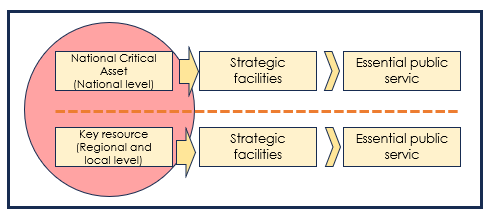
Note: ACN and key resources are conceptually similar; however, the difference lies in their territorial scope: the former has national jurisdiction, while the latter is delimited at the regional and local level.
When has the PNP been Overrun
It is important to provide a contemporary context to the problem posed by the intervention of the Armed Forces in the fight against organized crime. This phenomenon is related to the end of the Cold War, a period in which external threats diminished and internal threats intensified. Its characteristics, such as the number of victims and the violence generated, vary according to the social context of each country, with a particular emphasis on Latin America.[35] In this regard, the lack of understanding of the problem by the police, as well as their ineffective action in the face of these threats, has raised questions about their performance, leading to their functions being taken over by the Armed Forces.[36]
Against this backdrop, three key indicators have been identified that justify the intervention of the armed forces in the fight against organized crime, known as the ‘triad’. These elements are present when the police are overwhelmed, when their organizational structure collapses due to insufficient personnel and resources, and when their national strategy to guarantee public order fails to materialize successfully.
Accordingly, Hurtado and Doria describe and exemplify the factors that make up the organized crime triad. They also point out that in 2014 the Organization of American States (OAS) recognized the sovereignty of each nation to identify its security threats and, consequently, to define its security policy.[37] This principle of sovereignty allows each State to determine whether or not to resort to the Armed Forces to confront emerging challenges.
Chile offers an example of collaboration between the Armed Forces, civilian and police authorities in the fight against migrant smuggling, drug trafficking and Transnational Organized Crime (TOC).[38] The cases of Mexico and Colombia, described by Hurtado and Doria, show the inability of the police forces to contain the drug cartels, which has led to a situation of risk of becoming failed states, as they are unable to guarantee their own functioning or provide basic services to the population. There was also evidence of close economic ties between the police, the government and the cartels, which even facilitated criminal activities by these social actors.
Peru has not been immune to this problem. In the 1980s, the PNP was overwhelmed by the increase in violence, manifested in the assassination of local authorities, attacks on police stations and massacres of peasants. This situation was due to a lack of preparation and increased corruption in the PNP.[39] As a consequence, the government of Víctor Andrés Belaúnde decided that the Armed Forces would assume control of internal order.
Currently, the intervention of the Armed Forces in the control of internal order requires the approval of the local political or police authority, who must request the intervention from the Minister of the Interior, who formalizes the request to the President of the Republic. This procedure is applied in situations such as the criminal acts in the district of Putumayo and the criminality in the cities of the northern coast of the country, where circumstances similar to those registered in Mexico, Colombia and in the 1980s in Peru, such as kidnappings, threats and hired killings, are evident.
Conclusions
National regulations do not clearly specify the type of support that the Armed Forces should provide to the PNP during the reestablishment of internal order, although there are general regulations such as DL N° 1095. However, there are three possible ways to regulate this legal vacuum. The first comes from the Colombian National Army, which defines support as direct or indirect, using specialized personnel and logistical means, respectively. The second corresponds to the Chilean Army, which establishes support through logistical, transport and technological resources. Finally, the Peruvian Armed Forces have the CCFFAA guidelines, approved by MINDEF, which establish that support is provided through personnel for the protection of ACN and logistical resources. In this context, in order to improve coordination and uniformity in the support provided by the Armed Forces to the PNP, it is crucial that the guidelines established by the CCFFAA and approved by MINDEF are clear and precise. This would avoid ambiguities in the interpretation of procedures during military actions. In addition, it should be specified that when the Armed Forces assume control of internal order, the PNP is subordinated, however, at no time does it cease to fulfill its police functions, since the control of internal order remains its responsibility. On the other hand, there is a clear distinction between ACN and key resources. After assessing their criticality, resources that are not ACN but retain their importance can be classified as key resources. However, this distinction can be blurred, due to geographical and administrative factors affecting strategic facilities and SSPPEEs. In addition, strategic facilities, also considered infrastructure, are ACNs because they are critical to the public services that drive the country’s development. On the other hand, SSPPEEs, which ensure the livelihood of the citizen, can be ACNs or key resources, depending on the level of government. In this context, in the field of internal order, the Armed Forces have the mission to protect the ACNs that are within the national territory and under the responsibility of a Large Combat Unit (GUC). Therefore, in emergency situations, instead of committing an entire GUC, a specific element should be assigned to this task. Also, Military Police companies should specialize in internal order, with a focus on the protection of ACN and key resources. Finally, there is no explicit definition of the criteria that must occur for the PNP to be overstepped in its internal order control performance. In this regard, the CCFFAA, in coordination with MINDEF, has established three guidelines known as the “triad” to address this situation. Likewise, there are comparative studies in Mexico and Colombia where the indicators were escalations of violence and assassinations; in this sense, Peru was no stranger to this reality in the 1980s. In fact, declarations of State of Emergency should not only involve the participation of the Armed Forces. It is well known that the State has two key elements to legitimize its power: the Armed Forces and the PNP. Therefore, the participation of the PNP during the State of Emergency could be regulated with the sole purpose of strengthening its institutionality and raising awareness that the Armed Forces are an exception. Additionally, it is important to disseminate that the solution to the multiple problems in the area of internal order is multisectoral, not only military.
Endnotes
- Army of Peru, Planning of Land Operations ME 1-134 (Lima: Army Education and Doctrine Command, 2015), A5-1. ↑
- Ibid., 2-23. ↑
- National Army of Colombia, Operations MFRE 3 – 0 (Bogota: Colombian National Army Doctrine Center, 2017). ↑
- Army of Peru, Planning of Land Operations ME 1-134 (Lima: Army Education and Doctrine Command, 2015). ↑
- National Police of Peru, Manual of Operations for the Maintenance and Restoration of Public Order (Lima: Dirección General, 2016). ↑
- Presidency of the Republic, “D.S. Nº 003-2020-DE”, Reglamento del Decreto Legislativo Nº 1095. Decreto Legislativo que establece reglas de empleo y uso de la fuerza por parte de las Fuerzas Armadas en el territorio nacional (Legislative Decree that establishes rules for the employment and use of force by the Armed Forces in the national territory) (El Peruano, March 15, 2020). ↑
- Peace Research Institute Oslo (PRIO), Conflict Trends 2019 – Non-State Conflicts (Oslo: PRIO, 2019). ↑
- Gonzales Miguel, Calle Oscar, Campos Rolando, and Eduardo Manolo, “Radicalización Ideológica, Crimen Organizado y Seguridad Nacional: La Intervención de las Fuerzas Armadas,” Seguridad y Poder Terrestre 3, no. 4 (2024): 213, https://doi.org/10.56221/spt.v3i4.74. ↑
- Cam Emilio, “Internal Order: Defining the Support of the Armed Forces to the National Police,” Security and Land Power 3, no. 4 (2024): 112, https://doi.org/10.56221/spt.v3i4.71. ↑
- Presidency of the Republic, Reglamento del Decreto Legislativo Nº 1095. Legislative Decree that establishes rules for the employment and use of force by the Armed Forces in the national territory, Article 28.1º ↑
- Army of Peru, Operations and unified land actions MF 3-1 (Lima: Jefatura de Doctrina del Ejército, 2019b). ↑
- Army of Peru, Concepción de las operaciones y acciones militares MD 3-0 (Lima: Jefatura de Doctrina del Ejército, 2019a). ↑
- National Army of Colombia, Defense Support to Civil Authority MFE 3-28 (Bogotá: Centro de Doctrina del Ejército Nacional de Colombia, 2017a). ↑
- Ibid. ↑
- Library of the National Congress of Chile, Decreto Nº 265 Autoriza colaboración y delega en el Ministro de defensa nacional las facultades en materia que indica (Santiago: Ministerio de Defensa Nacional, Subsecretaría para las Fuerzas Armadas, July 9, 2019). ↑
- Presidency of the Republic, “D.S. Nº 003-2020-DE”, Reglamento del Decreto Legislativo Nº 1095. Decreto Legislativo que establece reglas de empleo y uso de la fuerza por parte de las Fuerzas Armadas en el territorio nacional (Legislative Decree that establishes rules for the employment and use of force by the Armed Forces in the national territory) (El Peruano, March 15, 2020). ↑
- Ministry of Defense, “Resolución Ministerial N° 0231-2022-DE/CCFFAA”, Directiva Nº 009-2022 JCCFFAA/D-3/DAI (Lima: Ministerio de Defensa, 2022). ↑
- Dirección Nacional de Inteligencia, Doctrina de Inteligencia (Lima: Sistema de Inteligencia Nacional, 2021). ↑
- Presidency of the Council of Ministers, “D.S. No. 106 – 2017 – PCM”, Supreme Decree approving the Regulation for the identification, evaluation and risk management of National Critical Assets (ACN) (El Peruano, November 10, 2017), 6. ↑
- Ibid. ↑
- Ibid. ↑
- Ibid. ↑
- Ibid. ↑
- Ibid. ↑
- Ibid. ↑
- Presidency of the Council of Ministers, “D.S. No. 106 – 2017 – PCM”, Supreme Decree approving the Regulation for the identification, evaluation and risk management of National Critical Assets (ACN) (El Peruano, November 10, 2017), 6. ↑
- Galindo Francisco, Critical infrastructure protection: a comparative law analysis
(Málaga: Universidad de Málaga, 2016). ↑
- Horzella Bárbara, “Protección de infraestructura crítica y Fuerzas Armadas conceptualización y experiencia comparada”, (Santiago: Asesoría Técnica Parlamentaria, Biblioteca del Congreso Nacional de Chile, 2019), 3. ↑
- Galindo Francisco, Critical infrastructure protection: a comparative law analysis
(Málaga: Universidad de Málaga, 2016). ↑
- Ibid. ↑
- Presidency of the Republic, “D.S. Nº 005 – 2021 – IN”, Supreme Decree that approves the National Directive of Internal Order for the protection of National Critical Assets – ACN (El Peruano, June 27, 2021). ↑
- Presidency of the Republic, “D.S. Nº 003-2020-DE”, Reglamento del Decreto Legislativo Nº 1095. Decreto Legislativo que establece reglas de empleo y uso de la fuerza por parte de las Fuerzas Armadas en el territorio nacional (Legislative Decree that establishes rules for the employment and use of force by the Armed Forces in the national territory) (El Peruano, March 15, 2020), 16. ↑
- Ibid. ↑
- Molero, M. & Pacheco, M., “Essential public services in Spain”. Revista luso – brasileira de direito do consumo, 5(15) (2014), Biblioteca digital jurídica do Superior Tribunal do Justicia. ↑
- Hurtado Carlos and Doria Adán, “Nuevos roles de las fuerzas armadas en seguridad. Experiences from Mexico, Colombia and Peru,” Revista Científica General José María Córdova, 18 (30) (2020): 381, https://doi.org/10.21830/19006586.548. ↑
- Ibid., 392. ↑
- Ibid., 383. ↑
- Library of the National Congress of Chile, Decreto Nº 265 Autoriza colaboración y delega en el Ministro de defensa nacional las facultades en materia que indica (Santiago: Ministerio de Defensa Nacional, Subsecretaría para las Fuerzas Armadas, July 9, 2019). ↑
- Hurtado Carlos and Doria Adán, “Nuevos roles de las fuerzas armadas en seguridad. Experiences from Mexico, Colombia and Peru,” Revista Científica General José María Córdova, 18 (30) (2020): 381, https://doi.org/10.21830/19006586.548. ↑