


Security Challenges Facing the Dominican Republic and the Government Response

By: Evan Ellis (18/10/2023). From September 24-28, 2023, a trip was made to Santo Domingo, Dominican Republic, to present a paper on crime and violence in the Caribbean at a forum organized by Funglode, one of the country’s leading think tanks. As part of this visit, he held a dialogue with a wide range of former and current security personnel and other experts on the security challenges facing the nation.
Use of Military Power: Flexibility and Scope of non-kinetic capabilities

By: Vitorio Enmanuele Bossio Ballesteros (05/10/2023). The complexity of threats to the security and defense of States merits the use of military power in a resolute, gradual, flexible and wide-ranging manner to control the escalation of the conflict, while maintaining its high coercive potential. In that sense, non-kinetic capabilities, beyond contributing to the development of conventional military operations, provide a wide range of options for applying military power below the threshold of armed conflict, since they provide flexibility and greater scope to the design and execution of a military response.
Legal Scope for the Use of Force During Coast Guard Operations: An Unfinished Issue

By: Eduardo Israel Zamora Chung (28/09/2023}. Industrial and productive activities in the aquatic field, which promote the socioeconomic development of the country, require that the General Directorate of Captaincies and Coast Guard of the Peruvian Navy – National Maritime Authority, guarantee their safety. To this end, Coast Guard Operations, conducted within the exercise of the Maritime Authority, must be framed in due legal process. In this regard, it is essential that this authority has clear rules for the proper use of force, since, currently, it lacks an adequate legal framework that legally safeguards its personnel and makes its response capacity more efficient.
Conference: “New Geopolitical Actors in a New and Complex World Order. The Big Tech Companies: Cyberspace & Artificial Intelligence”

On September 25, the Peruvian Army Center for Strategic Studies organized the Conference entitled “New Geopolitical Actors in a New and Complex World Order. The Big Tech Companies: Cyberspace & Artificial Intelligence”. The Keynote Lecture was given by Dr. Mario Torres Jarrín (Director of the Institute of European Studies and Human Rights) and was chaired by Army General David Ojeda Parra (Army General Commander) accompanied by the High Command of the Army.
Challenges of the Use of the Armed Forces in Support of the Peruvian National Police for Citizen Security

By: Miguel Ángel Contreras Gallejos (21/09/2023). Citizen security is the responsibility of society as a whole, involving not only state entities, but also private enterprise and even the organized community. This effort should converge in the achievement of living in harmony, enabling the development of daily activities normally. In this context, this article analyzes the response capacity of the Armed Forces (FF. AA.) to support the Peruvian National Police (PNP) in citizen security. The problem encountered is that the FF. AA. have capabilities for war, which must be adequate if effective support is to be provided. If the problem is not mitigated, it is likely that the operations of the Armed Forces produce negative effects on the population in relation to human rights, as well as that planners and participants are subject to judicial problems. In this regard, it is important to create an operational environment with adequate legal standards and a military force with optimal capabilities.
Conference and Presentation of the book titled: “The problems in the Valley of the Rivers Apurímac, Ene and Mantaro”

On September 8th, the Peruvian Army Center for Strategic Studies organized the conference and presentation of the book titled “The problems in the Valley of the Rivers Apurímac, Ene and Mantaro: Prospective Scenarios.” The Conference was carried out by Brigadier General Oscar Luis Calle Pérez (Chief of the General Staff of CE-VRAEM) and was presided […]
Shining Path and its Alliance with Drug Trafficking in the VRAEM
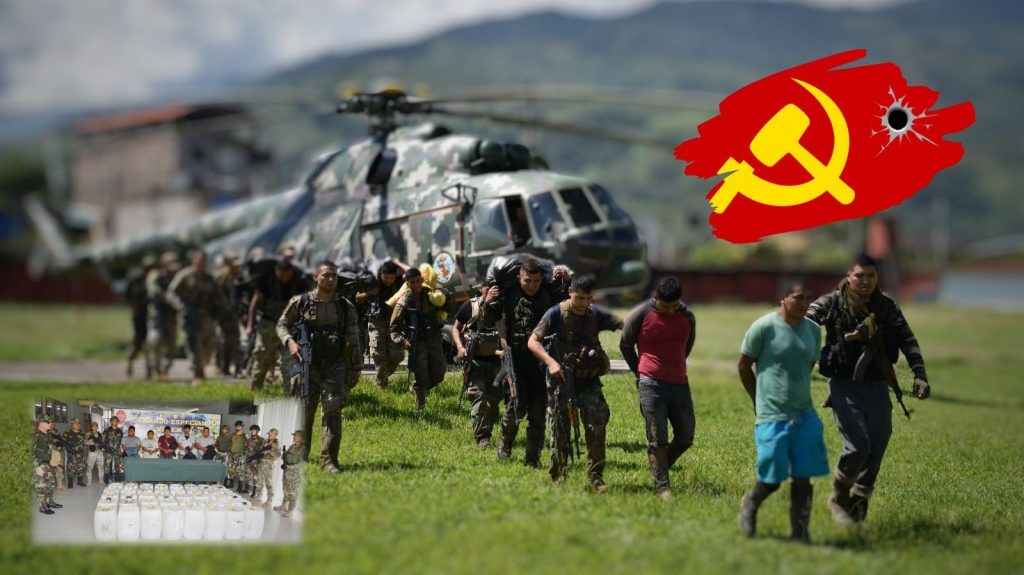
By: Eduardo Martín Cruz Chávez (07/09/2023). En este artículo se aborda la alianza existente entre los remanentes del grupo terrorista Sendero Luminoso (SL) y las organizaciones criminales dedicadas al narcotráfico en el valle de los ríos Apurímac, Ene y Mantaro (VRAEM). Por un lado, SL necesita solventar sus gastos administrativos y operativos; por otro lado, los narcotraficantes necesitan asegurar sus actividades en la zona, donde -desde hace más de tres décadas- las autoridades nacionales no han podido derrotar a los remanentes de SL, a pesar de un sinnúmero de operativos.
Conference “Russia and Ukraine, geopolitical and military analysis of the war in 2023”

On September 1st, the Peruvian Army Center for Strategic Studies organized the conference “Russia and Ukraine, geopolitical and military analysis of the war in 2023” aimed at military and civilian personnel of the Joint Command of the Armed Forces. This event was attended by Doctor Farid Kahhat (Lead Analyst Ad Honorem from CEEEP) and Clemente Rodriguez (Analyst – Researcher for CEEEP), and was presided by Army General Manuel Gómez de la Torre Aranibar (Chief of CCFFAA), who was accompanied by the High Command of CCFFAA.
Problems of the Valley of the Apurímac, Ene and Mantaro Rivers: Prospective Scenarios

By Miguel Ángel Gonzales Bojórquez, Oscar Luis Calle Pérez, Rolando Enrique Campos Hashimoto y Manolo Eduardo Villagra. This is a Peruvian Army Center for Strategic Studies (CEEEP) publication.
Continental Shelf and Maritime Sovereignty: An Argentine-Chilean Controversy

By: Edwin Ocampo Marquina (24/08/2023). In the year 2021, Chile made official its claim to the maritime limits imposed in the Treaty of Peace and Friendship of 1984. This is a debate with some historical background and great repercussions at diplomatic level, between Chile and Argentina. A disagreement that almost led them to a war at the end of the 1970s and that, once again, is present, but with an air of diplomatic and peaceful mediation thanks to international law. In 2009, Argentina began its boundary demarcation process before the Commission on the Limits of the Continental Shelf, a body created by the United Nations Convention on the Law of the Sea, which approved the proposal for the outer limit of the continental shelf presented by Argentina.

